Get Full Government Meeting Transcripts, Videos, & Alerts Forever!
Get email alerts on the Alaska Energy Security Task Force topic
No spam. Unsubscribe anytime.
Task Force presenters urge more capital, regional planning for rural generation, distribution and storage
Summary
Task Force co-chairs and regional representatives told the House Energy Committee that Alaska needs more coordinated capital, regional infrastructure planning and data to reduce costs and improve resilience for rural and coastal energy systems.
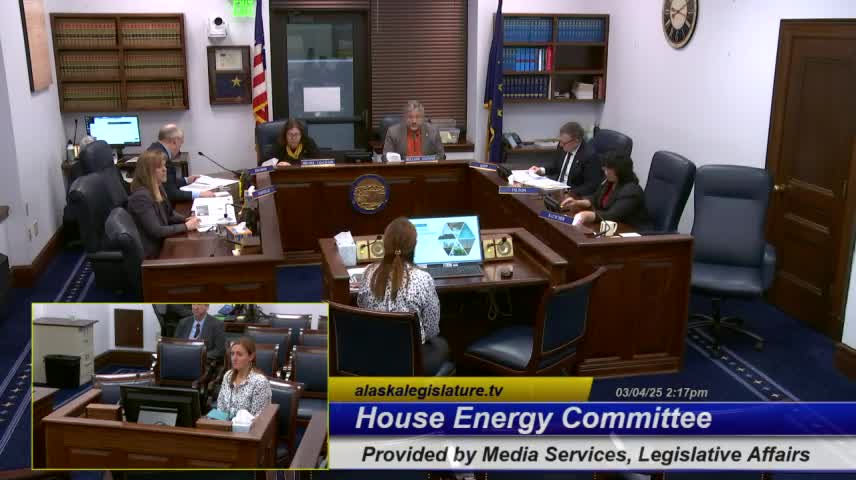
Clay Copeland, co-chair of the Alaska Energy Security Task Force and chairman of the Alaska Energy Authority Board, told the House Energy Committee on March 4, 2025, that the task force produced a broad set of recommendations to "advance the affordability, reliability, security, and resilience of energy to Alaskans."
Copeland said the task force organized work into six subcommittees and three regional tracks and that the rural generation, distribution and storage chapter emphasizes three priorities: increasing capital availability, making infrastructure investments that support regional planning and economies of scale, and reducing operational costs through training, logistics innovation and grid modernization.
"The single biggest driver of cost in rural Alaska is having very few ratepayers to spread cost across expensive infrastructure," Copeland said, describing why projects that aggregate demand or identify anchor loads can lower per-user costs. The task force recommended pilot regional projects to demonstrate economies of scale, evaluate emerging technologies (including micro nuclear, hydrogen and other options), and improve data collection to inform investment decisions.
Robert Venables, executive director of Southeast Conference and co-chair of the task force's coastal subcommittee, framed the recommendations in economic-development terms: targeted investments should focus on lowering energy costs so households and businesses have more discretionary income to support local economies. Venables highlighted work on heat-pump deployment and weatherization pilots in Southeast and said federal funding volatility has put some projects at risk even after awards were announced.
Copeland summarized the scale of the effort: more than 60 subcommittee meetings, 11 full task force meetings, roughly 150 hours of public meetings and eight published energy symposiums. He said many Alaska Energy Authority programs — the Renewable Energy Fund, the Power Project Loan Fund and circuit rider programs — already align with task force recommendations.
Committee members questioned how to prioritize projects across regions and how to use existing state tools, including the Renewable Energy Fund and Power Cost Equalization (PCE). Copeland and Venables said the Renewable Energy Fund remains a useful structure for vetting and ranking projects and that strategically investing in projects that permanently lower production costs will reduce reliance on PCE over time. Venables said the state should balance investments that address immediate need with bets on technologies and regions most likely to scale.
Presenters did not recommend specific new legislation during the hearing; rather, they presented the task force's recommendations and urged the committee to consider longer-term planning, improved data repositories and continued support for state programs that can leverage federal funds and private capital.