Get Full Government Meeting Transcripts, Videos, & Alerts Forever!
Get email alerts on the Cpacer Financing topic
No spam. Unsubscribe anytime.
Anchorage, Mat-Su officials outline CPACER financing to lower commercial energy and resilience costs
Summary
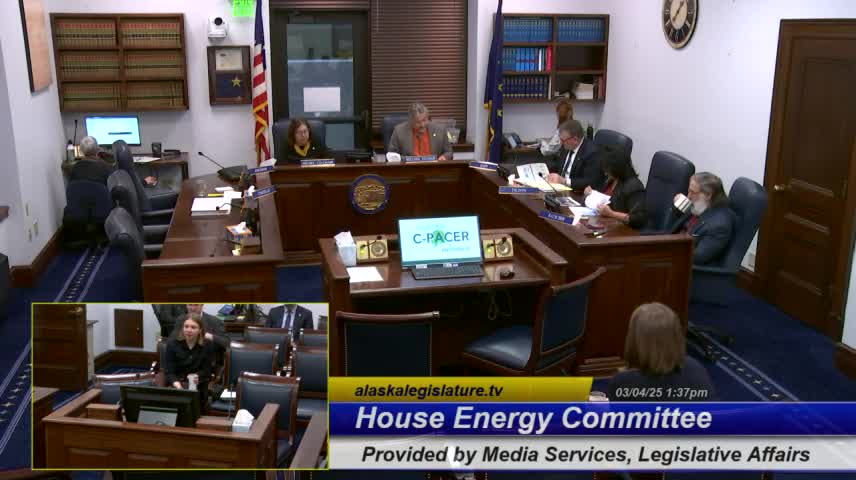
Calvin Chang, director of the Anchorage CPACER program at the Municipality of Anchorage, told the House Energy Committee on March 4, 2025, that CPACER (commercial property assessed clean energy and resilience) provides long-term private financing for energy-efficiency, renewable-energy and resilience projects tied to a property assessment rather than an owner.
Calvin Chang, director of the Anchorage CPACER program at the Municipality of Anchorage, told the House Energy Committee on March 4, 2025, that CPACER (commercial property assessed clean energy and resilience) provides long-term private financing for energy-efficiency, renewable-energy and resilience projects tied to a property assessment rather than an owner.
"It's commercial property assessed clean energy and resilience," Chang said, explaining the program's name and structure. "The key thing is it follows a property ... not the owner." He said the capital comes from private lenders and is repaid via a voluntary special assessment recorded as a lien on the property.
The program's supporters said CPACER can lower operating costs for commercial tenants and owners, improve building stock and drive local jobs by funding work that otherwise might not be financed. Chang cited Anchorage case studies including the Rim Office Building, a midtown Courtyard by Marriott new-construction project and a larger hotel deal he described as the municipality's largest CPACER loan to date. He said one transaction has financed almost $20,000,000 of work and that another project shows roughly $12 million in projected energy savings over 20 years.
Assemblymember Stephanie Nowers, sponsor of the Matanuska-Susitna Borough CPACE ordinance, told the committee the borough adopted its program to help businesses reduce high local energy costs and to protect investments when owners sell. She said the borough is using CPACE to support a new, roughly 28,000-square-foot mixed-use commercial development in Palmer and that two Mat-Su projects are now moving forward. "[CPACE] is a way for businesses to have a financially viable way to reduce their energy costs and insulate themselves from potential price spikes," Nowers said.
Committee members pressed presenters on program uptake and barriers. Chang said Anchorage has closed three CPACER loans so far and that awareness is a limiting factor: "a lot of folks don't know about it." He and Nowers said lenders and capital providers tend to prefer larger deals, leaving a gap for projects in the $50,000–$200,000 range. Nowers said banks' unfamiliarity with the structure has limited their willingness to finance smaller projects, and Chang added that some deals are simply too small to attract some capital providers.
Both presenters also discussed options for statewide administration. Nowers said having the Alaska Housing Finance Corporation (AHFC) or the newly formed Alaska Sustainable Energy Corporation administer the program statewide could reduce the administrative burden on local governments and help scale the program and its paperwork. Chang said such a model "could be a good fit" but that he could not speak on behalf of AHFC or ASEC.
Speakers recommended outreach to property owners, developers and capital providers and noted Alaska's 2022 state law change that expanded program eligibility and added resilience measures. Chang described a CPACER handbook, an Alaska CPACER website with resources, and Anchorage templates that local jurisdictions can adapt.
The committee took no formal votes on CPACER during the hearing. Members closed the CPACER portion of the agenda before moving to the Alaska Energy Security Task Force presentations.
Because CPACER structures and local program rules vary by jurisdiction, Chang and Nowers urged the legislature and local governments to consider standardized templates and outreach to increase participation.