Get Full Government Meeting Transcripts, Videos, & Alerts Forever!
Get email alerts on the Employee Ownership topic
No spam. Unsubscribe anytime.
State committee hears how ESOPs and employee ownership trusts work as Washington rolls out tax-credit program
Summary
Experts described mechanics, risks and state implementation of employee stock ownership plans, employee ownership trusts and Washington’s 2023 Employee Ownership Act, including a B&O tax credit with a $2 million annual cap and per-business limits.
The Consumer Protection and Business Committee heard a briefing March 4, 2025, on employee ownership models and the state’s new employee ownership program, with experts explaining how employee stock ownership plans (ESOPs) and employee ownership trusts (EOTs) operate and how Washington’s tax-credit program will be administered.
Corey Rosen, founder of the National Center for Employee Ownership, told the committee that ESOPs are retirement-style trusts that hold company shares on behalf of employees and that “the employees don't buy the shares. The company is buying the shares out of the future profits that it generates.” He described ESOP mechanics — a company sets up a trust that buys shares from owners, allocations are made annually based on compensation or a level formula, vesting typically occurs over up to six years, and departing employees receive a repurchase payment at fair market value determined by an appraisal. Rosen emphasized that ESOPs are governed by ERISA and recommended independent trustees and appraisals to avoid self-dealing.
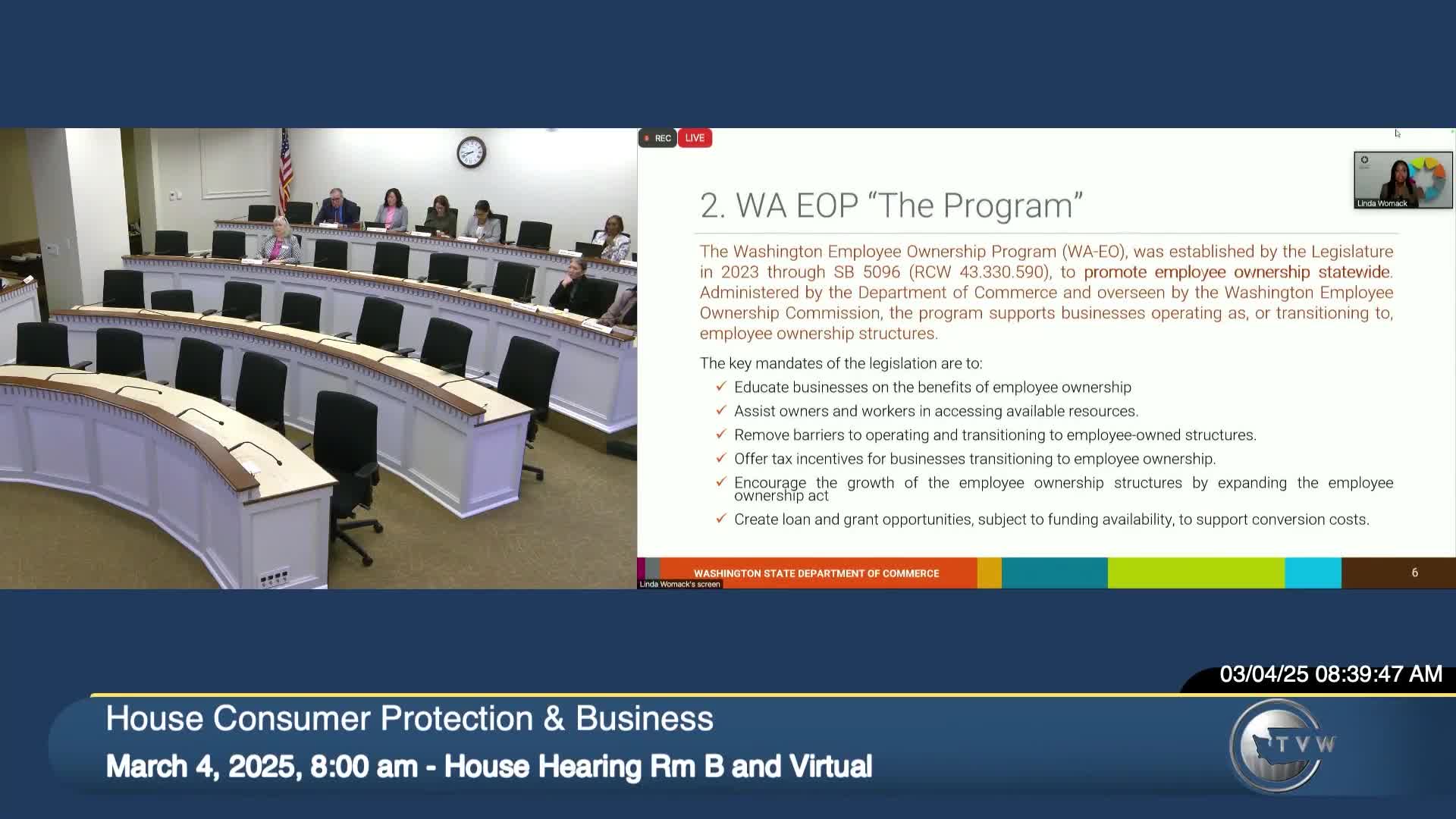
Linda Lee Womack, managing director of the Office of Economic Development and Competitiveness at the Washington State Department of Commerce, outlined the state program created by the legislature in 2023 (Senate Bill 5096). The Commerce program offers a business-and-occupation (B&O) tax credit to reimburse eligible conversion costs for businesses that convert to employee ownership. Womack said the credit became effective July 1, 2024, and that the program has an annual cap of $2,000,000, administered by the Department of Revenue on a first-come, first-served basis. She said the credit covers 50% of eligible conversion expenses and that the per-business limits are up to $25,000 for cooperatives and trusts and up to $100,000 for ESOP conversions. Commerce reported about $500,000 in reimbursement requests in the pipeline being reviewed by the Department of Revenue and said it is completing a data‑sharing agreement with Revenue to track program indicators.
Both Rosen and Commerce staff explained key differences between ESOPs and employee ownership trusts. Rosen said EOTs are simpler, typically cost less to set up (often $50,000–$100,000 versus $150,000–$500,000 for many private ESOP conversions), and do not confer individual equity that employees can sell on exit; rather, EOTs generally distribute profit shares or dividends and can include customized participation and governance rules. Rosen also noted that EOTs do not receive the U.S. federal tax benefits available to ESOPs.
Committee members asked how ESOPs handle licensing- or location-dependent businesses such as cannabis retailers. Rosen said ERISA preempts state residency requirements for ESOP participation, so a state could not require that ESOP participants live in Washington. He added that some licensing issues for professions have been handled in other states by naming an appropriately licensed trustee or using other workarounds, but he cautioned that ERISA limits what states can impose on ESOP eligibility.
Members asked about risks to employees if a company fails or cannot meet repurchase obligations. Rosen cited research showing loan defaults for buyouts were uncommon (he gave a historical default rate of about 2 per 1,000 per year) and said most companies that terminate ESOPs do so after receiving a high-value offer rather than due to an inability to fund repurchase obligations. He said life insurance and sale of the company are among the ways firms have managed repurchase liabilities, though failures do occur in a small fraction of cases.
On program implementation, Womack said Commerce has stood up the governor-appointed commission, drafted Washington Administrative Code language, is developing a technical assistance program to support conversions, and plans to complete the WAC by June 30. She said the program was funded for the biennium at approximately $1.7 million but that Commerce is examining the effects of a proposed cut (she described a possible reduction of $1.4 million) and that any reduction could affect program capacity and available incentives.
Committee members raised other operational questions: whether ESOP account values can be borrowed against (Rosen said it is uncommon and companies are cautious about loans against ESOP interests but that diversification options and transfers to 401(k) plans are possible in some circumstances), how ESOP distributions are taxed (Rosen described tax treatment comparable to other qualified retirement plans), and whether ESOPs have historically delivered higher account balances and lower layoff rates (Rosen cited his organization’s research showing higher median account balances and lower layoff rates for ESOP companies versus comparable non-ESOP firms).
Womack said Washington currently has roughly 200 employee‑owned businesses, including about 125 ESOPs, roughly 73 cooperatives and two employee ownership trusts, and Commerce projects that transitioning a portion of businesses owned by people aged 55 and older could materially increase payroll and revenue statewide if conversions occur at scale.
The committee closed with Womack and Rosen answering additional questions and Commerce committing to follow up on technical and budget questions by email. Commerce staff said next steps include launching the technical assistance provider procurement, finalizing the WAC, and leveraging the $2 million in annual incentives subject to legislative and budgetary constraints.