Get Full Government Meeting Transcripts, Videos, & Alerts Forever!
Get email alerts on the Municipal Employment Vacancies topic
No spam. Unsubscribe anytime.
Council hearing examines long-term city vacancies and $42 million in assumed salary savings
Summary
City officials told a Boston City Council committee on March 4 that citywide hiring has improved after targeted efforts, but departments still show hundreds of open positions and the administration budgets about $42 million in assumed salary savings for vacancies.
A Boston City Council committee on labor and workforce held a hearing March 4 to review long-term vacancies across city departments and the budget treatment of unfilled positions. Chair Benjamin Weber said the hearing (docket 0254) was intended to help the council understand why positions remain open and whether money budgeted for those roles could be used elsewhere as the city prepares its fiscal 2026 budget.
Ashley Grafrenberger, the city’s chief financial officer, told the committee that the city budgets total personnel costs for departments and offsets those totals with an assumption for salary savings to account for vacancies during the year. “We assume that at any point in the year, there will be vacancies,” Grafrenberger said, and added that “we have assumed total salary savings across the city of about $42,000,000” for city departments in the current fiscal year.
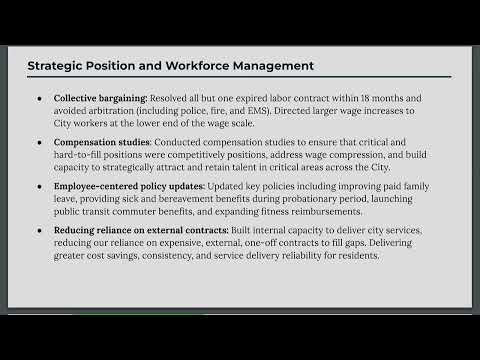
Alex Lawrence, the city’s chief people officer, described the city’s decentralized hiring system and a set of measures the administration has used to reduce vacancies. Those measures include directing a larger proportion of wage increases toward lower-paid workers in the most recent round of collective bargaining, conducting compensation studies for hard-to-fill roles, improving paid leave and commuter benefits, reducing external contract reliance, shortening internal approval steps and revamping hiring technology. Lawrence highlighted hiring-day events, targeted recruiting and internal pipelines such as cadet programs for police and fire as strategies that produced measurable gains.
Officials reported a mix of progress and continuing gaps. Grafrenberger said the city had 448 posted positions it was actively trying to fill as of Feb. 25. Boston Public Schools and the Boston Public Health Commission reported separate vacancy counts in committee testimony; witnesses and councilors discussed different tallies for BPS that reflect posting practices and seasonality. Councilors pressed for additional, department-level detail for use during the council’s amendment and budget process.
Council members repeatedly asked for follow-up data that city staff agreed to provide. Councilor Ed Flynn requested whether Boston EMS was using mandatory overtime for EMTs and paramedics; Chief People Officer Tanisha Peoples said staff would confer with her team and provide more-accurate answers. Councilors also sought breakdowns of vacancies by department, the dollar value of unfilled positions, historical trends and demographic or pay-band breakdowns of vacancy and retention data.
Why it matters: The committee framed the hearing as a way to inform budget decisions ahead of fiscal 2026. Grafrenberger said salary-savings assumptions give departments some flexibility during the year but also create questions for councilors deciding whether to reallocate funds to new priorities during the amendment process.
What’s next: City staff told councilors they will provide more granular data through the budget RFI and follow-up to individual requests, including vacancy lists, overtime and mandatory overtime records where available, and historical hiring and departure trends. The hearing record is to be used by the council during upcoming budget deliberations.