Get Full Government Meeting Transcripts, Videos, & Alerts Forever!
Get email alerts on the Environmental Crimes topic
No spam. Unsubscribe anytime.
Senate passes environmental-crimes bill after hours of amendments and debate
Summary
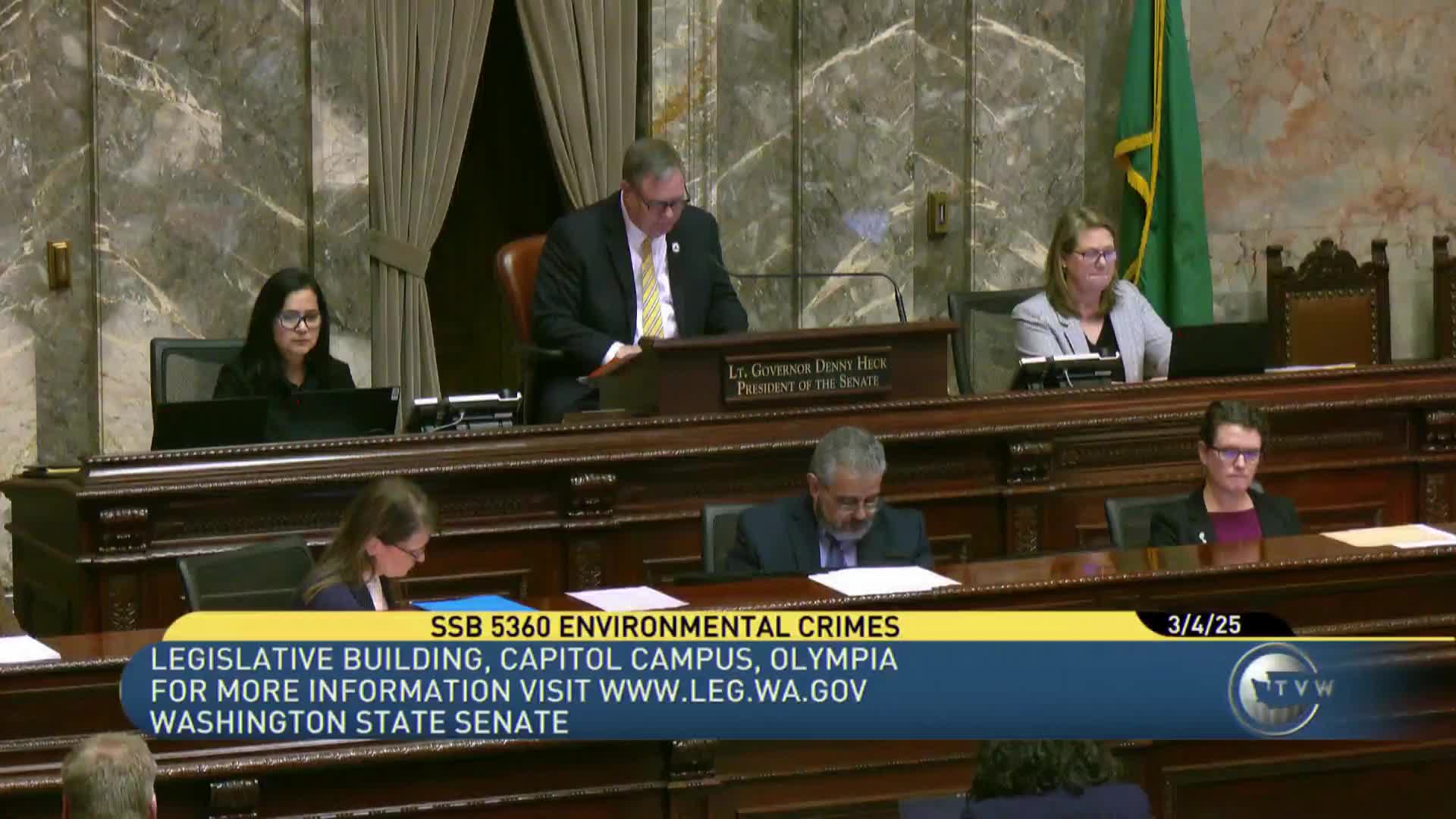
The Washington Senate passed substitute Senate Bill 5360, which raises criminal penalties for certain environmental violations, after adopting several targeted amendments and rejecting others. The bill passed 29-20 on final passage.
The Washington State Senate on March 3 passed substitute Senate Bill 5360, a measure that changes criminal penalties for certain environmental harms and amends parts of RCW 90.48, after several hours of floor debate and multiple amendments.
Supporters said the bill aims to align state law with federal enforcement standards and provide stronger tools to hold serious polluters accountable. "We see where environmental disasters and toxic pollution often falls on future generations to clean up," Senator Trudeau said on the floor as she described local incidents that motivated her to sponsor the bill.
Opponents raised concerns about the bill's scope, the mens rea (mental state) standards, and the potential for overcriminalization of businesses and workers who lack decision-making authority. "The vast majority of folks out there trying to build things are good people," Senator Braun said, arguing the measure could increase regulatory risk and hinder construction and manufacturing.
Nut graf: The chamber voted to pass the substantially amended bill after adopting several sponsor-led fixes and defeating multiple other changes; the final roll call was 29 yeas and 20 nays. The bill drew sustained debate over definitions, enforcement overlap with federal law, and liability standards for individual employees versus decision-makers.
Key actions and amendments
- Motion to substitute and advance substitute Senate Bill 5360 to second reading (mover: Senator Trudeau). This procedural motion carried, and the substitute bill was read into the record.
- Amendment 91 (mover: Senator Trudeau) — amended the mens rea language to reference criminal negligence as provided in RCW 9A.08.101. The amendment was adopted by voice vote.
- Amendment 93 (mover: Senator Trudeau) — clarified that the bill did not intend to delegate certain authority to the Department of Ecology. The amendment was adopted by voice vote.
- Amendment 79 (mover: Senator Short) — would have inserted agricultural exemptions to align state and federal law; the amendment was defeated (noes have it).
- Amendment 83 (mover: Senator Short) — would have narrowed individual liability by excluding certain "individual" workers; the amendment was defeated.
- Amendment 84 (mover: Senator Fortunato) — exempted silt and sediment already covered by construction stormwater permits; the amendment was adopted by voice vote.
- Amendment 85 (mover: Senator Short) — attempted to limit double regulation if federal enforcement was underway; the amendment failed on a recorded voice vote.
- Amendment 86 (mover: Senator Behnke) — sought to exempt persons or entities covered by particular federal statutes (42 U.S.C. section 6901); the amendment failed.
- Amendment 87 (mover: Senator Behnke) — would have incorporated an explicit "innocent until proven guilty" statement into the statute; the amendment failed after debate about whether such language is redundant with the criminal code.
- Amendment 59 (mover: Senator Trudeau) — clarified that permitted forest-health activities are exempt; the amendment was adopted.
- Amendment 92 (mover: Senator Trudeau) — exempted fugitive dust and odors from agricultural operations when following good agricultural practices; the amendment was adopted.
- Additional striking and substitute amendments (including numbers 80 and 82) were offered and defeated on the floor.
Final passage and next steps
After extended debate on intent standards, employer/employee liability, and federal-state enforcement coordination, the Senate advanced the engrossed substitute and placed it on final passage. The secretary called the roll and the Senate voted 29-20 in favor. The presiding officer declared a constitutional majority and the bill passed the Senate.
The sponsor said she expects continued work and stakeholder conversations as the bill moves through the process; opponents urged further refinement to avoid unintended consequences for workers and businesses.
Ending note: The bill text as debated includes cross-references to RCW 90.48 and to criminal-negligence language in RCW 9A.08.101; multiple amendments narrowed or clarified scope around agricultural practices, forest health, and construction stormwater. The measure will next proceed according to the legislative process for reconciliation and concurrence as required.