Get Full Government Meeting Transcripts, Videos, & Alerts Forever!
Get email alerts on the Hemp And Medical Cannabis topic
No spam. Unsubscribe anytime.
Senate State Affairs clears dozens of measures; debate over banning THC consumables and expanding medical cannabis continues
Summary
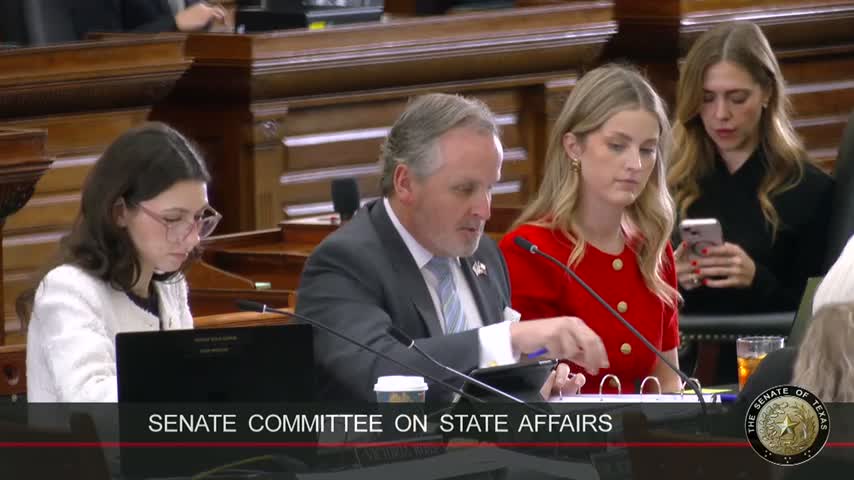
The Senate Committee on State Affairs quickly advanced a large number of measures to the full Senate, then spent most of the meeting debating whether to ban most consumable THC hemp products and how to expand the state’s Compassionate Use medical cannabis program.
The Senate Committee on State Affairs moved dozens of bills to the full Senate during a short consent-like series of roll calls, then spent several hours in an often‑emotional public hearing on competing approaches to hemp and medical cannabis.
In the first part of the Tuesday meeting the committee reported a long list of measures to the full Senate by roll call. Many of those were reported unanimously or with lopsided margins; the chair said the bills would be placed on calendars for consideration by the whole body.
The hearing that followed became the session’s central focus: committee members heard invited witnesses and then more than six hours of public testimony on Senate Bill 3, a proposal to ban most consumable hemp products that contain intoxicating cannabinoids, and S.B. 1505, which would expand and modernize the state’s Compassionate Use Program (often called TCUP) for physician‑prescribed low‑THC cannabis. The chair laid both measures out as pending business and kept both bills pending at the end of the meeting.
Why it mattered
Supporters of SB3 told the committee that newly‑marketed synthetically altered cannabinoids and high‑potency edible or vape products have led to accidental poisonings, emergency room visits, impaired driving and, they say, long‑term mental‑health harms for a small number of users — particularly minors. Law enforcement witnesses and several city and county chiefs and sheriffs pressed the committee for a single, enforceable standard that would let officers seize products without needing complex lab analyses and that would crack down on mislabeled or intentionally adulterated items.
Opponents — including many small‑business retail owners, farmers, physicians and patients — argued a broad ban would push consumers back to the unregulated black market, wipe out thousands of Texas jobs and small businesses, and cut off access for patients who say they rely on legal, lab‑tested hemp products for pain, sleep, anxiety or seizure control. Several physicians on the record urged strengthening regulation, better lab testing and limits on youth access rather than a wholesale ban.
SB1505: modernize access for patients
Supporters of Senate Bill 1505 told the committee the Compassionate Use Program needs operational fixes: more dispensing licenses, the ability for licensed dispensing organizations to maintain satellite storage to improve statewide distribution, and a shift from a percentage‑based THC limit to milligram‑per‑dose rules so physicians and pharmacies can offer reliable dosing and faster‑acting inhaled options for episodic conditions. Operators already licensed under the program and DPS officials described access and logistics problems under the current single‑location model and said satellite locations and modest expansion would reduce delays and patient costs.
Public testimony and the balance of arguments
The committee heard a wide cross section of voices. Dozens of patients and family members described what they said were personal emergencies tied to high‑potency products purchased in retail outlets or online; other witnesses — especially many veterans, hospice volunteers and clinicians — told personal stories of patients who said legal, tested hemp products had replaced opioids or improved terminal‑illness symptom control. Retailers and manufacturers repeatedly said they supported stronger packaging, testing and age‑gating requirements and asked the Legislature to build a regulatory framework rather than ban the market.
What the committee did
- Took up and reported dozens of bills to the full Senate by roll call earlier in the session (see “Votes at a glance” below). - Left SB3 (ban on most consumable THC hemp products) pending after hours of testimony. - Left SB1505 (TCUP improvements, including satellite dispensing and limited dose changes) pending as well.
Votes at a glance (committee roll calls taken the same day)
The committee reported the following measures to the full Senate; these were pro forma roll‑call votes recorded in committee and will appear on Senate calendars for further action by the full chamber. (Tallies are taken from the committee roll calls recorded in the meeting transcript.)
- Committee substitute, S.B. 523 — reported favorably to the full Senate (10 ayes, 0 nays) - Committee substitute, S.B. 62 — reported favorably (9 ayes, 1 nay) - S.B. 847 — reported favorably (9 ayes, 1 nay) - S.B. 706 — reported favorably (9 ayes, 1 present, not voting) - S.B. 869 — reported favorably (10 ayes, 0 nays) - S.B. 890 — reported favorably (10 ayes, 0 nays) - S.B. 992 — reported favorably (10 ayes, 0 nays) - S.B. 19 (committee substitute) — reported favorably (9 ayes, 1 nay) - S.B. 707 — reported favorably (9 ayes, 1 nay) - S.B. 888 — reported favorably (10 ayes, 0 nays) - S.B. 687 — reported favorably (10 ayes, 0 nays) - S.J.R. 34 — reported favorably (10 ayes, 0 nays) - S.C.R. 9 — reported favorably (9 ayes, 0 nays) - S.B. 18 — reported favorably (8 ayes, 1 nay) - S.B. 666 — reported favorably (9 ayes, 0 nays) - S.B. 688 — reported favorably (9 ayes, 0 nays) - S.B. 688 and related certification motions were placed on the local and uncontested calendars when motions were made without objection.
(For the full list of motions, recorded roll calls and clerk’s text, see the committee clerk’s minutes released with the official transcript.)
Why it matters to Texans
The committee’s actions send several bills to the full Senate for floor consideration. On the cannabis questions, members of both parties told the committee they wanted to protect kids and create clearer enforcement standards — but differed sharply on the remedy. Some urged an aggressive ban of most consumable THC products; others urged strengthened regulation, more testing and enforcement resources, and improvements to the medical program that would ensure patients have reliable, physician‑supervised access. The outcome will shape public safety, small businesses and patient access across Texas.
Ending note
The chair left both the THC ban and the compassionate‑use expansion pending. Committee staff said they expect drafting and follow‑up work in the coming days. The full Senate will receive the measures reported from committee and decide whether to schedule them for debate on the floor.