Get Full Government Meeting Transcripts, Videos, & Alerts Forever!
Get email alerts on the Electricity Dispatchable Goal topic
No spam. Unsubscribe anytime.
Long debate over bill to create 50% dispatchable‑generation goal and credits for new builds
Summary
Vice Chair Sarah King’s bill would change the 1999 natural‑gas generation goal into a 50% dispatchable goal for new generation and create a credit‑trading mechanism for compliance.
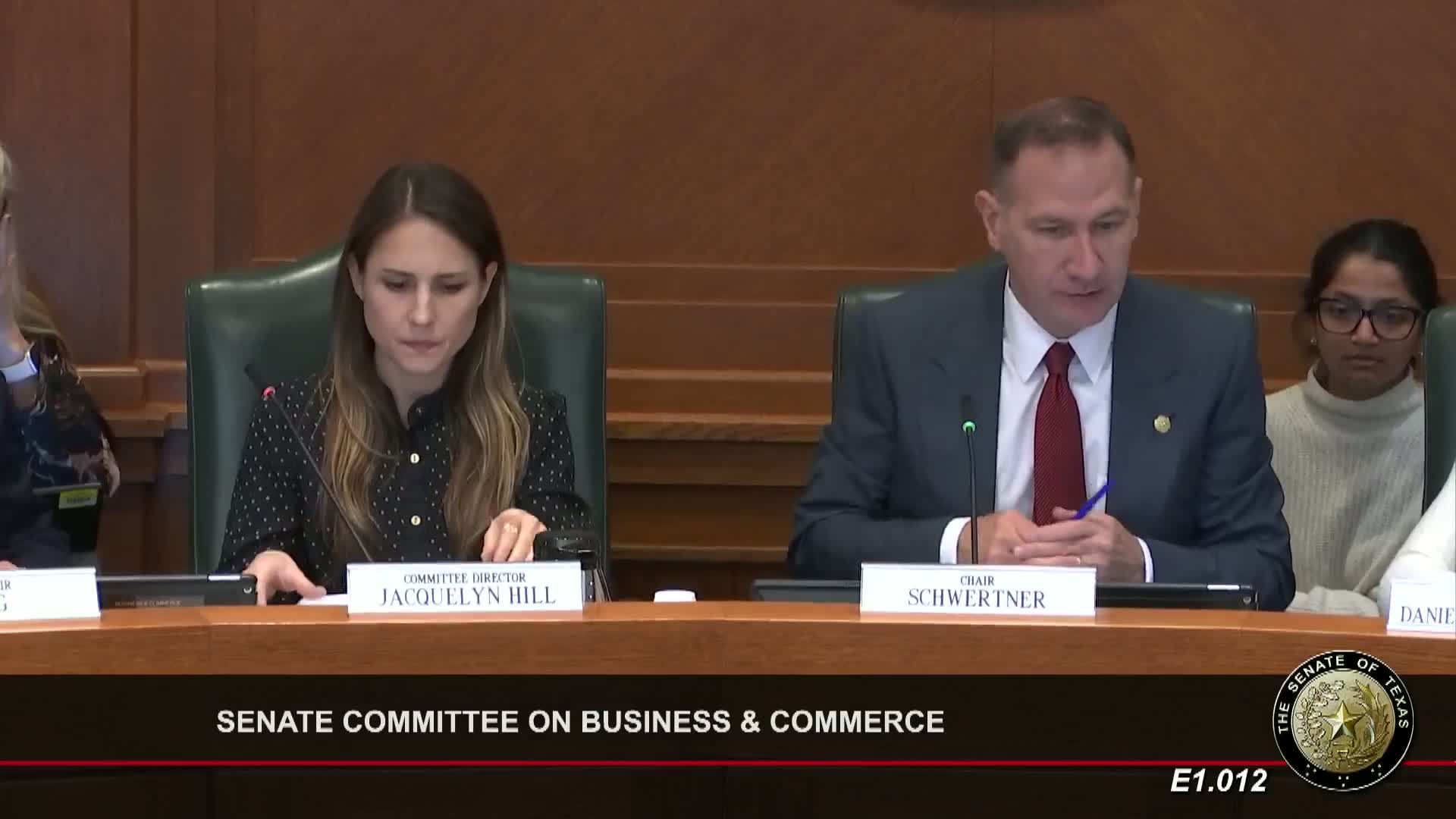
Vice Chair Sarah King’s Senate Bill 388 prompted a multi‑hour committee debate on Oct. 12, 2025, over whether Texas should convert its 1999 natural‑gas generation goal into a forward‑looking 50% dispatchable goal for new generation and use a credit‑trading mechanism to enforce it.
King told the Committee on Business & Commerce the bill updates a statutory goal originally written for natural gas and excludes renewables from the accounting. SB 388 would count renewables when assessing whether a year’s new generation met a 50% dispatchable threshold; "2026 will be the first year of the snapshot," King said, explaining how the Public Utility Commission (PUC) would review new capacity built in 2026 on Jan. 1, 2027.
The bill’s stated purpose is to incentivize more dispatchable resources — natural gas, firmed renewables or batteries — by creating an additional revenue stream for dispatchable generation through tradable credits. King described the mechanics with an example: if 5,000 megawatts of new capacity were built in 2026, 2,500 megawatts would need to be dispatchable to meet the 50% threshold; shortfalls would be made up by buying credits or making an alternative compliance payment.
Proponents and witnesses from grid operators agreed dispatchable resources enhance reliability. Keith Collins, ERCOT’s vice president of commercial operations, testified that dispatchable generation "is needed on our grid" and that recent market changes and programs such as the Dispatchable Reliability Reserve Service (DRRS) are steps toward building firming capacity. A PUC witness, Barksdale English, told the committee a credit trading program could be implemented and would evaluate historical new builds to set obligations.
Opponents — including the Texas Solar & Storage Association, Public Citizen, Sierra Club and several renewables proponents — said the bill could destabilize markets and raise costs for consumers if it prompts withholding, delays or duplicative incentives. Mark Stover of the Texas Solar & Storage Association said solar and storage "are increasing reliability, lowering power prices for consumers," and warned SB 388 could have "a destabilizing effect on the market." Adrian Shelley of Public Citizen urged the committee to value a broader set of dispatchable resources (demand response, controllable load) and recommended a study to set an evidence‑based target.
Several witnesses and members focused on how batteries should be credited. King and multiple witnesses discussed downgrading battery credit values because batteries cannot run 24/7: "They don't run they're unavailable 24/7 ... it’s been suggested in the committee substitute we adjust how much credit batteries receive based on hours they can provide electricity," King said. Industry witnesses recommended formulas that reflect battery duration and availability and that both new and existing thermal dispatchable plants be eligible to provide credits.
Technical questions included whether the 50% number is correct, whether credits would simply shift money from solar developers to batteries, and whether market‑level programs already underway (DRRS, HB1500 mechanisms) overlap with SB 388. Multiple witnesses referenced federal subsidies — the Inflation Reduction Act and production tax credits — as drivers of the current renewable‑heavy interconnection queue.
The committee allowed resource witnesses from the PUC and ERCOT to respond to technical questions about design choices and potential market side‑effects such as withholding new builds to capture higher future credit values.
Ending: The committee closed public testimony and left SB 388 pending; members signaled a desire to refine the bill’s credit formulas (especially for batteries) and to coordinate with ongoing market reforms and PUC rulemaking.