Get Full Government Meeting Transcripts, Videos, & Alerts Forever!
Get email alerts on the Education School Finance topic
No spam. Unsubscribe anytime.
Arizona House advances bill to tighten school financial reporting and penalties
Summary
Lawmakers in the Arizona House advanced House Bill 21-67 as amended, a measure that would increase oversight and penalties for school districts that fail to file required annual financial reports with the Auditor General and Arizona Department of Education.
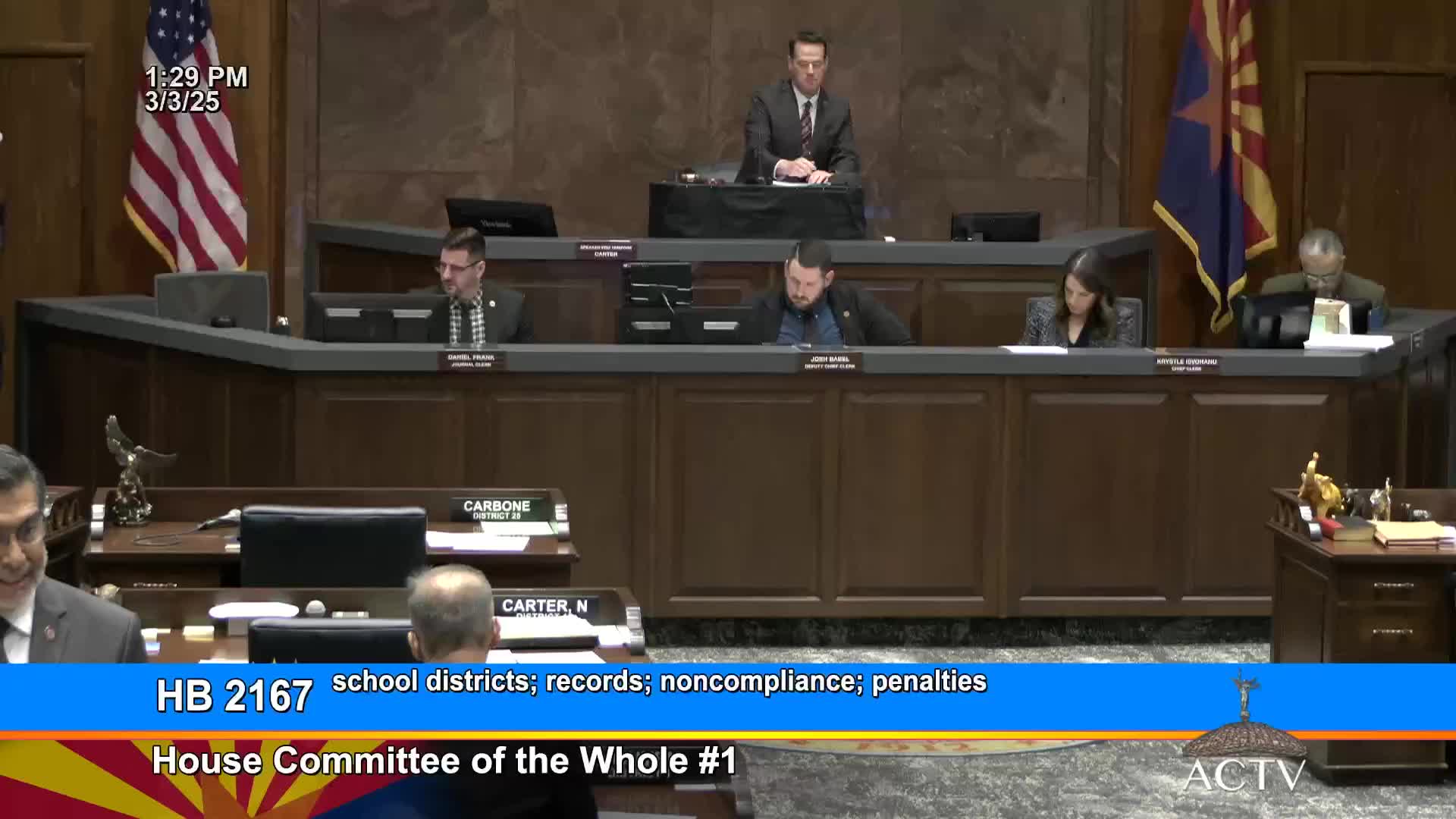
The Arizona House of Representatives advanced House Bill 21-67 on March 3, 2025, after a committee of the whole recommended the bill "do pass" as amended.
Representative Gress, the bill sponsor on the floor, told colleagues the measure responds to recurring failures by some districts — including what he identified as the Isaac Elementary School District — to submit required financial documents to the Auditor General. "There is not enough penalties in state law to compel these school districts to act, and this is going to move it in the right direction," Representative Gress said on the floor.
The bill as explained on the floor would increase accountability for districts that fail annual financial reporting and expand timelines and assistance from the Arizona Department of Education and the Auditor General. Gress said the Auditor General’s reviews use about 171 questions to test districts’ financial compliance and that some districts had not filed reports for more than five years, a condition he described as materially affecting compliance and local bond and override authority.
Supporters framed the bill as protecting taxpayers and ensuring districts that repeatedly fail to meet reporting requirements receive training and, if necessary, penalties. Gress said the bill was improved by bipartisan work and by extending timeframes for penalties so ADE and the Auditor General can assist districts before harsher consequences apply.
The committee action on the floor was a voice vote on the committee recommendation that the bill receive a "do pass" recommendation. The record shows the committee of the whole reported the bill out and the house voice vote was recorded as the ayes prevailing.
The bill proceeds to further floor consideration. The transcript does not list a final roll-call tally on third reading during this session; the committee recommendation and floor voice actions above are recorded in the House minutes.