Get Full Government Meeting Transcripts, Videos, & Alerts Forever!
Get email alerts on the Online Learning Idla topic
No spam. Unsubscribe anytime.
IDLA growth prompts per‑enrollment funding change and proposed course‑fee cut
Summary
The Idaho Digital Learning Academy reported enrollment growth that would increase its appropriation under the new per‑enrollment funding formula and announced a board proposal to cut the course fee from $75 to $40 for next year.
Jeff Simmons, superintendent of the Idaho Digital Learning Academy, told the Joint Finance‑Appropriations Committee on March 4 that IDLA’s recent enrollment growth is changing its funding profile now that the program is funded per eligible enrollment under House Bill 452.
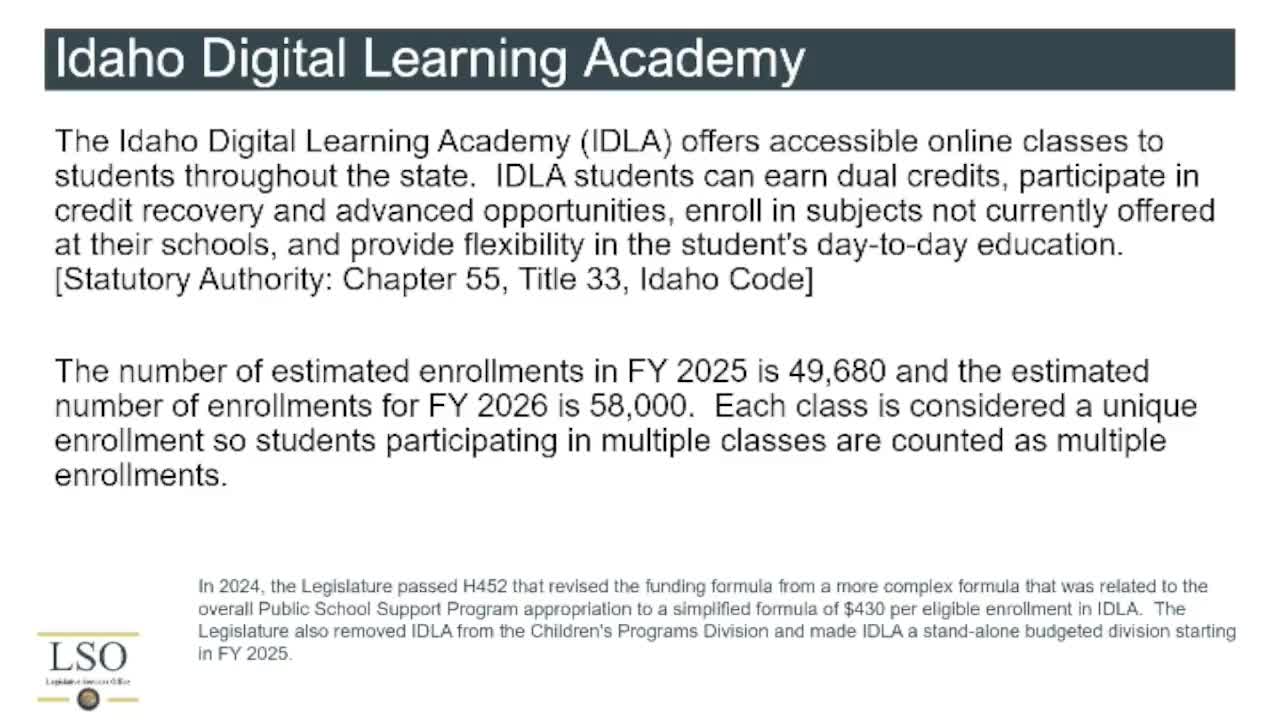
IDLA’s appropriation is set at $430 per eligible enrollment. Jared Tetrault told the committee that IDLA’s budget will increase if enrollment projections rise: a projection of 53,000 enrollments would trigger an approximate $1.4 million withdrawal (additional appropriation) from the PSIF/appropriation reconciliation process under the per‑enrollment model. Tetrault said the agency’s budget was originally set using an estimated 49,680 enrollments.
Simmons said IDLA’s actual enrollments were closer to 52,000 at the time of testimony and that the program has seen strong growth in driver’s‑education enrollments and an elementary K–5 literacy program. He said IDLA provides online dual credit, credit recovery, advanced opportunities and courses not available locally; the program reported roughly 101 full‑time positions plus several hundred part‑time teachers and principals on its roster.
On fees: Simmons told the committee that IDLA has statutory authority to charge course fees (capped at $75) and that the board has a proposal before it to reduce the per‑course fee to $40 (a $35 reduction) for the coming year. He said the agency has also worked to remove some textbook fees via open education resources in at least one college‑level course.
Simmons described program measures: IDLA reports a final percentage grade to the student’s home school when classes complete and said the system targets a roughly 90% pass rate for courses (it reported 89% last year). For the K–5 literacy program, Simmons said the agency pairs Istation diagnostic software with a certified elementary teacher and that early data indicate reduced typical summer slide for participating students.
Why it matters: changing from a budget line appropriation to per‑enrollment funding ties IDLA’s total appropriation directly to how many courses and students the academy serves. The proposed fee reduction would reduce a small financial barrier for students but requires the board’s final approval and the agency to manage costs accordingly.