Get Full Government Meeting Transcripts, Videos, & Alerts Forever!
Get email alerts on the Virtual Education topic
No spam. Unsubscribe anytime.
Senate education committee adopts substitute for virtual education bill, hears testimony on expansion and funding
Summary
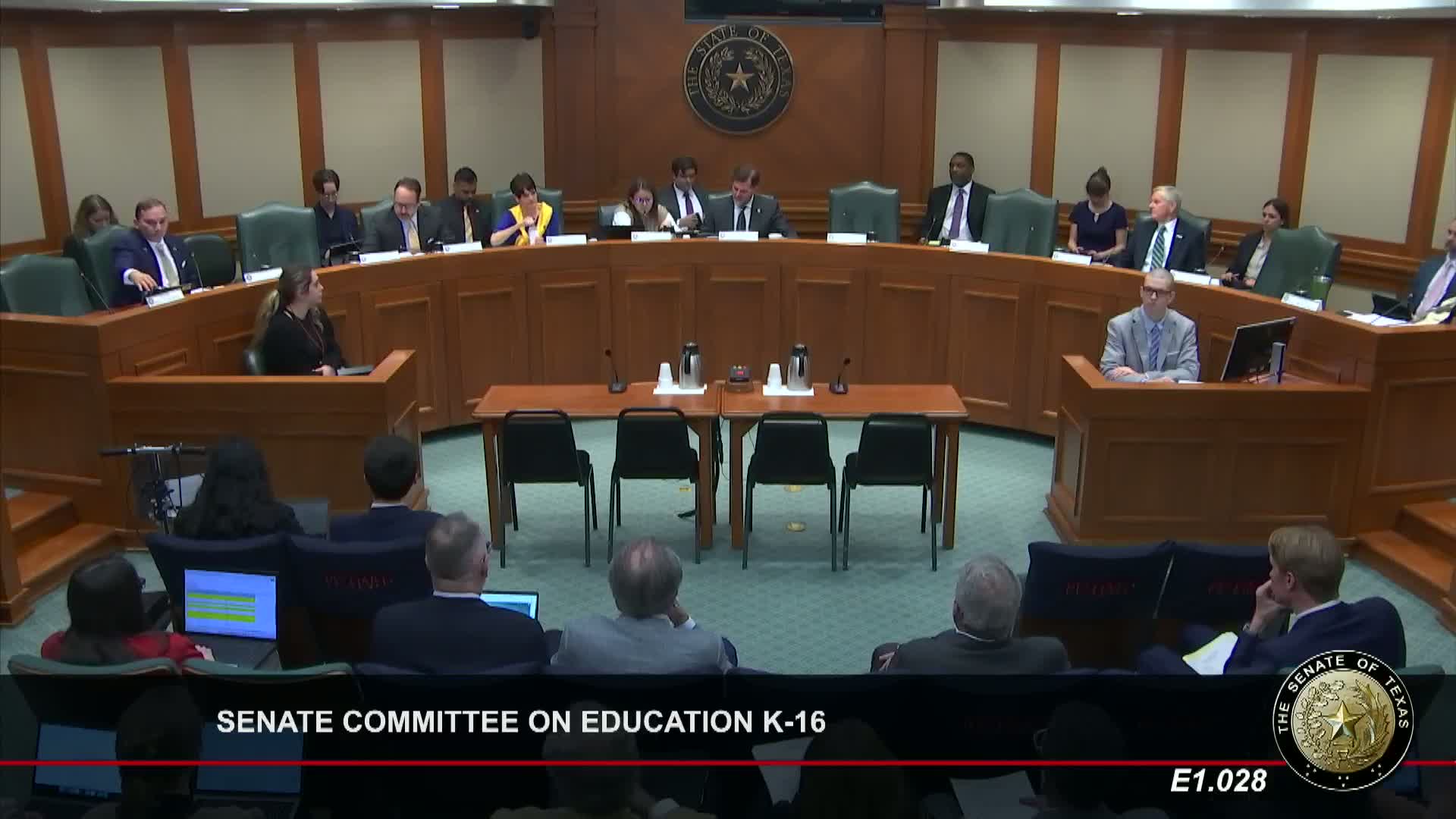
The Senate Committee on Education adopted a committee substitute for Senate Bill 5 69 and heard invited and public testimony on creating a single statutory framework for virtual and hybrid public education programs.
The Senate Committee on Education adopted a committee substitute for Senate Bill 5 69 and heard more than two hours of invited and public testimony about expanding and regulating virtual and hybrid public-school programs.
The substitute, sponsored by Sen. Roland Bettencourt and based on unanimous recommendations from the Texas Commission on Virtual Education, would create a single, unified section of code covering virtual courses, hybrid programs and virtual campuses while including provisions for parent and student rights, provider accountability, professional development, and state support. The committee later voted to report the substitute favorably to the full Senate.
Committee members and invited witnesses said the bill is intended to preserve programs that began under COVID-era waivers, provide quality controls and make virtual options available statewide. Rex Gore, who chaired the state commission, told the committee, “This bill aligns very well with the bipartisan unanimous recommendations of the commission,” and said the commission heard more than 37 hours of testimony from educators, parents and students before drafting its proposals.
Supporters described specific elements in the substitute: grandfathering language to continue existing district programs operating under previous waivers; a clarified definition of full-time hybrid programs; updated quality standards language; and explicit prohibitions on “pandemic‑style” simultaneous instruction (teachers required to teach in-person and remote students at the same time). The bill’s text also directs the state to provide technical and professional development support for virtual instruction.
Deputy Superintendent Brian Lusk of Dallas Independent School District described two local models — a full-time virtual “iLearn” program and a hybrid model that combines in‑person and virtual days — and said the district supports measures prohibiting simultaneous in‑person and online instruction and supporting teacher professional development. “Teachers had not had one moment to prepare,” he said of the COVID experience; he told the committee the bill’s professional development provisions were an important safeguard.
Witnesses from charter and special‑purpose districts, including Texas Tech K‑12 and Conroe ISD, and operators of statewide virtual programs described students who they said thrive in virtual settings: students with medical needs, highly mobile students (including foster youth and military families), students pursuing CTE and early‑college pathways, and others. A student invited to testify, Hope Faith Wiggins, described taking high school and college courses concurrently and said virtual options allowed her to “reach our fullest potential.”
On funding, senators and witnesses said the bill keeps virtual students’ funding tied to the resident district’s average daily attendance (ADA) calculation; Sen. Bettencourt and witnesses said the Legislative Budget Board produced a draft two‑year fiscal impact estimate of roughly $62 million in general revenue-related funds. A district representative explained that under the bill the district where a student is enrolled receives the ADA portion tied to that student.
Public‑comment witnesses from Conroe ISD, Texas Virtual Academy and other local programs urged passage, saying a permanent statutory framework would provide stability to programs that currently operate under waivers. Several school trustees and principals described populations they said benefit from virtual options, and one Conroe trustee said virtual school “is not just a preference. It is a lifeline” for some students.
Committee action and next steps: the committee adopted the substitute during the hearing and, at the business portion of the session, voted to report the committee substitute favorably to the full Senate (committee roll calls recorded in the hearing transcript). The bill will next be considered by the full Senate.
Why it matters: supporters emphasized access for 50,000+ students and expanded career‑and‑technical pathways; opponents and members asked for more budget detail. The committee’s adoption of the substitute preserves existing local programs and launches the bill toward floor consideration where fiscal and implementation questions will continue to be debated.