Get Full Government Meeting Transcripts, Videos, & Alerts Forever!
Get email alerts on the Water Infrastructure topic
No spam. Unsubscribe anytime.
Spring Hill approves purchase of land for reservoir, advances Project Swift pilot and sewer upgrades
Summary
The Board approved Resolution 25-68 to buy property for a planned water reservoir and heard staff briefings on sequencing for sewage plant expansion, EQ basin work and a demonstration purification pilot (Project Swift). The vote was unanimous 9–0.
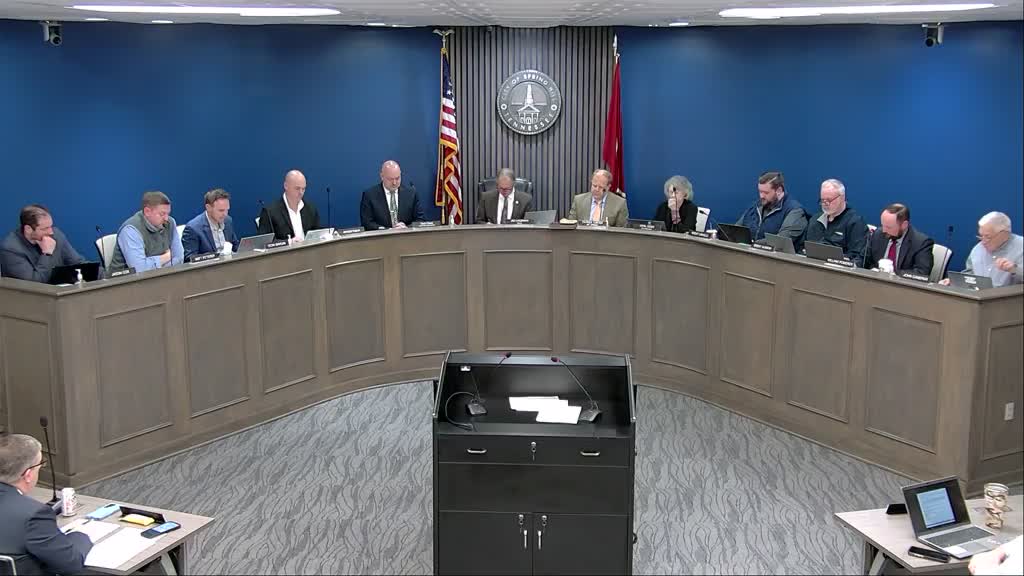
The Board of Mayor and Aldermen of Spring Hill on March 3 approved Resolution 25-68 to authorize purchase of property intended for a future water reservoir, a purchase the board’s supporters said will reduce planned dense housing and advance an advanced-purification pilot called Project Swift.
The purchase authorization passed unanimously, 9–0. Vice Mayor Pomeroy moved the motion and Alderman Murray seconded. The item drew extended discussion linking the land buy to sewer-plant expansion, an equalization basin and a demonstration purification pilot that staff say will be used for tests and public education.
Why it matters: supporters said buying the land lets the city shape development, protect the Duck River watershed and advance a longer-term water-treatment plan. “By owning this, we can go to development stages of design for a water reservoir that's going to help the community grow in a respectful way,” Alderman Alan Fuquay said. Alderman Lindell, Alderman Murray and others said the acquisition also removes about 1,100 housing units from a development scenario that they said would have increased traffic and sewer demand on Port Royal Road.
City staff and consultants outlined near-term sequencing for related infrastructure work. Dan Allen (public utilities) and Missy Stahl (capital improvements program director) told the board they are advancing multiple, interdependent projects in parallel: an expansion of the sewer plant, design and bidding of a headworks and EQ (equalization) basin, a filter maintenance project at the water plant, and a pilot demonstration facility for advanced purification. Allen said the city must complete critical-path work — notably a new fleet maintenance building for public works — before demolishing the existing headworks and moving forward with some construction phases.
Allen said the pilot facility is being designed both as an operational test site and as a demonstration/education venue for the public and other municipalities. “The intent is not to just do that for nine months, but really continue operating that facility for as long as the state needs us to,” Allen said, describing an entrance with public education exhibits and a separate lab-like pilot area with sampling stations.
Financial context: Vice Mayor Palmer described the land contract as roughly $77,000 per acre and said the sewer-development fund holds about $23 million; staff said the immediate acquisition and related work are expected to fit within sewer-development funding (project cost examples discussed included an $8 million estimate for a phase of the project). Staff also said earlier property purchases expanded available footprint and made a shallower, larger-surface-area reservoir more feasible long-term.
Questions and limits: City Attorney Patrick Carter and other members clarified legal and permitting dependencies. Board members repeatedly noted that construction sequencing and grant approval remain subject to external timing and regulatory review; Allen told the board he would return with more detailed procurement packages and a grant recommendation once consultant selection and scoping are complete.
The board’s action: Resolution 25-68 (authorize purchase of property for the water reservoir) was approved unanimously, 9–0. Members who spoke in favor emphasized long-term environmental protection, removal of high-density development from the immediate parcel, and the use of sewer-development fees rather than general-fund dollars.
Staff next steps include finalizing consultant selection for reservoir design, bidding the EQ basin/headworks package after minor design refinements, completing the fleet maintenance site so public-works equipment can relocate, and phasing demo/pilot procurement and early construction activities. Allen said he would return with a timeline and that staff would try to avoid repeated mobilization costs by sequencing contractor work to remain continuously on site.
Ending: Board members asked for more visual milestone tracking and public-facing outreach as the demonstration facility is built. Allen and staff said they will provide a milestone chart and continue public engagement as design and procurement progress.