Get Full Government Meeting Transcripts, Videos, & Alerts Forever!
Get email alerts on the Health Policy topic
No spam. Unsubscribe anytime.
Senate panel advances bill tightening standards for nursing education after low NCLEX pass rates
Summary
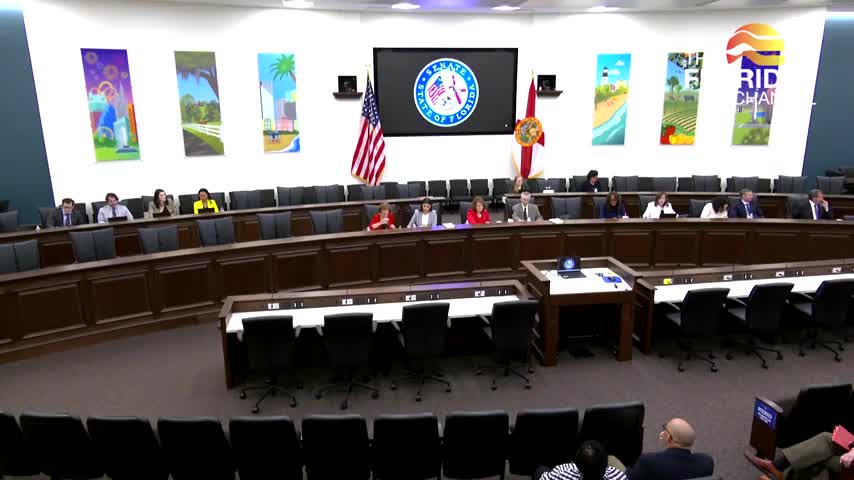
Senate Bill 526, a measure to tighten accountability for Florida nursing education programs, was reported favorably by the Florida Senate Committee on Health Policy after a two‑hour hearing and an adopted amendment that restored a two‑year probationary period for struggling programs.
Senate Bill 526, a measure to tighten accountability for Florida nursing education programs, was reported favorably by the Florida Senate Committee on Health Policy after a two‑hour hearing and an adopted amendment that restored a two‑year probationary period for struggling programs.
The bill’s sponsor, Senator Lori Harrell, told the committee that Florida’s graduates have been performing poorly on the National Council Licensure Examination (NCLEX). “For the last 10 years we have had terrible scores, awful scores, so bad that this year we were 50 out of 50 in people who are passing the NCLEX,” Harrell said as she explained the measure’s main provisions.
The bill would require practical nursing and registered‑nursing programs to establish admission criteria, use an exit exam before students attempt the NCLEX, and create remediation programs for students who fail the exit exam. It also would authorize the Department of Health to perform on‑site inspections, require programs to obtain accreditation within five years of enrolling their first students, and permit the Board of Nursing to deny applications from programs that have had adverse actions taken in other jurisdictions. The measure would subject program directors to discipline and create termination grounds for programs that fail to file required annual reports.
Why it matters: Florida’s NCLEX pass rate in the hearing was presented as well below the national average. Sponsor Harrell and supporters framed the bill as aiming to protect students and patients by ensuring graduates can pass the licensure exam and obtain employment, rather than leaving students with debt and no license.
Key provisions and how proponents and opponents described them - Exit exam and remediation: The bill mandates an exit exam for students approaching graduation and requires programs to offer remediation for students who fail that exam; the bill text, as described in the hearing, does not make the exit exam the sole bar to graduation. Harrell said the exit exam and remediation are intended to increase NCLEX passage and reduce students leaving programs with debt and no license.
- Denial and termination authority: The bill would allow the Board of Nursing to deny a program’s application if the program previously faced adverse action in another state and to terminate programs for failure to submit required annual reports. Harrell said this targets “fly‑by‑night groups” and schools that change names after losing approvals.
- Inspections and accreditation: The measure authorizes on‑site inspections by the Department of Health to verify compliance, and it retains the existing five‑year deadline for programs to obtain accreditation; an earlier Board of Nursing extension authority would be removed under the bill’s language, according to the sponsor.
- Probation period: A late amendment restored a two‑year probation period for programs with poor performance after the sponsor initially proposed reducing probation from two years to one; Senator Harrell said she reinstated two years after further consultation with stakeholders.
Concerns raised at the hearing - Access and closures: Senator Berman asked whether denying programs with adverse actions in other states could reduce access to nursing education in underserved areas. Harrell replied that the Board of Nursing could consider extenuating circumstances but expressed that Florida should not import programs with disciplinary histories.
- Impact on nontraditional students: Senator Davis and several witnesses, including Bob Harris of the Florida Association of Independent Nursing Schools and Dr. Tamisha Scott, a private‑school owner, warned that tighter sanctions and penalties could lead to school closures that disproportionately affect nontraditional students (working adults, parents, career‑changers). Harris said the bill “will have the impact of closing the opportunities for those students to become nurses.”
- Program director penalties and definitional gaps: Witnesses argued the bill could deter experienced program directors because it adds potential penalties, including discipline that could affect an individual’s nursing license. Bob Harris also said the bill lacks a clear definition of “adverse action,” which could cause unintended program closures.
Supporters’ argument and data cited Senator Harrell and supporters pointed to state and national pass‑rate figures presented in the hearing. Harrell said the national average passage is about 91 percent and that Florida’s recent passage rate was roughly 84 percent. Harrell also cited counts of nursing programs in Florida: “We currently have 314 RN programs in the state of Florida. 314 currently. We have a 94 LPN programs in Florida,” she said, to underscore program scale and the need for accountability.
Industry witnesses described both problems and progress. Alan Mortham, executive director of the Florida Association of Postsecondary Schools, told senators that private postsecondary schools produce a large share of Florida’s nurses and that their sector has raised pass rates in recent years without new statewide regulation. Mortham said private schools produced 5,596 NCLEX test‑takers in 2024 compared with 3,059 from public institutions and argued some regulatory functions are already handled by existing oversight bodies.
Votes and next steps After debate and the adopted amendment to restore a two‑year probation period, the committee called the roll. The committee recorded unanimous support on the record and “Senate Bill 526 will be reported favorably.”
What remains unresolved Witnesses and several senators asked for greater clarity in the bill on definitions (notably “adverse action”), whether and how exit exams would factor into graduation decisions, how remediation would be funded or required by public schools as well as private ones, and how the state would balance tighter oversight with keeping education available to nontraditional students.
Ending note: The sponsor said she is open to further changes as the bill moves through the process. Sponsor Senator Lori Harrell closed by saying the bill’s goal is “more nurses pass[ing] the test and then you can help pay back a hundred thousand dollars you owe on your nursing education.”