Get Full Government Meeting Transcripts, Videos, & Alerts Forever!
Get email alerts on the Long Term Care Covid Testing topic
No spam. Unsubscribe anytime.
Georgia committee backs bill to remove routine COVID testing for new long‑term‑care residents and staff
Summary
A Georgia House committee voted to recommend passage of a bill that would remove the routine requirement that long‑term care facilities test new residents and new staff members for COVID‑19.
A Georgia House committee voted to recommend passage of a bill that would remove the routine requirement that long‑term care facilities test new residents and new staff members for COVID‑19.
Sponsor and committee members said the rule was added during the COVID pandemic and is no longer routinely enforced; opponents warned that testing remains a cost‑effective tool to detect outbreaks among a highly vulnerable population. The committee voted to recommend passage by a 6‑3 margin.
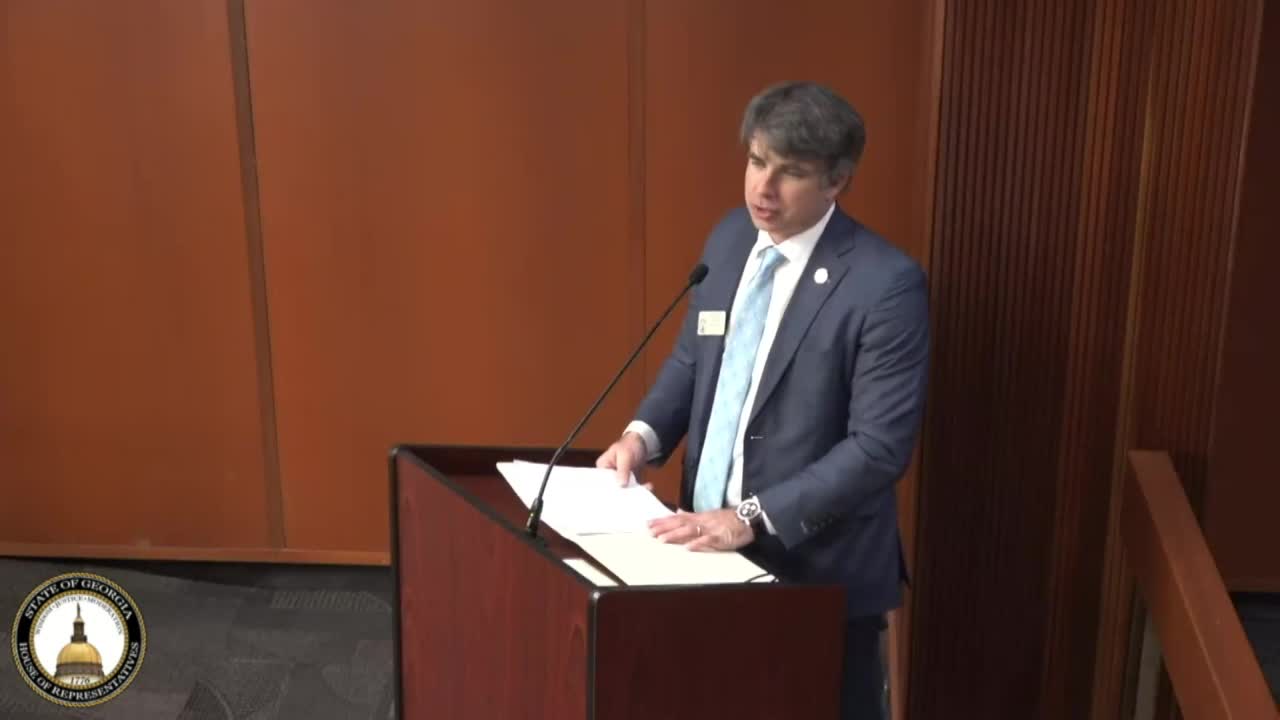
Chairman LaHood, who presented the measure, said the rule was a pandemic‑era addition and that the bill “just removes that requirement.” He told members the Department of Community Health’s surveyors are not inspecting for the test requirement and that the department has the authority to reinstate testing if an outbreak occurs.
Rep. Katie Campbell (first reference as Representative Katie Campbell), a committee member, pressed proponents on the public‑health tradeoffs. “Testing has been proven to save lives, especially with our most vulnerable population in long term care facilities,” Campbell said, noting the test she had taken recently “takes about 15 minutes” and arguing that testing can help detect spikes that are otherwise less visible now that pandemic surveillance has waned.
Seth Daniels, director of government affairs for the Georgia Senior Living Association, told the committee his members sought the change because the requirement is not being enforced consistently. “The vast majority, 99%, are not doing it and are not being checked for it,” Daniels said, adding that providers were seeking uniform enforcement language to avoid penalties for a practice that is no longer routine.
Supporters repeatedly pointed to existing infection‑control layers. LaHood and others noted that facilities still must complete a physician’s evaluation for new residents and that other infection‑control triggers exist: if multiple people show the same symptoms, agencies are notified and additional measures can be taken. Rep. Bonner said the bill represents a “return to normal standards and practices.”
Opponents said removing the routine requirement could remove an inexpensive layer of protection. Campbell and Rep. Bell questioned whether discarding a short antigen test — often cited as taking about 15 minutes to perform and document — was worth the potential risk to residents. Campbell also cited Centers for Disease Control data showing low staff vaccination rates in long‑term care and urged the committee to weigh that when deciding whether to remove the mandate.
The committee voted on a motion by Rep. Bonner to give the bill a “do pass” recommendation. The motion passed with six yeas and three noes; the transcript records the tally but does not list names with each recorded vote. The clerk recorded the legislative code for the measure as LC461108 and the hearing transcript identifies the item as House Bill 645.
The transcript shows no committee amendment and no instruction directing staff to draft follow‑up language. The Department of Community Health’s Healthcare Facility Regulation Division (HFRD) was discussed as the agency that performs surveys and inspections; witnesses and members said HFRD surveyors are not currently checking for the COVID‑test requirement.
The committee discussion ranged from operational concerns — that testing adds steps to already lengthy admission and hiring processes — to public‑health concerns about losing a routine screening tool. Several members emphasized that facilities may continue to require testing at their discretion and that the bill would only remove the state‑level blanket requirement for initial testing at admission or hire.
The committee recommended the bill for passage; further action by the full House was not recorded in the provided transcript.