Get Full Government Meeting Transcripts, Videos, & Alerts Forever!
Get email alerts on the Right To Repair Agriculture topic
No spam. Unsubscribe anytime.
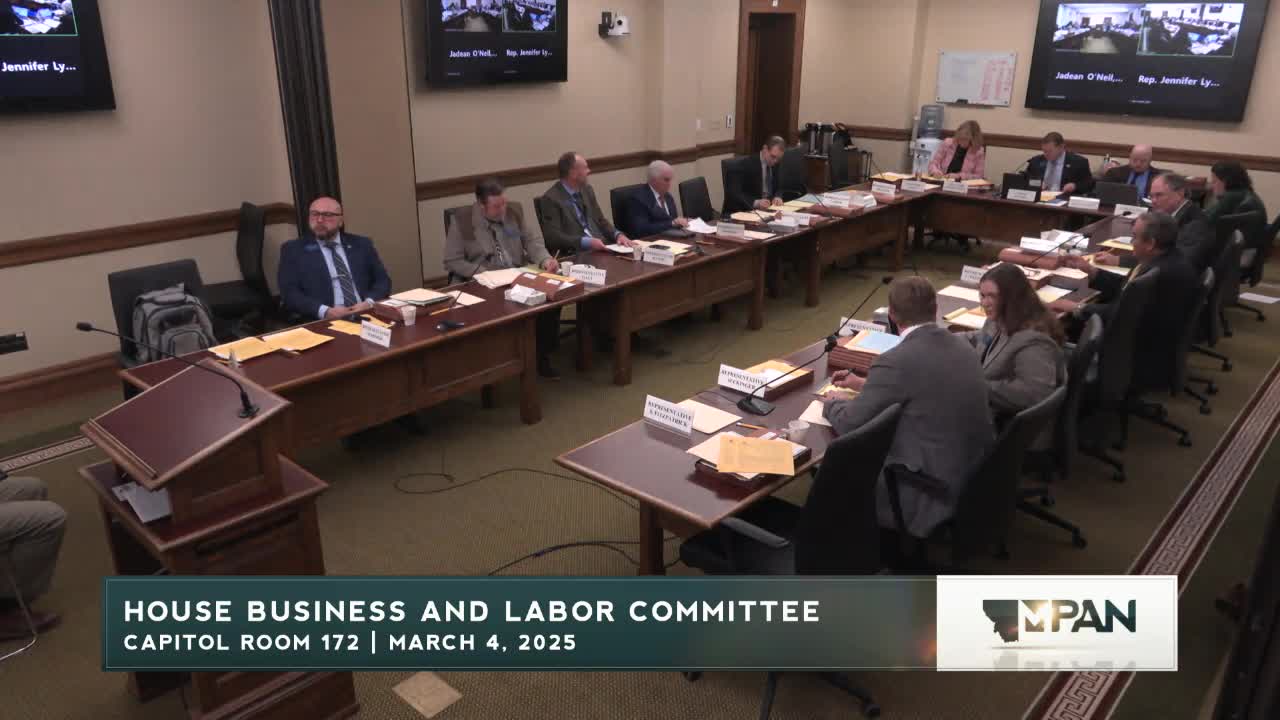
Committee tables right-to-repair bill for farm equipment after split testimony
Summary
House Bill 813, which would clarify owners’ rights to diagnose and repair emissions-related components on agricultural equipment, drew vocal support from farm and consumer advocates and opposition from equipment dealers and manufacturers. The committee voted to table the bill.
The House Business and Labor Committee tabled House Bill 813 after extended testimony from farmer advocates, dealer representatives and industry groups. The bill would clarify the right of equipment owners and independent repair providers to access documentation, tools and software needed to diagnose and repair emissions-related components of agricultural machinery.
Representative Tom France, sponsor of HB 813, framed the bill as aligning state law with federal standards and agency guidance. "The Environmental Protection Agency believes barriers to the proper repair and maintenance of non road equipment is harmful to the environment," France told the committee, citing federal statements that equipment owners must be able to maintain emission-control systems.
Proponents included representatives of Montana’s Farmers Union and Farm Bureau, farm operators and independent repair advocates. Eric Summerfeld (Montana Farmers Union) and Lisa Bennett (a Carbon County property owner who also uses agricultural equipment) emphasized the operational impacts when machinery is down during short seasonal windows. Bennett said downtime can cost farmers heavily: "On average, farmers lose about $4,000 a year," and she estimated the statewide aggregate loss at "over $3,000,000,000," testimony the committee heard during proponents’ remarks.
Witnesses cited federal agency guidance and enforcement activity as support for state action. Testimony referenced the Federal Trade Commission’s 2024 policy work (including the report commonly called "Nixing the Fix") and a recent FTC enforcement action against a manufacturer; proponents argued those developments show the federal government favors greater repair access.
Opponents — including equipment dealers, supplier associations and several manufacturers’ regional representatives — warned that required access to dealer-level tools could create safety and compliance risks, complicate warranty and resale rules, and raise cybersecurity exposures. Brad Griffin, executive director of the Montana Equipment Dealers Association, told the committee the measure "is unnecessary" and urged the committee to table it. Several dealers said manufacturer software and service tools are already available in customer packages and that complex diagnostics still require trained technicians.
Witnesses also discussed technical issues that arise with modern emissions systems — for example, pairing sensors or engine injectors and the impacts of remote data access. Eric Sommerfeld recounted concerns about remote disabling of machinery in a wartime context, saying opponents had used remote access examples in Ukraine to caution against unregulated access.
Committee members debated penalty language in the draft statute and whether the measure duplicated or conflicted with existing federal obligations. Representative Gist asked about stiff penalties in the bill’s draft; Representative France said he would be willing to work on modifications.
On executive action the committee voted to table House Bill 813. Vice Chair Seacens Crowe moved to "do concur" earlier in the proceeding; Representative Schomer offered a substitute motion to table. The roll-call tally on the motion to table was recorded as 11 in favor and 8 opposed.
Because the bill was tabled, no statutory changes were adopted; sponsors and proponents signaled an intent to continue discussions and to work with stakeholders on technical and penalty provisions.