Get Full Government Meeting Transcripts, Videos, & Alerts Forever!
Get email alerts on the Housing topic
No spam. Unsubscribe anytime.
Senate committee advances $50 million one-time deposit for Housing Montana Fund
Summary
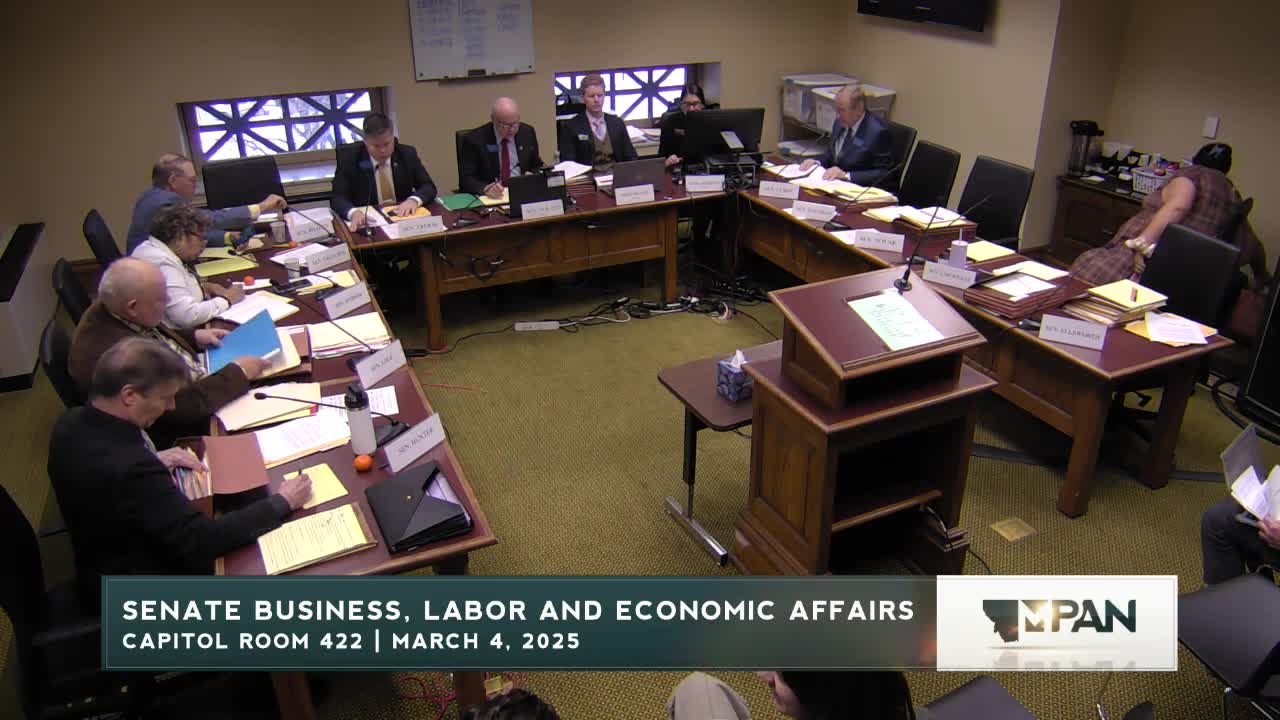
The Senate Business and Labor Committee voted to pass Senate Bill 405, a proposal to deposit $50 million of one-time general fund surplus into the Housing Montana Fund to provide gap and revolving financing for affordable housing projects across the state.
Senate Business and Labor advanced Senate Bill 405 on a roll-call vote after a public hearing that drew housing developers, nonprofit advocates and business groups.
The bill, sponsored by Sen. Dave Fern, would appropriate $50 million of one-time general fund surplus to the Housing Montana Fund, a revolving loan program first enacted in 1999. Supporters said the infusion would function as gap and bridge financing to leverage federal tax credits and private capital for projects that serve low- and moderate-income households.
Why it matters: Advocates and developers told the committee Montana has a shortfall of rental and workforce housing and that flexible, state-level capital is needed to close financing gaps that federal programs and market lenders cannot cover on their own.
Sen. Dave Fern, the bill sponsor, told the committee the Housing Montana Fund is “flexible” and can support both nonprofit and for-profit developers with stackable capital, sliding interest rates tied to area median income and infrastructure or shared-equity programs. He said the fund “creates a revolving fund” that can be sustained through loan repayments and short-term investment earnings.
Proponents described the fund as a ready-to-use financing tool. Aubrey Godbey, housing policy analyst at the Montana Budget & Policy Center, said the state faces a large deficit of units affordable to low-income renters and that the fund could “capitalize on matching federal funds” and serve as bridge financing. Danny Hess of the Montana Community Action Network and Jacob Koontz of Helena Area Habitat for Humanity also testified in support, noting how the fund can plug the last 5–15% financing gaps that keep projects from “penciling.”
Cheryl Cohen, executive director of the Montana Board of Housing, responded to questions about how the program would pair with federal tax credits and existing state programs. She explained that the fund’s flexibility — including the ability to subordinate lien position when appropriate — can make projects work where state coal-trust multifamily programs (which sometimes require first-lien status and property tax payment) cannot.
Committee action: The committee voted 8–4 to pass the bill out of committee and move it to the full Senate floor for further consideration.
What the bill would do and next steps: SB 405 would make a one-time appropriation to the Housing Montana Fund and allow the Board of Housing to administer loans and linked programs under existing statute. The bill language also authorizes the board to review and update its administrative rules. If the full Senate and House approve the appropriation and the governor signs it, the Board of Housing would begin issuing loans under the fund’s existing statutory framework.
Additional context: Witnesses noted the fund’s statutory requirement that 20% of funds be prioritized for rural communities, and multiple proponents said the financing can be “stacked” with federal low-income housing tax credits, tax-exempt bond financing paired with 4% credits, HOME and National Housing Trust Fund awards. Proponents also warned that mortgage interest and material-cost changes have tightened private financing capacity, increasing the need for flexible state capital.
The committee record contains multiple technical questions and clarifications about lien position, tax-credit pairings, and whether projects on tribal land are eligible; the Board of Housing said programs can and do operate on tribal land.
The hearing record and roll-call vote send SB 405 to the Senate floor for consideration.