Get Full Government Meeting Transcripts, Videos, & Alerts Forever!
Get email alerts on the Behavioral Health Capacity topic
No spam. Unsubscribe anytime.
Senate hears progress reports on two bills aiming to ease access to Montana State Hospital beds; sponsors seek more time to finalize amendments
Summary
Senate Bill 4-29 and 4-30, proposals to change commitment and admission processes for behavioral-health patients and to ease pressure on the Montana State Hospital, drew support from the Department of Public Health and Human Services and widespread requests from providers for more time and for funding for additional beds.
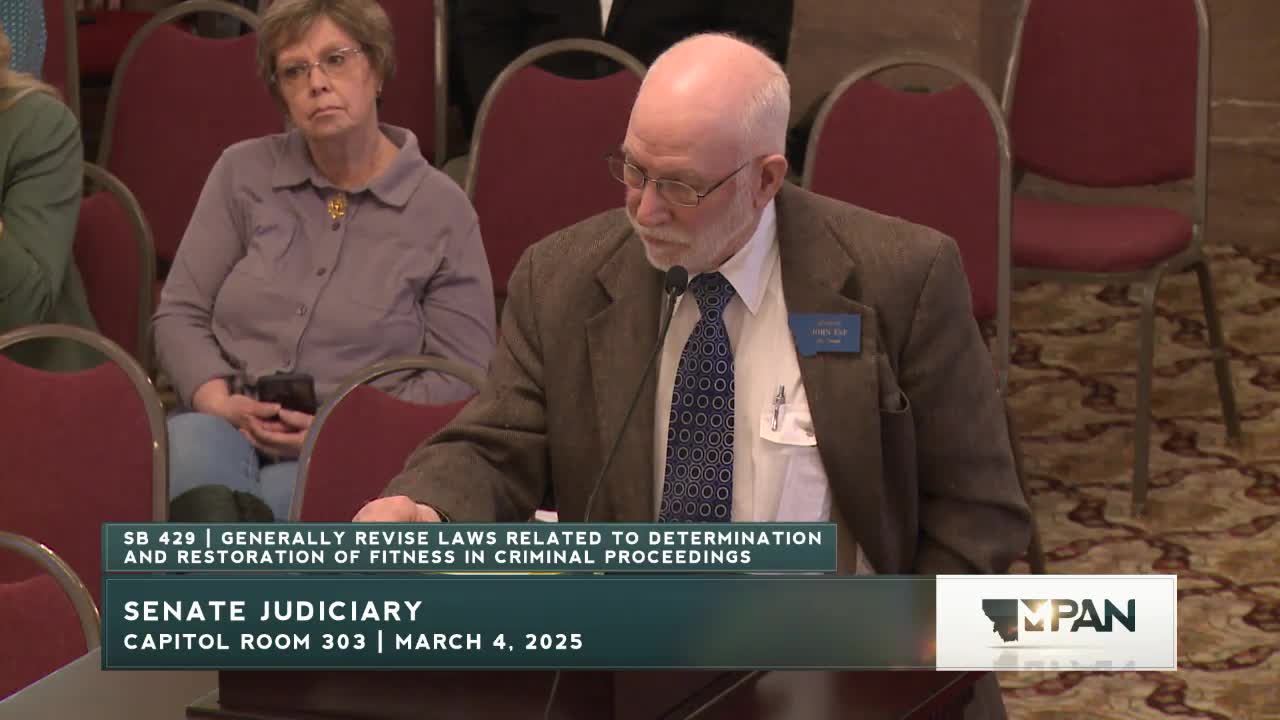
Senate Bill 4-29 and Senate Bill 4-30, both sponsored by Sen. John Esp, are companion bills that address access to inpatient psychiatric care and the off‑ramp into the Montana State Hospital. Committee members heard that the measures are still being negotiated and that stakeholders — including hospitals, county attorneys, sheriffs and behavioral‑health advocates — asked for more time to reach consensus.
Why it matters: Witnesses told the committee that Montana’s shortage of psychiatric beds has left community hospitals and emergency departments holding acutely ill patients for prolonged periods. Hospital officials and county attorneys said the state hospital’s license limits and workforce shortages constrain transfers and that a fix should pair statutory changes with funding for additional beds and staff.
Testimony and debate: Chad Parker, deputy chief legal counsel at the Department of Public Health and Human Services, said the department supports the sponsor’s plan and that discussions have produced draft amendments. Opponents — including the Montana Hospital Association, Benefis Health System, Billings Clinic/Logan Health, and several hospital chief nursing officers — urged the committee to make changes contingent on new bed capacity and staffing money rather than changing commitment rules alone. Several community providers described recent local episodes where severely psychotic patients required restraint, law‑enforcement coordination and extended emergency‑department stays.
Committee action and next steps: Sponsor Esp asked the committee to adopt a floor amendment so the bills could be treated as revenue bills and return to committee with a package that included agreed drafting and funding. In executive action the committee placed the sponsor’s amendment on the bills and returned them to the committee packet for further work; no final statutory change was adopted at the meeting.
Ending: Stakeholders said they had made progress in recent weeks and asked for the legislature’s patience while an amended, jointly supported package is completed. The committee signaled willingness to hold the bills in the packet and consider sponsor amendments after transmittal.