Get Full Government Meeting Transcripts, Videos, & Alerts Forever!
Get email alerts on the Health topic
No spam. Unsubscribe anytime.
Panel rejects medical assistance-in-dying bill after emotional testimony, 8-2
Summary
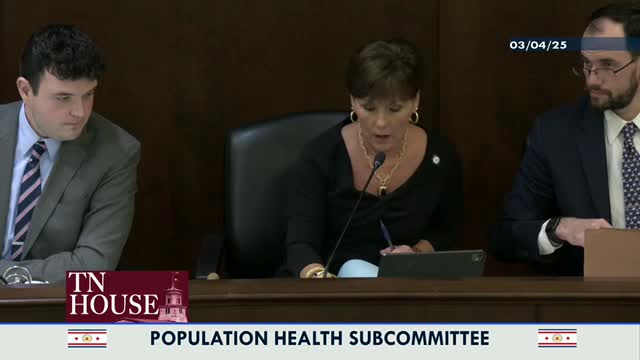
House Bill 598, which would have permitted medical assistance in dying with multiple safeguards, failed in the Population Health Subcommittee by a 2-8 vote on March 4, 2025, after testimony from physicians, ethicists and advocates for and against the measure.
The Population Health Subcommittee voted 2-8 on March 4, 2025, to reject House Bill 598, a measure that would have allowed medical assistance in dying for terminally ill adults under specified safeguards.
Sponsor Representative Freeman described the proposal as a way to give terminal patients a choice to end severe suffering and said the measure is modeled on statutes in other states. He summarized the procedure to the committee: a verbal and notarized written request, confirmation by an attending physician and a second physician, a psychological evaluation to rule out coercion, a prognosis of six months or less to live, and a requirement that the patient be able to self-administer the medication. "It's completely voluntary, nobody's going to be forced to do this," Freeman said.
Speakers opposed to the bill warned of unintended harms. Djoy Riley, M.D., executive director of the Tennessee Center for Bioethics and Culture, told the committee, "Medically assisted suicide, MAS ... harms patients by ending their lives. Vulnerable patients are at increased risk of being coerced or manipulated into accepting it." Riley said legalizing the practice could normalize suicide and weaken trust in medicine.
Katie Kelly, policy counsel with Americans United for Life, told members that data from jurisdictions where the practice is legal show it disproportionately affects people with disabilities, the elderly and people living in poverty. Kelly said the bill's mental-health safeguard is limited because it requires a referral only if the physician "has doubts as to the individual's mental capacity," and does not mandate a screening or formal evaluation in all cases.
Stephen Puckett, who said he was speaking for himself, raised enforcement concerns and urged the committee to examine underlying drivers such as pain management and access to care. Several committee members referenced medical and ethical considerations, including the Hippocratic Oath and the sanctity of life. Chairman Kumar said that even sympathetic clinicians take an oath not to advise or practice euthanasia and described difficulty reconciling that oath with a statute permitting medical assistance in dying.
Representative Freeman pushed back against slippery-slope arguments in committee debate, saying other states with such laws have not expanded eligibility to children or non-terminal conditions and that many eligible patients ultimately do not use the option. "There's a large percentage, more than half of the people who qualify for this program never go through with it," he said.
At the roll call, the clerk announced "2 ayes, 8 nays," and the chair declared that HB598 failed. The committee heard multiple public witnesses and held an extended out-of-session public-comment period before resuming deliberations. With the bill defeated in committee, it will not advance to the full House from this subcommittee record.