Get Full Government Meeting Transcripts, Videos, & Alerts Forever!
Get email alerts on the Digital Ids Biometric Data topic
No spam. Unsubscribe anytime.
Tennessee subcommittee advances bill to permit digital driver's licenses, limits biometric retention
Summary
The House Transportation Subcommittee on March 4 advanced House Bill 1316, which clarifies state law for mobile driver's licenses, permits third parties to accept a digital license on a permissive basis and restricts biometric data collection and retention to a brief verification window.
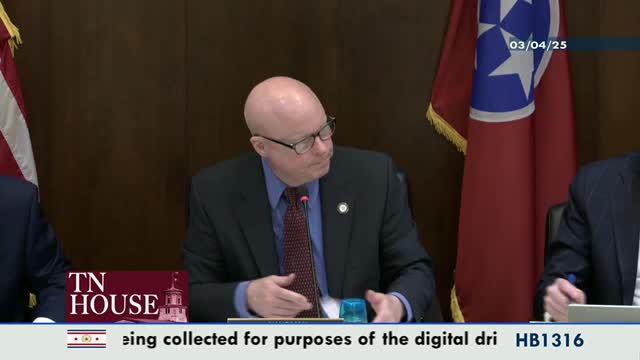
On March 4, 2025, the Tennessee House Transportation Subcommittee voted 7-2 to advance House Bill 1316, which would align state law with current practice on mobile driver's licenses and add limits on biometric data collection and retention for digital licenses.
The measure, carried in committee by Representative McCalmon, would amend Tennessee Code to allow people age 18 and older to take road skills tests while accompanied by a Department of Safety employee without first obtaining a driving permit. The bill also clarifies that certain recreational vehicles may be operated under a standard Class D license by tying the rule to intended use rather than a vehicle's gross vehicle weight rating. The bill includes new language governing mobile or digital driver's licenses: third parties may permissively accept a digital license, biometric data may be collected only to compare to the photo on file during the initial download, and collected biometric information must be purged and may not be retained or sold for unrelated uses.
Representative McCalmon placed amendment drafting code 004004 on the bill before debate; the amendment was adopted and the amended bill was advanced to the full transportation committee after a roll call vote of 7 ayes and 2 noes.
Department of Safety legislative director and assistant general counsel Elizabeth Stroker told the subcommittee the bill does not create a new licensing class and that the department already has the technology in place. "There are no fiscal —there's not a fiscal cost on the bill because this is something we've already developed and we had the funding to do so many many years ago," Stroker said. She added that the department would vet any private vendor through contract clauses and state information-security processes and that contract penalties and existing state law would apply in cases of negligent data handling.
Committee members pressed the department on privacy and breach risk. Representative Brunel raised the OPM breach as an example and said, "there's really no guarantee that this type of data will not be breached," adding concern that biometric data cannot be changed easily if compromised. Representative Renaud asked why the bill allows biometric verification data to be retained for up to three days; Stroker replied the period is a maximum to allow verification and fraud checks and that, "it cannot be kept longer than to verify the intended use, which should be immediate or no more than 3 days." The bill also explicitly prohibits use of a digital license for voting purposes, Stroker said.
Stroker declined to confirm a link between the bill and any federal pandemic-era relief funding when asked; she said she was not aware of any American Rescue Plan Act tie and reiterated the department believes no new fiscal cost would result from the statutory changes.
After the department's explanation and member questions, the subcommittee voted and sent the bill, as amended, to the full transportation committee.
The measure now advances to the full committee for further consideration; the committee did not adopt additional study requests or mandate changes beyond the amendment on the floor.
Votes at the subcommittee: amendment 004004 adopted; final motion to advance HB 1316 passed 7-2.