Get Full Government Meeting Transcripts, Videos, & Alerts Forever!
Get email alerts on the Committee Votes topic
No spam. Unsubscribe anytime.
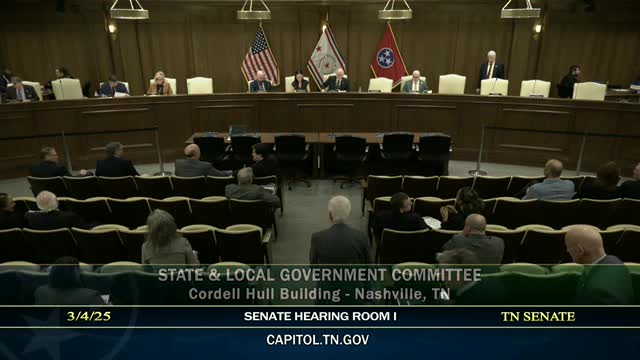
Senate State and Local Government Committee advances a package of bills and agency budgets
Summary
The committee approved two dozen items on its calendar, moving bills on public-safety funding, local government authority, housing finance and utility rules to the next stage; several agency budgets were also advanced to the finance committee.
The Senate State and Local Government Committee voted on a series of bills and budget items and advanced them to the next step in the legislative process.
The package included resolutions and bills on 911 funding, local-government authority to remove appointed board members, housing finance authority borrowing limits, utility governance and emergency lending, tax authority for mineral severance on county roads, and several agency budgets. Many measures passed on largely bipartisan votes; a small number drew recorded opposition.
Votes at a glance (motion text summarizes committee action; vote tallies shown as recorded in the committee roll calls): - Consent calendar: passed (9–0). Motion: adopt consent calendar; mover: Chairman Briggs; second: not specified. Outcome: approved. - SB 251 (Yeager) — allow certain retirees to return to hard-to-fill public-sector jobs and draw a reduced retirement payment: passed (9–0). - SB 390 (Rose) — clarifies comptroller authority to publish aggregated survey data: passed (9–0). - SB 329 (Powers) — replace references to facsimile transmission with electronic transmission across state/local government: passed (9–0). - SJR 48 (Massey) — ratify Tennessee Emergency Communications Board action raising the uniform 911 fee from $1.50 to $1.86 and adjust distribution and technology/comsolidation funds: passed (7–1–1 present-not-voting). - SB 129 (Hale) — increase Tennessee Housing Development Agency (THDA) borrowing cap from $4 billion to $5 billion: passed (9–0). - SB 329 amendment package and related technical bills: passed as recorded throughout the calendar. - SB 39 (Hale) — allow county appointing authorities and county commissions to remove appointed board/commission members (2/3 vote), with several clarifying amendments and a 5-business-day notice provision added in committee: passed (6–2–1 present-not-voting). - SB 247 (clarification to Greenbelt rules): passed (8–0 as recorded). - SB 988 (Hale) — require local governments to maintain documentation justifying development-related fees as public records on request: passed (8–1). - SB 1114 (remove sunset on certain records-request remedies): passed (9–0). - SB 889 (Reeves) — raise maximum mineral severance tax rates (local option) in stages for county road funding and require expanded reporting: passed (9–0). - SB 518 (Reeves) — allow emergency operating loans for public utilities, broaden contested-case authority and streamline bond issuance for utility systems: passed (9–0). - SB 477 (Bolin) — allow exonerees who meet specified criteria to apply to the Board of Claims directly and expand the ability of an exoneree's children to claim compensation; committee heard testimony from an exoneree, Joyce Watkins, who testified about her 27 years in prison before exoneration: passed (9–0). - Agency budgets advanced to finance: Tricor (passed to finance, recorded 7–0), Tennessee Housing Development Agency budget (passed to finance, 9–0), Board of Parole (passed to finance, 9–0), Tennessee Corrections Institute (passed to finance, recorded by roll call), and other agency budgets as listed on the committee calendar.
The committee also moved several technical and comptroller-request bills and placed some bills on the calendar for further work in the House or Senate calendars. Items recorded in the official roll calls were forwarded to finance or the calendar as indicated by the clerks during the meeting.
Notes: Roll-call tallies above reproduce the committee counts recorded aloud during the meeting; some items were amended on the floor of the committee before the final roll call. The committee frequently moved measures with a sponsor presentation, a short Q&A, then a roll-call vote. For full roll-call transcripts and audio, see the clerk's minutes for the meeting.