Get Full Government Meeting Transcripts, Videos, & Alerts Forever!
Get email alerts on the Expansion Requests Grants Staffing topic
No spam. Unsubscribe anytime.
Senate finance committee approves expansion requests for lead testing, opioid response, veterans approvals, TBI staffing and college mental health grants
Summary
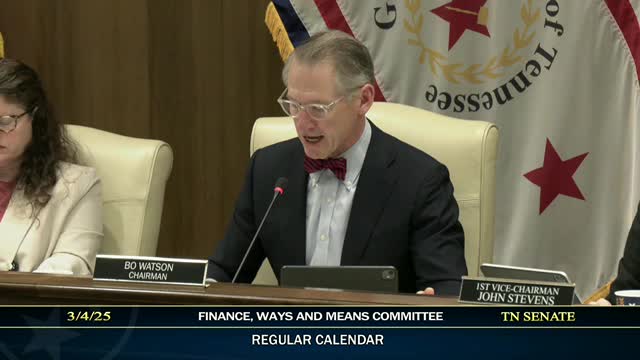
The Senate Finance, Ways and Means Committee on March 4 approved multiple expansion requests allowing state agencies to accept federal and external funds for lead testing, opioid response, veterans approvals, TBI staffing and college mental health services.
The Senate Finance, Ways and Means Committee on March 4 approved a series of expansion requests from state agencies to accept federal or other outside funds and add grant-funded staffing.
Department of Health — lead testing: John Webb, deputy commissioner for the Tennessee Department of Health, told the committee the department seeks permission to accept an $815,000 federal grant from the Environmental Protection Agency under the Water Infrastructure Improvements for the Nation Act. Webb said the money, spread over two years, will fund voluntary lead testing for schools and child-care centers. "It's $815,000 federal funding over 2 years, and it will require no new state positions," Webb said. The program will supply test kits that schools or day-care facilities can request; samples are sent to a laboratory for analysis. Margaret Major, with the department’s Maternal and Child Health Program, told senators the grant does not cover remediation: "The grant funding ... does not, at this point, cover remediation. So remediation's the responsibility of the testing facility, the school, or the childcare center." The committee approved the expansion by voice vote.
Department of Health — opioid abatement funds: Webb also described a roughly $2,400,000 grant from the Opioid Abatement Council, spread over three years, to expand opioid treatment and prevention work in high-impact areas. The funding will support six contract community health workers stationed at local health departments and expanded services in additional counties. Webb said the grant requires no new state positions and that the workers will be physically located in county health departments and also conduct community outreach. He listed Hancock, Hawkins, Marion, Grundy, Sequatchie, Rutherford and Shelby among the counties receiving resources; two county names in the committee record were redacted and are therefore recorded here as not specified. The department said it collects metrics bimonthly and conducts annual evaluations for the CDC; the committee approved the expansion by voice vote.
Tennessee Higher Education Commission (THEC) — veterans education: Steven Gentile, THEC executive director, described a $125,000 annual federal allocation from the U.S. Department of Veterans Affairs to support the state approving agency that manages GI Bill approvals across roughly 280 education providers. Gentile said the funding will add capacity without creating a net new state position by reorganizing existing staff. The committee approved the request by voice vote.
Tennessee Bureau of Investigation (TBI) — CJIS supervisor: Patrick Powell, policy director for the TBI, asked to use $108,400 in TICS (Tennessee Instant Check System) reserve funds to create a CJIS supervisor position within the TICS unit. The supervisor will lead training and auditing for local courts, law enforcement and other criminal justice users of the instant check system for firearm background checks. Powell said the position will be funded from TICS fees and reserves and that the statutory $10 fee per firearm background check will not be increased. "It's $10 for a background check," Powell said. The committee approved the expansion by voice vote.
Department of Mental Health — college-based integrated care: Deputy Commissioner Matt Yancey presented a five-year grant from the Substance Abuse and Mental Health Services Administration (SAMHSA) of $900,000 annually. The grant will be used to embed behavioral health staff in primary care clinics at three college campuses — the University of Tennessee at Martin, Tennessee Tech University and Bethel University — in partnership with local community mental health centers. Yancey said about $810,000 of the annual award will go to the community providers to hire two positions per campus (a master's-level mental health therapist and a case manager or peer specialist), with roughly 10% retained for administrative oversight by the department. The committee approved the expansion by voice vote.
Across the approvals, committee members asked for implementation details: how rules will be written (for grants where department authority is described), which counties are designated "high impact" for opioid funds, whether grant dollars pay for remediation in lead cases (they do not), where community health workers will be located (in county health departments), and whether TICS fee revenue is sufficient to support TBI staffing (TBI said a reserve covers the request and no fee increase is planned). Committee leaders recorded each approval by voice vote and noted that federal or other non-state funds carry no ongoing state funding obligation should the external dollars expire.