Get Full Government Meeting Transcripts, Videos, & Alerts Forever!
Get email alerts on the Farmland Preservation topic
No spam. Unsubscribe anytime.
Senate committee backs $25 million farmland preservation fund
Summary
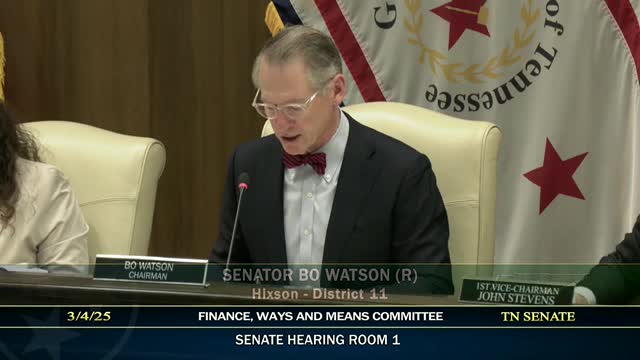
The Senate Finance, Ways and Means Committee voted 10-0 March 4 to recommend Senate Bill 207, a one-time $25 million appropriation to create a farmland preservation fund administered by the Department of Agriculture to support voluntary conservation easements.
The Senate Finance, Ways and Means Committee on March 4 recommended passage of Senate Bill 207, approving a one-time $25,000,000 appropriation to create a farmland preservation fund aimed at helping landowners place voluntary conservation easements on farmland and forestland.
Sponsor Senator Johnson said the program would be administered by the Tennessee Department of Agriculture and that the money is included in the governor’s budget. "Senate bill 207 would establish the farmland preservation fund to help combat the loss of farmland and forestland in Tennessee. The governor has appropriated $25,000,000 in the budget, which would be used to fund grants, to encourage conservation easements on farmland and forestland across the state," Johnson said.
The bill’s supporters told the committee the measure is voluntary and meant to assist family farmers for whom conservation easements are not otherwise economically feasible. Johnson and co-sponsor Senator Yeager cited state land-loss figures during debate: the committee heard that Tennessee lost roughly 1,100,000 acres to development between 1997 and 2017 and an additional 432,941 acres since 2017.
On process and administration, Johnson said the Department of Agriculture would have broad authority to adopt rules and determine how grants are awarded. "Each situation is so incredibly unique," he said, describing factors such as parcel size and easement valuation that will affect awards. Committee members were told those department rules would be subject to the legislature’s oversight process through the Government Operations Committee.
Committee members also asked whether an easement prevents a landowner from selling property. Johnson clarified that owners may sell land subject to an easement but the easement’s restrictions travel with the property. "This does not in any way prohibit a land owner who enters into one of these conservation easements from selling their land. They can," he said. The sponsor also gave an example of an easement that allowed one home per 100 acres as an illustration of how owners can tailor restrictions.
Senator Yarbrough asked how the program will prioritize parcels that would not otherwise be preserved. Johnson said the bill expresses legislative intent to focus on easements that "might not otherwise happen because they're not economically viable," and said the department and stakeholders would monitor rulemaking and program outcomes.
The committee recorded a roll-call vote and the motion passed unanimously. The clerk reported 10 ayes and advised the calendar committee accordingly: "Senate bill 207 is recommended for passage to the committee on calendar." The bill moves forward with the $25,000,000 one-time appropriation and administration by the Department of Agriculture.
This measure would create a permanent easement mechanism (the easement itself runs in perpetuity unless the specific easement language allows limits). The appropriation is a one-time allocation in the governor’s budget; any future funding would require action by a later General Assembly.