Get Full Government Meeting Transcripts, Videos, & Alerts Forever!
Get email alerts on the Family Law Child Support Custody topic
No spam. Unsubscribe anytime.
Appeals court reviews contested divorce judgment: child support, transportation and incorporation of partial agreement at issue
Summary
In the custody and divorce appeal Hardy v. Rondeh, the court heard disputes over whether a partial agreement was incorporated into the final judgment, child‑support calculations (including treatment of a fifth child), and transportation and parental‑time arrangements.
The Appeals Court heard argument in a contested divorce and custody appeal focused on child support, a partial divorce agreement, and parenting‑time logistics.
Appellant Cassidy Hardy argued the trial judge adopted post‑trial submissions and raised child support from an earlier temporary $309/week to about $389/week without adequate notice or opportunity to respond; she also challenged changes the judge made to a partial stipulation the parties expected would be incorporated intact. The appellee (father) and the trial court, by contrast, said the court applied incomes listed on the parties’ financial statements to the child‑support guidelines and that the partial agreement could be altered by a subsequent order.
Why it matters: The appeal raises procedural questions about the finality and modification of partial agreements submitted before a final judgment, the proper calculation of guideline child support when additional children are born, and the degree of specificity a court must provide when adopting or modifying stipulations resolving parenting logistics.
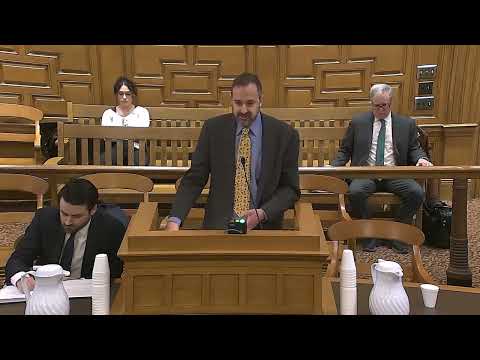
Appellant’s arguments: Brian Heenahan, for Cassidy Hardy, said the trial court relied on a post‑trial proposed judgment and adopted terms that were not part of the evidence at trial. He noted the court raised support to $389 per week — more than 40% of the mother’s gross income according to his calculation — and altered transportation language so that the order said parents “generally” would provide transportation, a term he argued is too vague for enforcement. He also said the mother received limited trial time and that various motions were permitted or excluded inconsistently.
Appellee’s response: Jeffrey Pickering for the father said the judge expressly stated she would use the incomes listed on the parties’ financial statements to calculate support and deviated only modestly (the judge set $389/week rather than $391/week). Pickering argued the guidelines do not require decreasing support because of a subsequent family obligation, that the partial stipulation explicitly allowed modification by order or judgment, and that the trial court has broad discretion over trial length and evidentiary rulings.
Court questions and context: Justices pressed counsel on whether a partial agreement had been entered as a judgment before the final judgment, whether the judge gave reasons for the small downward deviation in the guideline calculation, and whether the parties had submitted competing proposed findings in accordance with the court’s scheduling instructions. The court also queried whether transportation and parenting contact schedules were reasonable given the parties’ respective home locations and existing parenting‑time allocations.
Clarifying details in argument: Counsel disputed the timing and content of proposed findings and post‑trial filings; dates cited included the earlier 2020 temporary support order (January 16, 2020), proposed financial filings in August 2023, and a partial judgment/settlement submissions in January–December 2023. The trial judge’s final findings were longer than the father’s proposed findings and the judge reduced the guideline amount by a small margin; the parties also disagreed about whether the mother timely sought additional trial time or moved for modifications prior to judgment.
Ending: The court took argument and asked procedural and evidentiary questions; no ruling was issued from the bench.