Get Full Government Meeting Transcripts, Videos, & Alerts Forever!
Get email alerts on the Criminal Appeals Joint Venture Assault topic
No spam. Unsubscribe anytime.
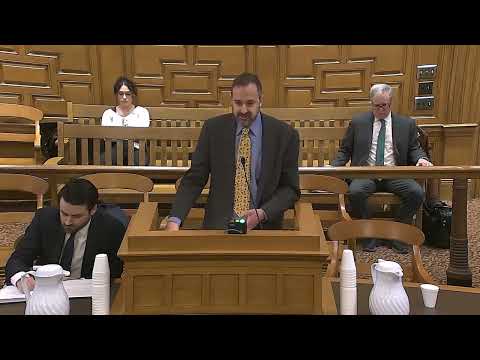
Appeals court hears arguments in Springfield bar‑fight prosecutions involving off‑duty officers
Summary
At oral argument the court heard contrasting accounts over whether evidence supported joint‑venture assault convictions and whether training and post‑incident reporting were properly admitted at trial in Commonwealth v. Cicero and Commonwealth v. Billingsley.
The Massachusetts Appeals Court heard argument in two consolidated criminal appeals stemming from a late‑night altercation outside a Springfield bar in which four victims were severely injured.
The defendants, former off‑duty officers Christian Cicero and Daniel Billingsley, argued that the evidence was insufficient to support convictions based on a joint‑venture theory and that the trial court erred in admitting testimony about officer training and post‑incident efforts to report the assaults. The commonwealth said the record — including video, testimony that 10–15 men converged on four victims, and injuries including a broken leg and skull fracture — was sufficient for a jury to find shared intent and to reject self‑defense claims.
Why it matters: The appeals center on how courts should assess inferred group intent when many participants are present and on the limits of admitting evidence about a defendant’s training and subsequent reporting to police. A decision could clarify how appellate courts treat joint‑venture inferences and the admissibility of training and post‑incident conduct in cases involving law‑enforcement personnel.
Arguments for defense: Christopher DeMeo, counsel for Christian Cicero, told the panel the surveillance and witness testimony left open “other options for how it could have ended,” and emphasized that no witness had seen Cicero strike anyone. DeMeo urged that mere presence and a contemporaneous walk outside did not allow a jury to infer the shared intent required for joint‑venture assault. He also argued the trial court improperly allowed testimony about a complaining witness’s repeated trips to police and overextended evidence of officer self‑defense training, calling it prejudicial and of marginal probative value.
Commonwealth response: Jared Cohen, arguing for the commonwealth, said the jury heard testimony that Cicero and Billingsley were among a group of off‑duty officers who left the bar and later confronted the victims on Island Pond Road, and that the Bank of America surveillance clip shows officers leaving the bar and the cab departing before the group confronted the victims. Cohen summarized trial evidence that one witness saw a person wave off the cab, that multiple officers converged on the victims, and that witnesses reported being told, “We’re not satisfied with what happened in the bar,” which the prosecutor described as linking the street encounter to the earlier bar altercation. Cohen also noted the severity of injuries, including a broken leg and skull fracture, to argue the force used was excessive and relevant to disproving self‑defense.
Issues about training and reporting: Counsel debated a contested evidentiary ruling on Sergeant VanZandt’s in‑service training testimony. Defense counsel argued the training evidence invited the jury to infer an improper duty to use those techniques and was confusing; the commonwealth said the judge gave a limiting instruction and the jury is presumed to follow it, and that training was relevant to whether force used was excessive. Defense counsel also contested testimony describing victims’ repeated attempts to report the incident to police as hearsay or impermissible bolstering; the commonwealth maintained the testimony described conduct (filing a complaint) and was probative when compared with defendants’ post‑incident conduct.
Factual disputes: Attorneys disagreed about who led and who escalated the confrontation. Witness Jeffrey Bienvenu testified some officers vocalized and verbally engaged the victims as they approached; victims testified they were attacked by a large group and identified individuals from the bar. Defense counsel emphasized inconsistent accounts and argued that where two plausible but conflicting versions exist, the commonwealth cannot sustain its burden on intent.
What the court asked: Justices pressed counsel on legal standards for sufficiency and for the jury’s use of training evidence, including whether training changes an objective reasonable‑person standard and whether subsequent reporting supports an inference of victimhood rather than fabrication.
Next steps: The panel asked clarifying questions and took the arguments. No decision was announced at argument.
Ending: Both sides told the court their positions and the matter was submitted for decision.