Get Full Government Meeting Transcripts, Videos, & Alerts Forever!
Get email alerts on the Microstamping topic
No spam. Unsubscribe anytime.
State lawmakers, experts debate microstamping rollout, funding and enforcement timelines
Summary
Legislators and technical witnesses at the Special Legislative Commission on Emerging Firearm Technology reviewed microstamping laws in California and New York, discussed implementation timelines, agency funding and criminal penalties for tampering, and described forensic and trafficking data benefits for law enforcement.
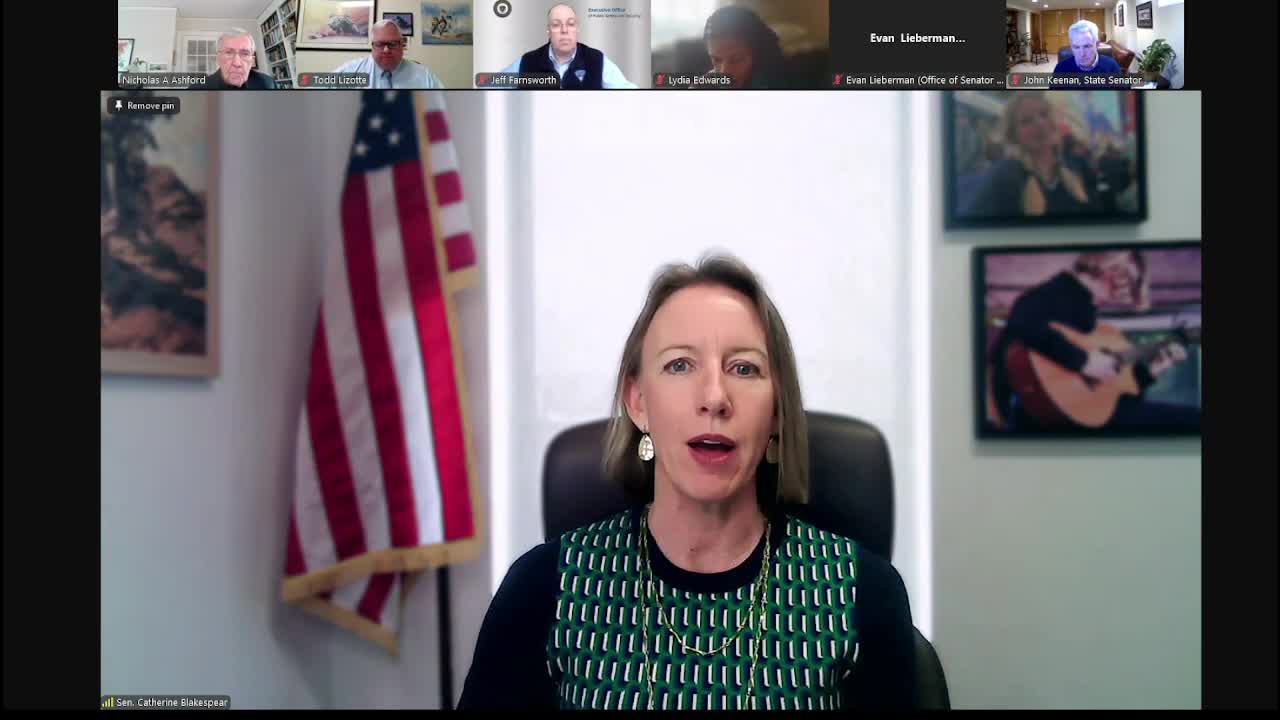
California State Senator Catherine Blakesphere and New York legislative staffers told members of the Special Legislative Commission on Emerging Firearm Technology that states adopting microstamping laws face implementation hurdles that include agency funding, technical standards and enforcement timelines.
Blakesphere, the author of California’s SB 452, said California moved from a manufacturer-focused mandate to a point-of-sale approach and is “on time to start enforcing that law starting January 1 of 2028,” but that the state Department of Justice must secure budgeted grants and set production standards before enforcement begins. “There can be less of a focus on the need to make sure that that money is there,” she said.
The senator framed microstamping as a law-enforcement tool to link spent casings to firearms and said it could increase solvability rates for gun crimes. “We have a gun violence epidemic in this country that is preventable,” Blakesphere said. She cited statewide clearance rates she described for California—about 40% for gun crimes and 55% for homicides—and told the commission that peer-reviewed studies show microstamping codes on spent casings are “between about 68% and 90% legible.”
Evan Lieberman, assistant legislative director for New York State Senator Brad Hohman Siegel, summarized New York’s S.4116A and the staged implementation the law requires. He said the law tasked New York’s Division of Criminal Justice Services with certifying viability of the technology within 180 days, establishing performance standards and verification criteria within set timeframes, convening forensic experts, and, if viability is certified, phasing in criminal penalties. The New York law, Lieberman said, also required DCJS to develop training and licensing standards and designate an “engraver of last resort” to ensure compliance.
Lieberman told commissioners that New York’s implementation has proceeded more slowly than advocates expected but that the legislature provided additional funding in 2023 and DCJS issued a request for information to outside experts. He said the RFI is due April 17 and that DCJS has tentatively planned a public update by this summer. On penalties, Lieberman said modifying a microstamping-enabled pistol is a crime in New York: “The first offense is a class B misdemeanor, and the second offense or subsequent offense is a class A misdemeanor.”
A technical witness who identified himself as a long-time developer of microstamping and related marking technologies told the commission that implementation is technically feasible and need not require heavy new infrastructure in forensic labs. He described how imaging a cartridge can reveal marks and said the marking and database practices are analogous to serialization used in other manufactured goods. “I can show you a cartridge…and see it. It’s clear as day,” the witness said, adding that per-unit costs fall as production scales.
Commission members pressed witnesses about broader uses of microstamping data, including whether it could inform investigations of suicide by firearm or reveal trafficking patterns. A commissioner asked whether microstamping could help trace firearms when guns themselves are absent from a scene; witnesses said cartridge-level data can generate temporal and spatial patterns useful to identify reuse, trafficking routes and hotspots, though they cautioned such benefits depend on consistent data collection, interagency sharing and sustained funding.
Panelists emphasized several implementation constraints: the need for agency-administered verification and licensing, grants or other funding for private manufacturers to produce components, and penalties for intentional tampering. Both the California and New York presenters urged close collaboration among lawmakers, forensic agencies and advocates to set performance standards and allow an orderly phase-in of verification and enforcement.
The commission did not take a formal vote on policy in the session excerpted here; the discussion focused on implementation design, funding and enforcement questions for states that have passed or are considering microstamping requirements. Commission members asked for additional briefings and technical demonstrations to inform future recommendations.