Get Full Government Meeting Transcripts, Videos, & Alerts Forever!
Get email alerts on the School Facilities topic
No spam. Unsubscribe anytime.
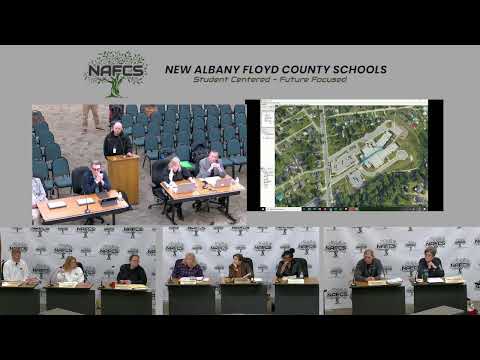
Schmidt Associates presents district-wide facilities assessment; board hears priorities, demographic outlook
Summary
Schmidt Associates presented a district-wide facilities assessment to the New Albany-Floyd County School Board on March 3, outlining building-condition scores, space-program needs and a draft list of prioritized projects; no decisions were made at the work session.
Schmidt Associates presented a district-wide facilities assessment to the New Albany-Floyd County School Board during a March 3 work session, walking board members through building-condition scores, space-program evaluations and a draft prioritized list of projects. No decisions were taken; the presentation was described as an assessment phase and a basis for future options and public input.
Kyle Miller, project manager for Schmidt Associates, said the study started more than a year earlier and included staff input sessions at each building, an engineering assessment (mechanical, electrical, plumbing), and a live programming database that models space, current enrollment and alternative configurations. He said the firm scored systems and spaces on 0-to-4 scales to identify urgent items and longer-term needs.
Superintendent Dr. Madison emphasized the process orientation of the evening: "no decisions have been made. This is going to be a process," he told the board. Schmidt's presentation covered condition scores (building envelopes, interior finishes, mechanical/electrical/plumbing, technology and site), utilization and programming (classroom sizes, cafeteria and gym capacity, special education and support spaces), and a prioritized cost summary with assumed inflation for multi-year planning.
Key findings and figures presented in the work session (as described by Schmidt and district staff):
- Demographics: Consultant Susan Brudnick————————'s demographic study projects a net decline of about 204 students over 10 years, with total district enrollment declining to about 10,785 in that period (from a recent high above 11,000). The consultants noted that local residential construction alone is not expected to drive enrollment growth large enough to require new schools.
- Condition and utilization: Across the district, older schools scored lower on building-systems condition (mechanical, electrical, plumbing) and in some cases on utilization or program efficiency. The transportation center and some older elementary schools (examples discussed: Georgetown, Grant Line, Floyd's Knobs) scored relatively low for condition or space efficiency. Newer buildings such as Green Valley and Slate Run scored comparatively well.
- Priorities by category: Consultants highlighted roofing, mechanical systems (HVAC), electrical gear, plumbing, and accessibility/safety upgrades as frequent needs. Staff input frequently raised the need for additional student and staff restrooms, flexible pull-out/resource rooms for special education and interventions, improved welcome/secure entry points, additional playgrounds for certain grade configurations, and parking/traffic improvements at several sites.
- Cost and phasing: Schmidt provided a district-level cost rollup and described a method that applies an annual inflation factor (about 5% per year) to multi-year budgets; the report includes 22% soft-cost allowances (design, surveying, finance, construction manager fees) in project totals. The presentation included draft timing and priority columns showing which items the core group viewed as near-term (within about five years) versus longer-term.
Board members and staff asked a series of clarifying questions about how space needs were programmed, how the live database models enrollment and classroom size (consultants said they used 24 students per elementary classroom as a planning baseline and 18 for preschool in the model, with the ability to change those assumptions), and which parts of the report reflected staff input versus consultant assessment. The group agreed to return at a later date (board members discussed an additional work session March 31) for further review and to begin exploring options and potential financing approaches.
The consultants and district staff noted that some items on the priority list were already budgeted or planned (projects in the 2024 bond program and other capital projects), but other items would require matching funds, grant applications or voter-approved bonds; district staff noted the 2024 and proposed 2025 capital plans had been roughly sized at about $19 million each (the transcript indicates those planned geo-bond amounts were under discussion and, for 2025, paused pending state legislative developments). Schmidt and staff emphasized the assessment was a starting point to identify issues and invite deeper study and community input before the board would consider formal project approvals or bond proposals.
No formal board action was taken during the work session; district staff and Schmidt Associates will return with additional materials and potential option sets for board consideration at future meetings.
Ending
The presentation provided a data-driven basis to prioritize building repairs and programmatic space needs. Board members asked for supplementary details (site maps, developable acreage by campus, building age and renovation histories, and formal capacity calculations) to inform later decisions and potential community engagement around options and financing.