
Gaithersburg holds public hearing on opting out of county CCOC; council to keep record open
Get AI-powered insights, summaries, and transcripts
Sign Up Free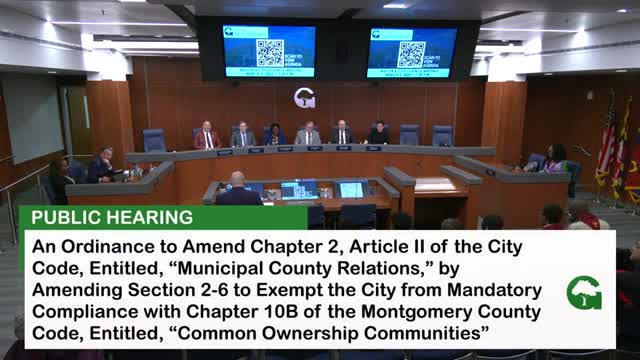
Summary
City staff presented a draft ordinance to remove Montgomery County Chapter 10B (the county CCOC) from the list of county laws applicable to Gaithersburg; residents urged the city to create an in‑house alternative and the council set a schedule for further review.
The Gaithersburg Mayor and City Council on March 3 conducted a public hearing on a proposed ordinance to remove Chapter 10B of the Montgomery County Code—the county Commission on Common Ownership Communities (CCOC)—from the list of county laws applicable to the city.
Assistant City Attorney Eric Perla summarized the draft ordinance and legal background, telling the council the draft would remove the county CCOC from the county laws the city currently applies and that residents would still be able to obtain county training services and use other county dispute-resolution resources such as the county conflict resolution center or file complaints with the Office of the Attorney General’s Division of Consumer Protection.
Perla reviewed state law questions raised at prior meetings and said the Homeowners Association Act (referenced in the meeting as section 11B-104) provides a limited carve-out permitting some counties to establish HOA commissions; he said condominium law (cited as Real Property Code §11-122) does not contain the same carve-out but that neither statutory text expressly prohibits a municipality from creating a local commission similar to the CCOC. Perla also noted that House Bill 306 and Senate Bill 866, currently pending in the General Assembly, would create a common ownership community unit within the Attorney General’s Division of Consumer Protection—if enacted, Perla said, that state unit could provide many services similar to the CCOC.
Two Kettlands residents testified in favor of the city establishing an in-house alternative to the county CCOC. Marsha Nass described repeated drainage and enforcement disputes with a homeowners association and said a city-level program “is desperately needed as a dispute mechanism where abuse of power can be properly addressed.” Deb Wenzel said she supports the city’s decision to opt out of the county program and thanked the council for listening to residents who have reported HOA abuses.
Staff recommended holding the public record open until 5 p.m. on March 17, 2025, with anticipated policy discussion on April 7 and final action on April 27, 2025. The council voted to hold the record open by voice vote; the motion carried unanimously.
Perla told council members he would track state legislation (HB306/SB866) and update the council if that legislation progressed in a way that affected the city’s options.
The council did not adopt a local CCOC or a municipal consumer protection code at the meeting; staff and council discussed the city’s authority to consider consumer-protection measures and the potential resource and staffing implications of creating a comprehensive municipal enforcement apparatus.