Get Full Government Meeting Transcripts, Videos, & Alerts Forever!
Get email alerts on the Cushing Park Splash Pad topic
No spam. Unsubscribe anytime.
Framingham parks staff outline Cushing Park splash pad design, safety and budget concerns
Summary
Parks and Recreation presented conceptual designs and operational trade-offs for a proposed splash pad at Cushing Park, seeking $500,000 from the Community Preservation Act fund to complement a $1 million FY26 city capital request; committee members pressed for clearer budget breakdowns, contingency language and public outreach plans.
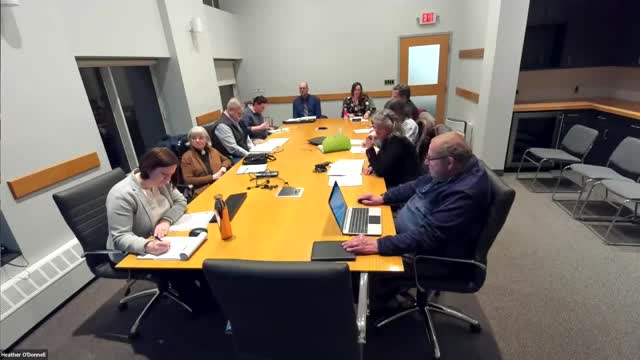
Framingham Parks and Recreation officials on March 3 presented conceptual designs, operational options and safety considerations for a proposed splash pad at Cushing Park and asked the Community Preservation Committee to consider $500,000 in CPA funding to complement a $1 million request in the city’s FY26 capital budget.
The presentation, led by Allison Elliott, deputy director of Parks, Recreation and Cultural Affairs, and introduced by Jim Snyder, the department’s director, described a design process now under way with CHA as the project designer and community outreach conducted in January. The parks staff said the project team aims to finalize design documents, then prepare construction bidding documents. Ashley Daniels Ramos, a Framingham resident who organized local interest and helped run a multilingual survey, is listed as a co-applicant for the project.
Why it matters: the committee must weigh a construction-scale request against public-health and operational trade-offs. Committee members pressed Parks and Recreation for clearer budget breakdowns, contingency language and operational commitments — including staffing and maintenance — before the committee’s upcoming public hearing and any formal funding decision.
Allison Elliott told the committee the team is studying two broad site options inside Cushing Park, described in the presentation as “location A” (near the Academy building and existing utilities) and “location B” (a flatter open area near the nursery). Elliott said the locations were picked in part because of proximity to parking, restrooms and existing utilities, which affect construction costs and utility routing.
The parks team described two broadly different system types: recirculating systems, which filter and reuse water and require chemical handling, additional equipment such as UV treatment in some jurisdictions, and continuous staff oversight; and spray-to-drain systems, which discharge water and may have lower mechanical complexity but different drainage and environmental impacts. Elliott said the first two splash pads the city installed use spray-to-drain, low-flow features to limit water use.
Elliott warned of health and operational trade-offs in recirculating systems, saying, “Between 2020 and 2023, three children died from a brain infection caused by germs encountered at a splash pad that were not properly disinfected.” She added that some jurisdictions (she cited New York State) require an additional ultraviolet treatment step for recirculating splash pads because lower water volumes reduce dilution compared with pools.
Parks staff presented water-use data from the Arlington Street splash pad: the feature ran about 100 days in its first season and averaged roughly 6,000 gallons per day over that period, for a season total under 650,000 gallons. Staff said actual operating hours and features (for example, large bucket dumps versus staggered spray patterns) significantly affect water consumption and staffing needs. Typical operating parameters discussed included seasonal operation from late spring to early fall and programmed hours (examples cited were 10 a.m. to 5 p.m. or 10 a.m. to 7 p.m.).
On finance, the parks presentation asked the committee for $500,000 in CPA funds “to complement” a mayoral recommendation of $1,000,000 in the city’s FY26 capital budget. Parks staff said the project team intends an overall construction budget in the neighborhood of $1,500,000, to include construction, oversight and contingency; the committee requested that the project resubmit its budget summary to make those funding splits explicit. Committee members repeatedly asked staff to show on the summary form how much of the CPA request would cover construction versus soft costs or contingency.
Committee member Karen pressed the parks team to “redo this for me because the form is not a budget summary form,” asking that the CPA request be listed explicitly and that the form reconcile the stated project budget, the designer’s project estimate and the contingency used in planning. Parks staff replied they would resubmit an aligned form and said the mayor’s recommended $1,000,000 still requires City Council appropriation, likely by July 1.
Members raised other operational considerations: supervision levels and staffing (several members urged that staffing is essential), restroom and changing access in the existing Academy building, whether effluent could be reused for irrigation (staff said reuse would require disinfection and effectively lead toward recirculating approaches), and drainage routing. Staff explained that options vary: some communities send splash-pad discharge to the sanitary sewer via a diverter when the feature runs, while others connect to storm drains or design on-site infiltration, and that local watershed protection (Parks staff named Beaver Dam Brook) affects choices.
The committee did not take a funding vote at the March 3 meeting. Members asked Parks and Recreation to: (1) resubmit the budget form to show the $500,000 CPA request alongside the $1,000,000 city capital request and to make contingency assumptions explicit, (2) propose contingency and permitting conditions similar to prior CPC-funded park projects, and (3) return with refined materials before the committee’s public hearing later this month. Parks staff said they could guarantee the department could spend $500,000 on construction work if the committee approved that allocation.
The presentation also noted next steps for outreach: a community feedback tool to be published online, targeted engagement with youth groups and PTOs, and additional community meetings tied to the conceptual designs. CHA, the selected designer, will use that feedback as the team moves from conceptual to final design.
Closing: committee members said they will discuss specific contingency language and funding conditions at the committee’s next meeting and include any finalized recommendations in the public hearing record. Parks staff left the committee with a commitment to return with a clarified budget summary and refined project materials.