Get Full Government Meeting Transcripts, Videos, & Alerts Forever!
Get email alerts on the Infrastructure topic
No spam. Unsubscribe anytime.
Council declines feasibility study to move Riverbank wastewater to North Valley Regional project
Summary
After debate, the Riverbank City Council chose not to authorize a feasibility study to evaluate building a pump station and pipeline to send Riverbank wastewater to the North Valley Regional Water Project. The proposal would have cost roughly $50,000–$75,000; Modesto had indicated conditional interest in taking Riverbank flow.
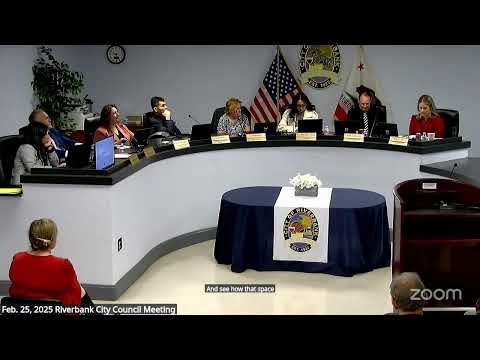
Vice Mayor Fosse proposed that the city commission a feasibility study to evaluate constructing a lift station and pipeline to send untreated wastewater to the North Valley Regional Water Project in Modesto as an alternative to Riverbank building its own recycled-water treatment expansion. The council declined to proceed with the study after extended discussion.
Fosse outlined three options she said were available: build the Riverbank regional recycled-water project (the current plan), construct a pump station and pipeline to convey untreated wastewater to Modesto’s North Valley regional facility, or change Riverbank’s discharge permit to allow more discharge to the Tuolumne River. Fosse said the project cost estimate for Riverbank’s in-town recycled water project has risen to around $120 million (from earlier estimates near $90 million), while she described North Valley’s facility as completed in 2018 at a cost under $20 million and able to handle far larger flows: "it moves 20,000,000 gallons per day," she said, compared with Riverbank’s planned 2.9 million gpd.
Fosse proposed a feasibility study costing roughly $50,000–$75,000, with Modesto agreeing to split the cost (reducing Riverbank’s share to an estimated $25,000–$37,500). She said Modesto had indicated willingness to accept Riverbank flow and that a study could confirm whether pipeline conveyance would be more economical and reduce rate impacts to Riverbank customers.
Supporters in the public and on the dais urged further study to compare alternatives and protect ratepayers. Opponents raised concerns that routing Riverbank wastewater to Modesto could drain local groundwater recharge (Riverbank’s current treated effluent recharges local basins) and place growth-control leverage in Modesto’s hands. Council members also noted significant prior investment: staff and consultants have already spent an estimated $5–6 million on design and grant application work for the in-town project (15%, 30% and 60% designs and program management); those design costs are reimbursable only if grants are secured, city staff said.
After debate, several council members said they were not prepared to pursue the feasibility study and expressed concern about the potential for losing local groundwater recharge and for future dependency on Modesto’s capacity. Council direction recorded at the meeting was not to progress with the feasibility study; there was no formal motion to fund the study.