Get Full Government Meeting Transcripts, Videos, & Alerts Forever!
Get email alerts on the Transportation Infrastructure topic
No spam. Unsubscribe anytime.
Kalamazoo delays major downtown two‑way conversions to 2026; city outlines construction, water‑main response and business outreach plans
Summary
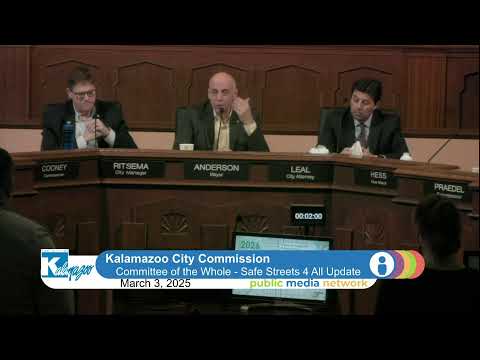
Kalamazoo City staff told the City Commission on March 3 that the downtown Streets for All two‑way conversion projects will be delayed roughly one year, with substantial construction now expected to begin in 2026 and continue through 2028.
Kalamazoo City staff told the City Commission on March 3 that the downtown Streets for All two‑way conversion projects will be delayed roughly one year, with substantial construction now expected to begin in 2026 and continue through 2028.
The delay stems from outstanding grant administration and contract work with state and federal partners, officials said. The projects — including West Main, Douglas, Kalamazoo Avenue, and later Michigan Avenue and the so‑called “Spaghetti Bowl”/Stadium Drive area — are federally funded under programs the city described as tied to the Bipartisan Infrastructure Law and other grants. Public Services Director James Baker and Deputy CPED Director Christina Anderson briefed commissioners and answered questions about schedules, community engagement and utility work tied to the streets program.
“Grant administration has taken a little bit longer than we anticipated,” Baker said, describing work needed between the city, the Michigan Department of Transportation and federal agencies before the city can put the projects out to bid. He said that for some grants the city is seeking an agreement that would allow Kalamazoo to administer and procure construction locally rather than have MDOT or another state agency administer the contract. Baker warned that bidding before those agreements are complete risks cost overruns or incomplete projects.
Staff outlined a revised multi‑year sequence: the city will start as early as possible in 2026 with West Main and Douglas, then move to Kalamazoo Avenue (covering the Stewart neighborhood and downtown). Whatever is not finished in 2026 would be completed in 2027, and Michigan Avenue is planned as a two‑year project beginning in 2027 and finishing in 2028. The Stadium Drive/Spaghetti Bowl design work is slated for a design request for proposals later this year. Deputy Director Anderson said the city will issue roughly 70% design drawings for Michigan Avenue in summer 2025 and return to the public for additional comment before final construction documents.
The presentation tied several water‑system projects to the street schedule. Baker said the city will replace about 1,300 lead service lines in the Edison neighborhood over 2025–2026 and will perform a roughly 1.7‑mile pipe‑lining project in the Knollwood neighborhood to reduce disruptive dig‑and‑replace work. Baker said the city replaced more than eight miles of water main in 2024 and estimated there are about 50 miles remaining on the near‑term list. He gave the city’s current high‑level cost range for that remaining work as about $150 million to $300 million.
“In 2024 we had 68 main breaks,” Baker said. He added the city had already experienced more main breaks in the current year than that total, noting crews were responding to a high number of breaks and that the department had instituted overtime and an emergency street restoration contract to speed repairs and reopen roadways.
Commissioners pressed staff on mitigation for businesses that will face disruption during multi‑year construction. Commissioner Cody asked that staff re‑engage neighborhoods and businesses shortly before construction begins; Anderson said staff are coordinating with planning and economic development to time postcards, door‑knocking and neighborhood meetings relative to each project phase. Commissioner Hoffman renewed an earlier request for a mitigation fund for affected businesses; staff said the city cannot use tax dollars to directly benefit private businesses but is exploring alternative funding mechanisms and guidelines and will consider special budget requests for the coming years.
Several commissioners urged the city to work with philanthropic partners, community organizations and media to spotlight businesses and to organize activation events during construction. Staff said they meet regularly with public services, planning, economic development, communications, transit and utilities in pre‑construction coordination meetings and will increase that communication cadence during construction seasons.
Baker and Anderson described the planned traffic phasing: each completed street segment becomes a detour route for subsequent work, which informed the order of operations. The city emphasized small‑piece construction to limit disruption and to preserve access for residents and businesses.
Commissioners also asked about federal support and contracting. Staff said the city is working with the Federal Highway Administration on agreements and with MDOT; the funding and project goals remain aligned with the original grant awards and staff said they had no indication the projects were in jeopardy, but the contractual requirements remain incomplete.
A public commenter at the start of the meeting said she received a boil‑water advisory at her door in early February and that the city did not directly notify her when the advisory was lifted. “No one bothered to text me. No one bothered to call me. No one put a note on my door,” the resident said, adding the incident imposed financial costs for bottled water and energy to boil water. Baker later said he would follow up with the commenter.
Votes at a glance: the meeting recorded one procedural motion. Commissioner Hoffman moved to excuse Commissioner Decker; Commissioner Cooney supported the motion and it passed by voice vote with Commissioners Hoffman, Cooney, Bridal, Wilson, Vice Mayor Hess and Mayor Anderson voting yes; Commissioner Decker was absent.
Staff identified next steps including (1) finishing grant and contract work required to advertise bids, (2) returning design‑level drawings to the public (Michigan Avenue ~70% drawings in summer 2025), (3) continued coordination with economic development and communications on business outreach and pre‑construction notification, (4) pursuing alternative mitigation funding options and (5) continuing water‑system capital work including lead line replacement and targeted pipelining.
Commissioners scheduled follow‑up and said they will continue to press for robust pre‑construction outreach to avoid the business disruptions seen in prior projects. The commission’s Committee of the Whole adjourned to the regular business meeting set for 7 p.m.