Get Full Government Meeting Transcripts, Videos, & Alerts Forever!
Get email alerts on the Sign Variance topic
No spam. Unsubscribe anytime.
Board approves 3'8" height variance for Symbiosis sign at 617 Detroit Street over objections
Summary
The ZBA granted a 3‑foot‑8‑inch variance to allow a wall sign at 23 feet 8 inches on a building zoned C2B, overturning objections from some board members who said the tenant could comply by placing signage lower or over its entrance. Supporters cited building facade articulation and prior signs at the location.
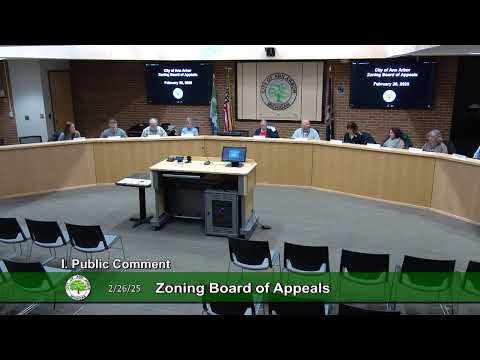
The Ann Arbor Zoning Board of Appeals on Feb. 26 approved a 3‑foot‑8‑inch variance to permit a wall sign for the tenant Symbiosis at 617 Detroit Street to be installed with its top at 23 feet 8 inches, above the 20‑foot maximum for wall signs on buildings under 45 feet, as specified in Table 5.24‑3.
City staff described the property as a C2B‑zoned parcel with a building erected in 1952 and an overall height of about 25 feet. John Barrett said the applicant proposed placing the sign on a façade plane that offers the most visibility to people crossing the adjacent bridge and that the proposed sign area fits the tenant’s allowed square‑footage for signage; the variance request concerns only height.
Scott McCauley of Phillips Sign and Lighting and Dan Cook representing Symbiosis urged the board to approve a modest variance, saying the facade contains horizontal trim and eyebrow details above the windows that constrain where a sign of legible size can be placed. McCauley noted similar signs existed on the façade prior to the 2019 ordinance change that set the 20‑foot rule.
Several board members opposed the request, saying the tenant had alternatives: place a sign lower on the same façade, place graphics over the primary entrance on Detroit Street, or split signage across facades without exceeding allowed area. "Every business wants as big a sign as they can possibly get," board member Patty Leskowsky said; she and at least one other member voted against the variance.
Board members who supported the variance pointed to the building's articulation — protruding trim bands and what one member called "eyebrows" above the windows — and argued those elements make it difficult to place a legible sign entirely beneath the 20‑foot band. The motion carried with seven votes in favor and two opposed (Todd Grama and a fellow board member recorded as "DeVardi" in the minutes). The board read the motion into the record and directed installation per submitted plans.
Why it matters: The decision illustrates how the 2019 sign ordinance's height limit is being applied to older downtown facades and shows the board balancing design constraints and consistency with the code. Board members urged applicants to consider alternative compliant placements before seeking variances.