Get Full Government Meeting Transcripts, Videos, & Alerts Forever!
Get email alerts on the Municipalization topic
No spam. Unsubscribe anytime.
Ann Arbor council rejects $1.73 million phase‑2 municipalization study vote
Summary
Council deadlocks on a professional services contract to study buying DTE assets after hours of public comment; related staff preparatory actions also failed.
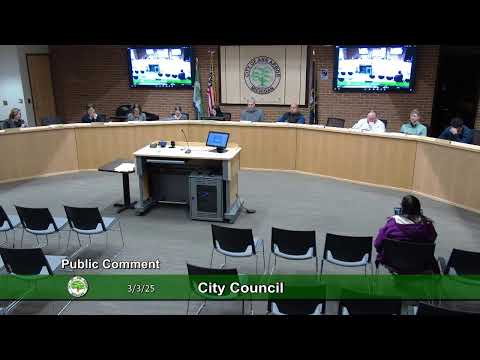
The Ann Arbor City Council voted down a proposal on March 3 to hire NewGen Strategies and Solutions LLC for a phase‑2 electric grid valuation and municipalization study, rejecting a $1,728,000 contract that would have advanced work on whether the city should acquire DTE Electric Company assets.
Supporters said the study was necessary to give residents independent information before considering municipalization. Milton Baker, a resident who spoke during public comment, urged council to “empower us with this information by voting for it tonight.” Several other residents — including Ella Edelstein, Mike Nowak and Isha Khan — urged the council to move forward, citing reliability, climate and equity concerns.
Opponents and some council members said the city’s current fiscal and political uncertainty made a large new allocation imprudent. Council members who voted no raised concerns that acquiring DTE assets could cost hundreds of millions to more than a billion dollars and that litigation and system upgrades would add many years of cost and uncertainty.
The contract (DC1) was moved by Council Member Medina and seconded by Council Member Disch. After a roll‑call vote the tally was 5 yes, 5 no, and the motion failed. A separate companion measure (DC2) to authorize preparatory staff work to put an acquisition question before voters also failed later in the meeting.
Why it matters: supporters argued the city needs an independent valuation to decide a potential billion‑dollar choice about utility ownership and climate goals; opponents said the city should not commit significant general‑fund dollars while federal support and local social‑service budgets face new uncertainty.
Supporting details and context
City staff and council members referenced results from the earlier phase‑1 work, which provided a broad cost range for acquisition and noted substantial legal and regulatory uncertainty. Speakers cited the phase‑1 estimate range discussed at the meeting (approximately $281 million to $1.15 billion) and said a phase‑2 study would reduce that uncertainty. Council and staff described potential funding sources for the study discussed during earlier budget work: identified air‑rights revenue and $1,000,000 of unanticipated revenue previously set aside, leaving roughly $1.7 million asked for DC1.
Council debate split along two lines: those who said the study is an essential informational step before any voter question; and those who said current budget and federal policy uncertainty — including possible federal funding cuts affecting local social services and grants — make such an allocation risky now. Council members who supported the study emphasized public power’s potential to improve reliability, advance climate goals and allow local rate design; opponents emphasized unknown litigation cost and the risk of diverting funds from existing programs.
Votes and formal actions
- DC1 (professional services agreement with NewGen Strategies and Solutions LLC for $1,728,000) — mover: Council Member Medina; seconder: Council Member Disch; roll‑call vote 5 yes, 5 no; outcome: failed. - DC2 (authorize staff preliminary work to prepare for a voter acquisition question and litigation) — mover: Council Member Cornell; seconder: Council Member Disch; outcome: failed.
Discussion vs. decision
The record contains extensive public comment both supporting and opposing municipalization; staff and council described funding sources and prior budget actions. The council explicitly separated the discussion (public comments and policy arguments) from formal action (roll‑call votes), and both companion motions failed, leaving no formal direction to proceed with a municipal acquisition valuation study.
Ending
Because both motions failed, the council did not direct staff to proceed with a phase‑2 valuation or with preparatory work to put an acquisition question before voters. Council members and community advocates indicated the debate will continue in subsequent meetings and via potential citizen initiatives.