Get Full Government Meeting Transcripts, Videos, & Alerts Forever!
Get email alerts on the Public Comment Bwl Sustainability Ems topic
No spam. Unsubscribe anytime.
Residents urge action on Board of Water and Light bills, smart meters and sustainability; ambulance response debated
Summary
Public commenters pressed the Charter Commission on Board of Water and Light rate notices and smart‑meter impacts, urged creation of a sustainability office in the charter, and urged caution before requiring ambulance service in the charter. The commission scheduled discussion of BWL and sustainability language for its next meeting.
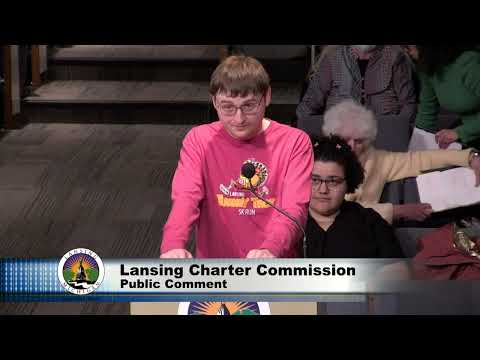
During public comment at the Feb. 18 Lansing Charter Commission meeting, residents raised affordability concerns tied to Board of Water and Light (BWL) billing, urged the commission to add a sustainability office to the charter, and urged caution about placing ambulance‑service requirements into the charter.
Tasha Canty, introduced during public comment, said she is “on the verge of losing my house” and reported owing $5,686.80. “I paid $9,600 this year in Board of Water and Light bills. I went hungry,” Canty said, asking the commission to consider protections for residents who cannot pay steep utility bills and to press BWL for more public engagement and longer notice before rate increases.
Linda Keefe said residents have reported sharp increases in utility bills after the city installed new smart meters, and she urged the commission to consider percentage‑of‑income payment plan (PIPP) models that exist in many states. “There are programs throughout the states... PIPP that might pay up to 6% of income for utilities,” Keefe said, and suggested the city and BWL work together on affordability measures.
Several speakers supported placing sustainability authority in the charter. Randy Dikeis (also introduced as Randy Dicus earlier in the meeting) urged a high‑visibility, independently authorized sustainability department or office, saying the city needs authority to pursue green building incentives, materials‑management changes and community solar for low‑income households.
Commenters and one speaker representing neighborhood groups urged the commission to address ward maps to ensure neighborhoods are not split. Multiple speakers said they had submitted maps and plans showing seven, eight or nine ward options.
On emergency medical response, Loretta Stanaway and other commenters cautioned against automatically writing an ambulance‑service mandate into the charter. Stanaway described work she has done with the fire chief exploring “medical taxis” — basic life‑support vehicles for frequent low‑acuity runs — and warned that a strict charter requirement that the Fire Department provide all ambulance services could block alternative models meant to free advanced resources for high‑priority calls.
The commission’s officer reports flagged that the Board of Water and Light and the Department of Sustainability language are scheduled for discussion at the commission’s March 11 meeting. Commissioners and staff said they would bring correspondence, maps and related materials to that meeting.
Key points from public comment and commission schedule: - Resident testimony about utility hardship, including a specific unpaid balance cited as $5,686.80 and annual BWL spending cited at $9,600 by one speaker. - Residents reported concerns about smart meters and asked for PIPP‑style options and more public notice from BWL. - A citizen proposed adding a sustainability agency/office to the charter to secure visibility and authority for climate and materials‑management work. - A resident suggested exploring medical‑taxi models to limit low‑acuity ambulance runs; others warned against putting mandatory ambulance‑service language in the charter without considering operational impacts. - The commission scheduled discussion of BWL language and the Department of Sustainability for its March 11 meeting.