Get Full Government Meeting Transcripts, Videos, & Alerts Forever!
Get email alerts on the Zoning Hearing Officer And Amend Special Use Permits topic
No spam. Unsubscribe anytime.
Lee County planning commission recommends county board consider zoning hearing officer and adds oversight, term‑limit language
Summary
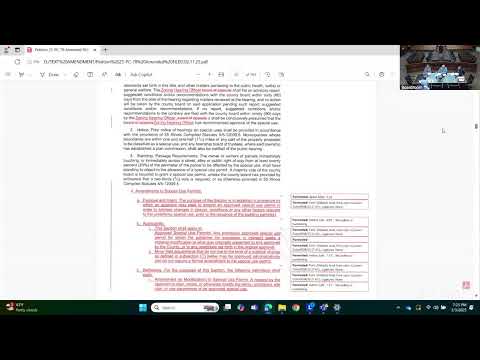
At a Lee County Regional Planning Commission meeting, members reviewed petition 25 PC 78, a text amendment from the Lee County Zoning Administrator that would replace references to the Zoning Board of Appeals with a zoning hearing officer and add a procedure for amending approved special use permits.
At a Lee County Regional Planning Commission meeting, members reviewed petition 25 PC 78, a text amendment from the Lee County Zoning Administrator that would replace references to the Zoning Board of Appeals in the county's Title 10 zoning code with a newly created position, the zoning hearing officer, and add a procedure for amending previously approved special use permits.
The proposal would authorize the county board to appoint an attorney-licensed zoning hearing officer under 55 ILCS 5/5-12015, give that officer the powers formerly assigned to the Zoning Board of Appeals, and remove the existing quorum requirement for hearings. The draft also creates a two-track amendment process for special use permits: minor field adjustments that can be decided administratively and major amendments that require notice and a public hearing before the county board. The zoning administrator said amendments must be sought after county board approval of the original special use but before issuance of a building permit.
The change aims to address conflicts of interest and perceived bias that the zoning administrator said have arisen in a small community. "By adopting a zoning hearing officer who would be a licensed attorney who's licensed to practice in the state of Illinois, we're hoping that it'll bring a more black and white process, where we're taking away the perceived conflicts or conflicts of interest," Alice Henkel, identified in the meeting as the petitioner and sworn for testimony, said. Henkel also said counties face increased litigation and complexity in zoning matters, particularly around wind and solar projects, and that an attorney could better read and apply the law.
Under the draft language presented, the zoning hearing officer would be appointed on recommendation by a county board committee and confirmed by a majority of board members present and voting. Alternate hearing officers may be appointed to serve when the primary officer is unavailable. The draft references the state statute 55 ILCS 5/5-12015 as the authority for creating the county position.
The commission discussed how the amendment would treat changes to approved special use permits. Henkel described two classifications: material changes that substantially alter a project and minor field adjustments such as slight shifts in building placement, buffering or adjustments to landscaping. She said the zoning administrator would initially determine whether a requested amendment is minor or major; major amendments would follow the public hearing procedures and notification requirements spelled out in the draft. Henkel noted the draft carries forward a statutory "standing" provision that allows owners of parcels immediately touching or across the street from a project to force a supermajority (three-quarters) county board vote on an amended special use permit.
Commissioners and members of the public asked about oversight, removal and term limits for a single appointed hearing officer, cost and public participation. Henkel said the county has tried to model compensation to fit within the current Zoning Board of Appeals budget and discussed options such as per diem or salary. She said the county plans to keep Judge Slavin and attorney Tim Zollinger available as hearing facilitators for large wind and solar petitions; statutory rules require petitioners to pay those fees directly in those cases. Henkel also said the draft removes the separate zoning compliance officer title from the code to clarify overlapping duties between compliance and administration.
Several commissioners raised concerns that replacing a five-member citizen board with a single hearing officer would reduce the diversity of perspectives and local knowledge on the decision-making body. Commissioners asked how public testimony and cross-examination would be preserved; Henkel said hearing procedures and public participation would remain similar and that the zoning administrator would work with the hearing officer on sensitive cases. Commissioners also pressed for a clear removal process and explicit term or review mechanisms for appointed hearing officers, noting the draft as presented did not include term limits.
After discussion, a commissioner moved that the commission recommend the county board consider the text amendment but that the county board incorporate language establishing (1) a removal process and retention/review hearings, (2) the possibility of term limits or other periodic review, and (3) oversight of the hearing officer's rules and procedures to ensure compliance. The motion was seconded and the commission voted in favor; the chair declared the motion carried and the recommendation will be forwarded to the county board.
The commission also approved minutes from previous meetings and adjourned. No member of the public presented evidence in the meeting record for this petition.
What remains unspecified in the record: the meeting date and the count of votes by name on the final recommendation; the draft's exact removal or term-language text (commissioners asked that language be added), and any specific compensation agreement for a hearing officer. The commission noted it intends to forward its recommendation to the county board for final action and possible additional procedural language.