Get Full Government Meeting Transcripts, Videos, & Alerts Forever!
Get email alerts on the Nonacademic Skills topic
No spam. Unsubscribe anytime.
Jamestown schools advance pilots to report nonacademic skills; board approves goal for Leadership for Learning
Summary
Jamestown Public Schools on March 3 outlined staggered pilots to measure nonacademic skills—elementary, middle and high school will use different tools and measures—and the board approved Strategic Focus 2, Goal 2 to continue progress monitoring.
Jamestown staff told the board on March 3 that the district is in the early stages of piloting ways to measure and report nonacademic skills—sometimes called life skills or career-ready practices—across elementary, middle and high school levels.
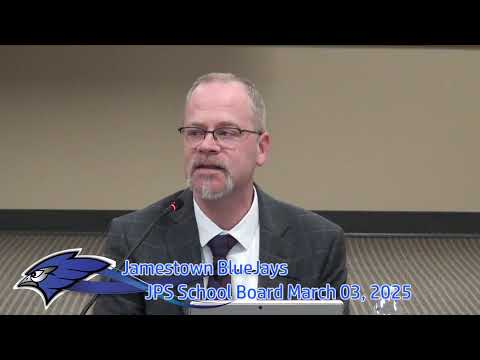
Mr. Gaylor, presenting for the district, said the work ties directly to the district’s accreditation standards and strategic plan. “Our goal is really that we identify those nonacademic skills and then we find ways to effectively communicate them to students and parents,” he said.
At the elementary level the district selected Empower Learning as the collection and reporting platform but paused the midyear rollout after teacher feedback; an ELT subcommittee will revisit the design. At middle schools staff described a longstanding citizenship grade that includes pride in self, pride in others and pride in school and that the middle-school team is drafting a standards-based report card to mirror elementary expectations.
At the high school staff said CTE teachers have been giving feedback for years under a career-ready-practices framework. The district identified five critical career-ready areas—responsibility, technical skills, communication, problem solving and teamwork—derived from a broader state list. Staff said the high school is also piloting a mastery-record transcript platform (described by staff as a “Mastery Transcript” or Mastery Learning Record) that lets students submit evidence and instructors certify that evidence for things like senior capstone projects.
Mr. Gaylor stressed the work’s differentiation by level: elementary teams are reconsidering adding new life-skill labels where schoolwide respectful/responsible/safe expectations already exist; middle schools are formalizing existing citizenship feedback; and the high school is testing evidence-based reporting tied to career-ready practices and a mastery-record pilot led by Tony McIntyre.
Board member Jason Rohrer asked how behavioral expectations such as “arriving to class on time” would translate to a four-point proficiency scale; Mr. Gaylor said the district would build proficiency descriptors and that many of the state portrait and career-ready frameworks already use a four-point scale with “3” as the expected level and “4” indicating exceeding expectations.
The board voted to approve the district’s Strategic Focus 2, Leadership for Learning, Goal 2 (nonacademic skills progress monitoring). Board member Jamie Vare moved the motion; board member Dan Tweeden seconded. The motion passed on voice/roll call: “Aye” recorded by chair; no dissents were recorded.
Next steps listed by staff included continuing pilots at each level, collecting broader stakeholder (family and student) feedback, training for teachers on entering and certifying evidence in the chosen platforms, and refining reporting tools so parents and students can view nonacademic feedback alongside academic grades.