Get Full Government Meeting Transcripts, Videos, & Alerts Forever!
Get email alerts on the Education Tax Credit topic
No spam. Unsubscribe anytime.
Ways and Means advances package of tax and regulatory bills, including scholarship cap increase and vaping registry
Summary
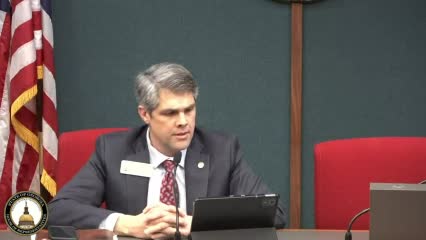
The Georgia House Ways and Means Committee moved several bills to full committee after debate and testimony, including a measure to raise the cap on scholarship tax credits to $140 million, a vaping-product registry bill, and measures on small-business health reimbursements and military income taxation.
The Georgia House Ways and Means Committee on a late-session day advanced a package of tax and regulatory bills, moving them to the full committee by voice votes after debate, public testimony and a handful of amendments.
The most substantial policy change approved on the floor was a revision to the state's scholarship tax-credit program that raises the cap on available credits from $120 million to $140 million and changes several program mechanics. Lawmakers also moved forward a vaping-product registry bill that drew lengthy public testimony from retail operators and law-enforcement officials, a small-employer individual coverage reimbursement proposal, a military pay exemption measure, and other local tax and historic-preservation items.
The scholarship credit bill (HB 328, substitute LC501172S) was presented as an update to existing scholarship tax-credit rules. Committee discussion recorded the bill would: increase the program cap from $120 million to $140 million; allow insurance companies to participate at higher total levels but at a smaller percentage of their policy taxes; clarify that corporate-level tax credits cannot be rolled over to the next corporate tax year; allow unfunded subscription amounts to be reapplied at 95 percent after July 1 of each year; and (as introduced) extend the funding deadline for subscriptions from 60 days to 120 days. During committee consideration, Chairman Newton successfully offered an amendment restoring the 60-day funding deadline. The bill advanced by voice vote.
Representative Buckner pressed for additional accountability around that and related voucher-style programs, noting the committee lacked uniform reporting on outcomes. "This may not be the time or place, but I just have to raise that because I feel like it's important for us to be fair to all," Buckner said, asking for future reporting on graduation rates and participation data. The transcript shows Buckner withdrew a formal amendment but recorded his request for more uniform reporting requirements.
The committee also advanced HB 577, a statewide registry and enforcement mechanism for nicotine-vapor products that would be administered by the Department of Revenue. Supporters said the registry is meant to help law enforcement and retailers identify products that have received federal review or are otherwise lawful; opponents from the retail sector warned the bill, as drafted, would effectively ban open (refillable) devices and some e-liquids used by adult smokers trying to quit. Retail owners Lisa Ganot and Susan Stetsman testified they feared loss of legal products and customers if open systems and many domestically manufactured liquids were excluded from a state registry. Ganot told the committee she would be forced to close her store if the bill removed open systems: "I'm asking you to vote no to this bill because you are making yet extremely difficult to the consumers, to the adults that we're trying to service," she said.
Law-enforcement representatives and some Republican members urged passage, saying that most illicit vaping products entering the state come from overseas and that a registry would help identify illegal imports and protect youth. David Jones, chief of staff for the Cobb County Sheriff's Office, told the committee the measure would give officers a tool to identify illegal products more quickly.
Other bills advanced included: - HB 7 (LC501191S): a $4,000 income tax credit for graduates of qualifying workforce-development programs who take high-tech jobs in rural communities (available up to three years). Reported favorably in subcommittee and passed by the full committee voice vote. - HB 341 (LC501189S): a small-employer individual coverage reimbursement measure for employers with 10 or fewer employees; the bill was described in committee as carrying a multi-year, capped appropriation and sunsets; the committee approved a technical amendment and advanced the measure. - HB 266: a measure to exempt active-duty military pay from state income tax for service members who want to claim Georgia residency; the committee advanced the bill by voice vote. - HB 526 (LC501200S): a permissive local property-tax abatement extension for income-producing historic commercial rehabilitation projects; the committee gave a due-pass recommendation. - HB 168 (LC500978): a requirement to add local delegations to the SPLOST (special-purpose local option sales tax) reapproval process; advanced to full committee. - HB 376 (LC501202S): an increase in a project cap from $30 million to $50 million and related technical changes discussed in subcommittee; advanced by the committee.
Where bills carried extensive public testimony (notably HB 577 on vaping), the committee recorded both business- and enforcement-side perspectives and indicated staff-level edits could follow before final consideration by the full committee. For bills that include funding caps or sunset dates, committee members asked staff to provide fiscal notes and to clarify how the programs would interact with federal programs.
The committee advanced all measures by voice vote; specific roll-call tallies were not recorded in the transcript excerpts provided to the committee clerk.
What's next: the bills will be scheduled for full Ways and Means consideration. Sponsors and committee members indicated they expect technical edits on some measures before final votes and that reporting or accountability language could be revisited in follow-up bills.