Get Full Government Meeting Transcripts, Videos, & Alerts Forever!
Get email alerts on the Agriculture topic
No spam. Unsubscribe anytime.
House passes bill protecting mobile sawmill operations on agricultural land
Summary
The House approved HB 413 to prohibit local ordinances that would ban mobile sawmills on agricultural land, a bill proponents said preserves property rights and supports rural economies and wildfire mitigation.
The Georgia House passed House Bill 413 on March 3, a measure that prohibits local governments from enacting ordinances that ban the operation of mobile sawmills on agricultural property.
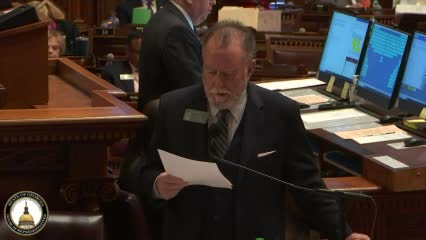
Representative David Jenkins presented the bill as a measure to protect farmers and landowners, arguing that mobile sawmills support rural economies, reduce waste, and can help remove fuel that might otherwise contribute to wildfires. Jenkins said the bill did not remove zoning authority from local governments; rather, it clarifies that operation of trailer- or mobile-mounted sawmills is an agricultural practice when conducted on agricultural land.
During floor discussion lawmakers asked about local control, whether counties had actually adopted prohibitions, and whether associations such as the Association County Commissioners of Georgia (ACCG) and the Georgia Municipal Association (GMA) had taken positions. Jenkins said ACCG was informed and described GMA as having provided no input; he characterized both as neutral. Representative Jasmine Clark and others asked whether the bill was a preemption of local authority; the sponsor said local zoning remains intact and that changes primarily clarify state-level agricultural practice definitions and scale limits.
Supporters noted potential benefits for recovery after storms and the ability of small farms to process timber on-site, improving speed and reducing hauling costs. Opponents raised environmental questions about carbon release from processed wood and asked about scale and safety. The bill’s text specifically references trailer-mounted mills to distinguish from larger commercial operations.
The House ordered the previous question, adopted the committee substitute, and passed the bill. The clerk recorded the final vote as 162 yeas and 13 nays.