Get Full Government Meeting Transcripts, Videos, & Alerts Forever!
Get email alerts on the Wastewater Septic Conversion topic
No spam. Unsubscribe anytime.
Manatee utilities describe options and costs for Snead Island sewer connections; annexation remains a barrier
Summary
Manatee County utilities staff reviewed prior feasibility work on connecting Snead Island to public sewer, estimated high costs for under‑river piping, and said annexation discussions and funding obstacles have limited progress.
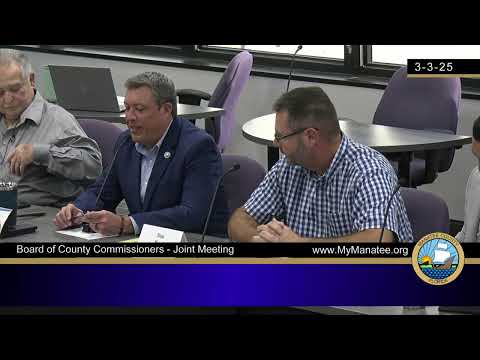
Patrick Shea, Manatee County utilities director, briefed the joint meeting on wastewater planning related to Snead Island and Palmetto on March 3 and outlined the utility‑scale costs and options county staff reviewed in 2019.
Shea said the county provides wholesale drinking water to the City of Palmetto and that the county is expanding its North Regional wastewater treatment plant with a programmed design estimated at about $255 million for an additional 5 million gallons per day of capacity. He said a 2019 county review of options for Snead Island — including direct connections or reassigning Palmetto customers to the county system — showed capital costs in the eight‑digit range to extend sewer under the river to the island, depending on alignment and construction choices.
Why it matters: Snead Island has a mix of septic systems and some areas with high water tables close to estuarine waters. County and city officials said they want to reduce septic‑system risks but face technical, cost and jurisdictional challenges.
Shea said one option would be to allow annexation into Palmetto so properties could connect to the city system; he said some Snead Island properties already did that. County and city officials said annexation has been proposed in some cases but many property owners have resisted annexation because of tax and identity considerations. Shea said converting the island away from septic would require substantial capital investment and local coordination, and that county staff remain open to coordinated, grant‑funded approaches to reduce septic‑related environmental risk.
Ending: Officials agreed to keep the topic on the partnership agenda and to pursue grant and interlocal options to address septic systems that threaten water quality while acknowledging annexation and funding remain barriers.