Get Full Government Meeting Transcripts, Videos, & Alerts Forever!
Get email alerts on the 90 Bellingham Road Chabad topic
No spam. Unsubscribe anytime.
Brookline ZBA continues hearing on proposed 23,000 sq ft Chabad at 90–100 Bellingham Road after extensive neighbor opposition
Summary
The Brookline Zoning Board of Appeals continued a contentious hearing on a proposed 23,000-square-foot Chabad at 90–100 Bellingham Road after hearing detailed presentations from the applicant and more than two dozen neighborhood speakers who raised traffic, privacy, stormwater and noise concerns.
The Town of Brookline Zoning Board of Appeals opened a multi-hour hearing on a proposal to build a new Chabad center at 90–100 Bellingham Road. Attorney Jeffrey Allen presented plans for what he said is a roughly 23,000-square-foot religious facility intended to house worship space, classrooms, administrative offices and ancillary program areas; the project drew extensive public comment and the board continued the matter to Thursday, March 6 for further submissions and deliberation.
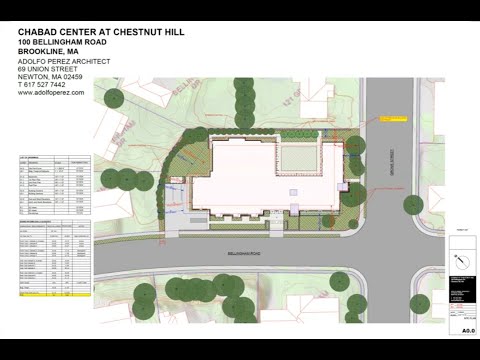
Allen told the board the proposal is protected under the Dover Amendment and cited case law and zoning-by-law provisions as the legal framework for the applicant’s request for relief. Architect Adolfo Perez reviewed the site plan and elevations, describing massing that includes a two-story sanctuary, a one-story classroom wing and a rear courtyard. Rabbi Mendi Omenur, who leads Chabad at Chestnut Hill, told the board the congregation has outgrown its current Bellingham Road house and seeks a permanent home to support worship, preschool, Sunday school and adult education.
The presentation included the applicant’s programmatic estimates and comparative figures: Allen said the proposed building would be about 23,000 square feet with a floor-area ratio (FAR) of roughly 0.82; he compared that to larger religious uses nearby, including Temple Emmett at about 54,245 square feet and a FAR of approximately 0.93. The applicant described operational plans including multiple classroom spaces, a social hall that can expand worship capacity on large holy days, and administrative staff to manage community programs. The project team said there is no parking requirement for religious uses under the Town of Brookline zoning bylaw (section 6.023.c), and that most congregants currently park on surrounding streets.
Board members asked detailed questions about program size, regular and peak attendance, pick-up and drop-off operations for preschool and Sunday school, and potential traffic and stormwater impacts. Rabbi Mendi estimated weekday morning services currently draw about 10–12 worshipers; Friday night services could be 20–40 people; Saturday morning services were described as about 100 attendees now with hopes of modest growth; high-holiday attendance has reached roughly 200 in rented space. The rabbi said about 30–35% of attendees walk to services, with the remainder driving.
Public comment continued for more than an hour. Dozens of abutters and neighbors described concerns about the building’s massing, shadowing, privacy impacts (bedrooms and decks facing classrooms and courtyard windows), the location of a proposed playground near backyards, expanded impervious surface and stormwater risks (some speakers said the neighborhood overlies aquifers and that many homes are on ledge), and the effect of increased cars on Grove and Bellingham streets. Several commenters urged a traffic study, an environmental/drainage review, changes to building massing or a smaller program, and mechanisms to ensure promises would be enforced if the project proceeds.
Attorney Robert (Rob) Levy, representing several abutters, told the board his clients were not opposed to a religious use per se but urged enforcement of “reasonable regulations” permitted under Dover to preserve neighborhood character and safety. Multiple residents provided first-hand accounts, including one neighbor who said: “My bedroom window will be directly in line with giant windows for children's classrooms.” Several others recounted recent vehicle accidents near the Grove/Bellingham intersection and asked that the board require traffic analysis before allowing additional density.
Town counsel Jonathan Simpson (attorney) guided the board on legal boundaries under Dover and related case law. He advised that while the board may require reasonable regulations tied to municipal purposes (for example, public safety), it should be cautious about imposing conditions that would effectively regulate the religious use itself. Simpson said the zoning board could request information but that requiring a traffic study in the absence of an applicable parking regulation would be legally questionable; he also advised that stormwater and other non-zoning general bylaw requirements remain applicable and would continue to be enforced by the town’s engineering and building departments.
At the end of the evening the board did not take any final action. The ZBA asked the applicant to supply a more granular, room-by-room justification for the program (how many classrooms, expected attendance per room and typical schedules), mapping that shows nearby religious institutions and their footprints for comparison, and to clarify operational details (drop-off/pick-up plans, whether any offsite/satellite parking would be used for major holy days). The board asked planning and building staff to report back on whether mechanical/elevator overrun elements are exempt from the measured building height under section 5.31 of the zoning bylaw. Attorney Allen affirmed on the record that the applicant would agree to a condition that “none of the uses will ever be available to third parties,” and the hearing was continued to March 6.
The record of the hearing includes dozens of written comments that the board said it had reviewed, a large public turnout (about 79 people on the Zoom call), and a substantial set of neighborhood concerns the board said it will take into account when it resumes the hearing.