Get Full Government Meeting Transcripts, Videos, & Alerts Forever!
Get email alerts on the Impaired Driving Task Force topic
No spam. Unsubscribe anytime.
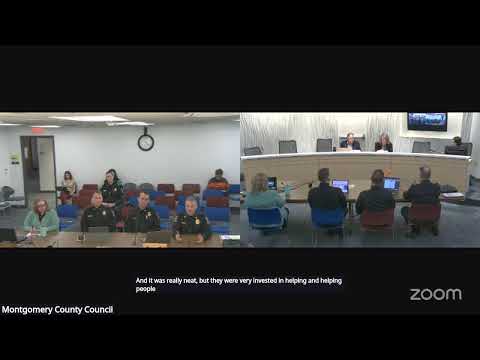
Police brief council on holiday DUI task force, enforcement gaps and polysubstance challenges
Summary
Montgomery County Police briefed the County Council March 3, 2025, on the department’s holiday alcohol task force, trends in impaired driving and traffic fatalities, and enforcement challenges around polysubstance impairment and evidence in court.
Montgomery County Police briefed the County Council March 3, 2025, on the department’s holiday alcohol task force, trends in impaired driving and traffic fatalities, and enforcement challenges around polysubstance impairment and evidence in court.
“Over the years, you know, you've seen our numbers. They've they've unfortunately dropped off a little bit from where we were, several years ago,” Assistant Chief Dave McBain said, describing a multi‑factor decline in DUI enforcement that the department attributes in part to staffing shortages and training gaps during the COVID period. McBain said the department has been reintroducing advanced training and a renewal of standardized field sobriety testing to improve officers’ readiness.
The holiday task force — typically run in November and December with Montgomery County officers augmented by allied agencies — focuses on DUI and DUID detection. Montgomery County officials reported that the task force produced “very good” numbers this year, exceeding the prior year’s results, and that historically the unit aims for roughly “280 to 300” arrests during a task force period when resources are concentrated.
Police described enforcement and programmatic steps the department is taking: expanded SFST refresher training, roll‑out of ARIDE (Advanced Roadside Impaired Driving Enforcement), targeted summertime task forces for high‑risk holidays, and use of drug recognition experts (DREs) for suspected drug impairment. A department speaker said, “we have about 18 in the county right now” referring to trained DREs, and noted that more DREs would reduce delays when evaluations are needed.
County police also described technical tools and limitations. Officers said that preliminary oral‑fluid roadside devices have been piloted and that oral‑fluid testing is a non‑evidentiary tool comparable to a preliminary breath test: useful for corroboration at the scene but not, by itself, admissible as evidence in court. The department described how blood testing by the Maryland State Police toxicology lab is used when an evidentiary specimen is required, and that an alcohol positive often ends further toxicology testing in practice because of laboratory resourcing.
Police and council members discussed state legislative developments and other countermeasures. McBain mentioned Senate Bill 292 (secondary traffic violations) and council members raised HB105, which would require ignition interlocks for first‑time DUI offenders; police said the Motor Vehicle Administration and the interlock program (MBA/MVA tracking) would be the likely source for data on interlock effectiveness.
Council members and police also discussed enforcement partnership with Alcoholic Beverage Services (ABS) compliance checks for underage service and the greater difficulty of proving overservice in court. Police said the county runs compliance checks with underage volunteers to identify license violations and that overservice investigations require plain‑clothes observations and cooperation that can be resource‑intensive.
On outcomes and metrics, police noted both decreases in traffic stops overall and spikes in impairment at fatal collisions in recent years; they emphasized the need to pair enforcement with education and prevention measures such as automated enforcement for pedestrian safety and public information campaigns. Council members asked staff to collect overlapping data sets (task‑force activity, collision locations and timing, DUI court outcomes, and interlock program statistics) to help evaluate interventions’ effectiveness.
The briefing closed with council direction to police and staff to return follow‑up data and to coordinate with state agencies and local partners on evaluation measures.