
Housing Opportunities Commission seeks county support for Elizabeth House demolition, Cider Mill repairs
Get AI-powered insights, summaries, and transcripts
Sign Up Free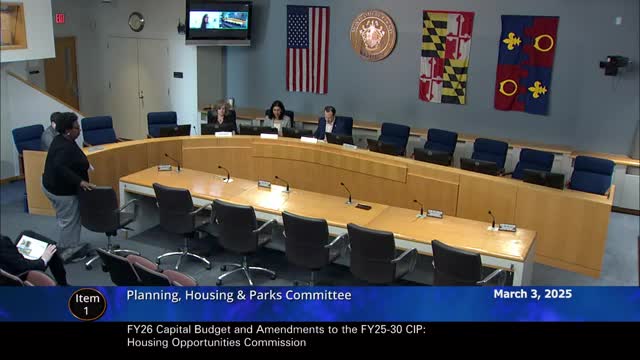
Summary
Housing Opportunities Commission officials briefed a Montgomery County Council committee on two capital requests tied to current‑revenue funding: $1.5 million for additional demolition and environmental remediation work at the former Elizabeth House site, and $2.3 million in FY25 for capital improvements and safety upgrades at the Cider Mill property.
Housing Opportunities Commission officials briefed a Montgomery County Council committee on two capital requests tied to current‑revenue funding: $1.5 million for additional demolition and environmental remediation work at the former Elizabeth House site, and $2.3 million in FY25 for capital improvements and security at the Cider Mill property.
Chelsea Andrews, president of the Housing Opportunities Commission, said the Elizabeth House demolition encountered "unexpected additional expenses related to environmental repairs or remediation" and that HOC has advanced the funds while discussions continue with the Department of General Services (DGS) on interim beautification and ADA improvements. "This is a hallmark site for the county and ensuring that we take care of it in an appropriate way is what we're seeking support on," Andrews said.
Why it matters: Committee staff told members the county executive did not issue an affirmative funding recommendation for these projects in the recommended amended FY25–30 capital improvements program (CIP), and council staff therefore recommends deferring formal action until the operating budget process. Anita Aite of the Office of Management and Budget explained that an initial $3 million previously provided for Elizabeth House was a shared cost: "The county paid half of the $3,000,000 and HOC is responsible for the other half," and said further details will be included in the March budget submission.
Details on the two projects: - Elizabeth House demolition: Andrews said Elizabeth House is a former public housing site whose residents were relocated. During demolition, HOC identified environmental issues that increased costs by about $1.5 million. HOC and DGS are discussing an interim approach for the cleared site that could include modest ADA improvements and landscaping rather than leaving it fenced and unused while longer‑term redevelopment is planned. HOC officials said the demolition project has no income stream and they are seeking county support to cover the additional remediation costs. - Cider Mill capital and safety work: Andrews said Cider Mill is HOC's largest property, with "over 860 residents." HOC reported more than $7 million in capital investment since acquiring the property and requested funding for security upgrades and repairs to unsafe balconies that have been partitioned off. "The balconies have to be partitioned off because they're not safe for any of our residents to stand on them," Andrews said, noting falling concrete and inspection risks.
Council response and next steps: Councilmember Luckey thanked HOC and said she supported the targeted requests, noting improved collaboration among district offices, HOC and police. Council staff and HOC agreed no committee action will be taken now; funding would be considered as part of the FY26 operating budget process, since the executive has deferred recommendation. HOC and OMB said they will continue coordination with DGS about cost-sharing and the interim use for the Elizabeth House site.
Context from HOC: Andrews also flagged broader fiscal pressures: roughly 45% of HOC's funding comes from federal sources tied to the voucher program, and HOC manages vouchers for more than 9,000 residents. She said national uncertainty at the U.S. Department of Housing and Urban Development (HUD) and construction‑cost trends are areas HOC is monitoring that could affect operations and capital needs.
No vote or formal committee action was taken; council staff recommended the items remain under consideration until the executive branch submits operating budget recommendations.