Planning Commission postpones decision on Barbat proposal for fueling station, convenience store and carryout at Crooks and South Boulevard
Loading...
Summary
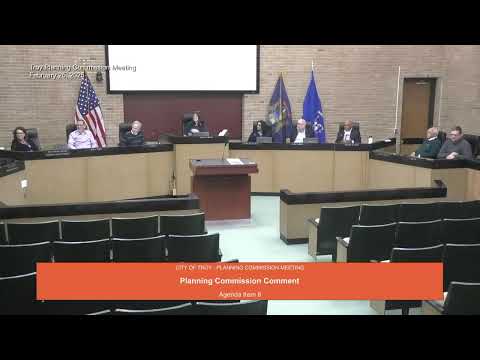
The City of Troy Planning Commission on Feb. 25 postponed a decision on a special-use application from the Barbat Organization to redevelop the former Rite Aid site at the southeast corner of Crooks Road and South Boulevard (1981 South Boulevard) into a convenience store with fuel pumps, a carryout restaurant and EV charging.
The City of Troy Planning Commission on Feb. 25 postponed a decision on a special-use application from the Barbat Organization to redevelop the former Rite Aid site at the southeast corner of Crooks Road and South Boulevard (1981 South Boulevard) into a convenience store with fuel pumps, a carryout restaurant and EV charging.
Ben Carlisle, senior planner for the City of Troy, told commissioners the property is in the Neighborhood Node zoning and that ‘‘vehicle fueling or automotive uses require special use approval in this district’’; staff’s review raised questions about a requested setback deviation along Crooks, a parking shortfall, the canopy design and the timing of the proposed restaurant.
The session matters because the site sits at a gateway intersection; Commissioners and nearby business owners said they wanted assurance the project would address traffic, pedestrian safety and the character of the corner.
The application would demolish the existing building and construct a 6,300-square-foot single-story building that would combine a convenience store, a takeout restaurant with a covered patio facing Crooks and a fueling canopy set toward the rear of the lot. Carlisle said the applicant proposes 51 parking spaces; the zoning ordinance calculation shows a requirement of 61 spaces for the combined uses. The project includes an initial set of EV chargers and infrastructure for more in the future.
Eric Williams, a civil engineer with Stonefield Engineering and the applicant’s representative, said the development team intends to install four EV charging stalls in the initial build and to run underground conduit so more chargers can be added later. ‘‘We don’t intend to install 16 EV spaces at this point,’’ Williams said. ‘‘The plan in front of you has 4 EV spaces that are just below the canopy. At this point in time, that is what we are committed to installing as a part of the first phase of construction.’’
Architect John Abro said the team will add the more detailed materials and extend the enhanced facade treatments across the building elevations, responding to staff’s request that the building present a stronger gateway appearance on South Boulevard as well as Crooks.
During the staff presentation, Carlisle noted specific code considerations: the Neighborhood Node master-plan guidance favors buildings pulled forward to create a pedestrian edge; vehicle fueling stations in section 6.28 of the zoning ordinance require that canopies match the primary building materials; and special-use approval should be measured against seven statutory standards, including compatibility with surrounding uses and public services. Carlisle recommended the commission require final canopy materials that match the building and that EV charging be installed as part of initial construction rather than delayed.
Commissioners and residents pressed the applicant about traffic, parking and safety. Several nearby business owners said they were worried about visibility to existing shops in the strip plaza directly east of the site and about delivery and fire-lane access during peak events at neighboring businesses. Commissioners also debated whether EV stalls should be counted as conventional parking: staff said the applicant counted pump stalls and EV stalls in the 51 total, but several commissioners said EV stalls are likely to be used differently than short-term parking in front of the convenience store.
Dwayne Barbat, co-owner of the Barbat Organization, described a family-run operation and said the company intends to operate the site locally; Barbat said the owners would consider a monument or gateway sign and commit to high standards of lighting and landscaping. Scott Scribe, who identified himself as a partner, said the team is finalizing a lease with a pizza tenant for the restaurant space and said the restaurant would open concurrently with the store and fueling operation.
Public commenters were split. Several residents and business owners asked the commission either to require access from Square Lake instead of Livernois or to ensure traffic mitigations (a bypass/turning lane and improved pedestrian crossings) if the Livernois access remains. The owner of a Shell station across the street and other small-business speakers said competition among gas retailers is normal and that the project could improve safety and site appearance compared with the existing empty building.
After discussion the commission voted to postpone action and asked the applicant for a focused set of follow-ups: a color photometric plan, final canopy and facade details that tie canopy materials to the main building, a clearer depiction of EV-charger infrastructure and counts, turning/vehicle-tracking diagrams showing fuel-truck and delivery-truck movements, and revised elevations that show the south (South Boulevard) and west (Crooks) facades with the enhanced materials requested by staff. The commission also asked staff to coordinate with Oakland County engineering on whether a southbound bypass or left-turn lane on Livernois is required.
The applicant agreed to supply the additional materials to city planning staff. Commissioners said they expect the applicant to revise the architectural detail and to clarify whether EV chargers will be installed during the first phase. The postponement gives staff time to review those materials before the application returns to the commission.
What’s next: the applicant will submit the requested photometric, turning-radius and canopy details to planning staff; if those items are resolved administratively the project could return for a final site plan action or a return public meeting as required by city practice.