Get Full Government Meeting Transcripts, Videos, & Alerts Forever!
Get email alerts on the Land Use topic
No spam. Unsubscribe anytime.
Residents press Escalon officials for traffic fixes and Bellaterra protections as Murphy Ranch proposal advances
Summary
At a public workshop, residents asked the Escalon City Council and Planning Commission to delay annexation or require traffic mitigation at the Highway 120 and Brennan Road intersection, and to ensure the proposed Murphy Ranch subdivision shares costs and benefits with the adjacent Bellaterra Landscape Lighting Maintenance District.
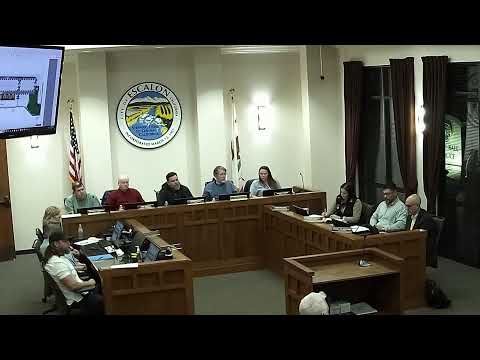
Escalon City officials heard an hour of public comment at a joint workshop on the proposed Murphy Ranch residential subdivision, with neighbors urging traffic safety improvements at the Highway 120 and Brennan Road intersection and protections for the Bellaterra Landscape Lighting Maintenance District before the project advances to formal review.
City planning staff told the assembled residents that the Murphy Ranch application is under staff review and that "this project is consistent with the city's general plan," but emphasized the workshop is an information-gathering step and not a decision meeting. The city manager said staff has recorded residents' questions and "will bring answers to these questions ... right before or as we get to the planning commission."
The concern that dominated public comment was safety at 120 and Brennan. Resident Natalie Gallegos cited the developer Florsheim Homes' traffic study (conducted April 18–June 1, 2023, on Tuesdays through Thursdays) and said the study itself shows the intersection currently "rates at an F during peak hours" and that under cumulative conditions "delay at the intersection ... would be so high that their system, Syncro, is incapable of accurately reporting the delay." Several speakers said the study's days and timing undercount weekday or weekend peak traffic and asked for a new, intersection-specific analysis.
Residents described recurring crashes and at least two recent deaths at or near the intersection and warned that the planned subdivision—one speaker said roughly 75 homes—would route hundreds more daily vehicle trips onto California Street and neighborhood streets. The Florsheim study was cited in public remarks as projecting between about 700 and 1,000 additional vehicle trips per day on California Street; residents asked the city to require mitigation or pause annexation until Caltrans completes safety work on Highway 120.
Speakers pressed several mitigation options: adding a turning lane or a traffic signal at 120 and Brennan, opening an alternate connection via Riesling to reduce cut-through traffic on California Street and Bellaterra, and ensuring any sound walls and other buffers protect adjacent homes from railroad and industrial noise. Kaylee Siegel, whose home backs to the proposed site, said, "I would like a single story behind my house," asking that developers or the city require single-story lots immediately adjacent to existing yards.
Bellaterra residents sought to protect the Bellaterra Landscape Lighting Maintenance District (LLMD), which they said currently pays $535 annually per parcel. Speakers said the district has had benefits reduced over time and argued Murphy Ranch should be added to the LLMD or otherwise pay proportionate ad valorem assessments because the new development would use district streets, parks and drainage features. Residents also said Shadowwood Park—paid by Bellaterra property owners—was proposed as a storm basin feature for Murphy Ranch and asked for clarity and compensation.
Other commenters urged balance: some said modest growth is needed to help the city budget and free up housing stock inside town; Sarah Myers, who identified herself as supportive of careful growth, told officials the Escalon Unified School District is not overcrowded and that tax revenue from new homes could help the district. Gabriela Vargas, speaking as a homeowner, urged the city to get a focused, updated traffic study isolating the 120/Brennan intersection rather than relying only on cumulative traffic models.
City staff provided procedural context: the parcel's low-density residential designation appears in the city's general plan adopted in February 2005, and in February 2020 the City Council adopted Resolution 4-20 directing staff to process two annexation applications (the Murphy Ranch site and a site associated with the Sarin Lutheran Church) notwithstanding a broader sewer moratorium. Staff also referenced the state's Permit Streamlining Act (1977) as a deadline-oriented framework for application processing. Staff repeatedly told residents that answers to many technical questions will be supplied as part of the planning commission packet.
No formal votes or decisions were taken at the workshop. City staff said the Murphy Ranch application will be brought forward for formal hearings at the planning commission and later the city council, at which point mitigation requirements, specific roadway improvements, the subdivision map and any development agreements would be subject to debate and formal action.
Officials and residents identified next steps: the city will compile written responses to questions and include them in the planning commission packet; residents requested that the city coordinate with Caltrans on safety upgrades for Highway 120 and consider alternative access plans, including reopening Riesling, limiting vehicle access to California Street, and requiring developer contributions to any intersection or neighborhood mitigation.
The workshop closed with staff noting that public comments will be incorporated into future staff reports and that the planning commission and city council will have the substantive deliberations and decision authority.