Get Full Government Meeting Transcripts, Videos, & Alerts Forever!
Get email alerts on the Council Rules topic
No spam. Unsubscribe anytime.
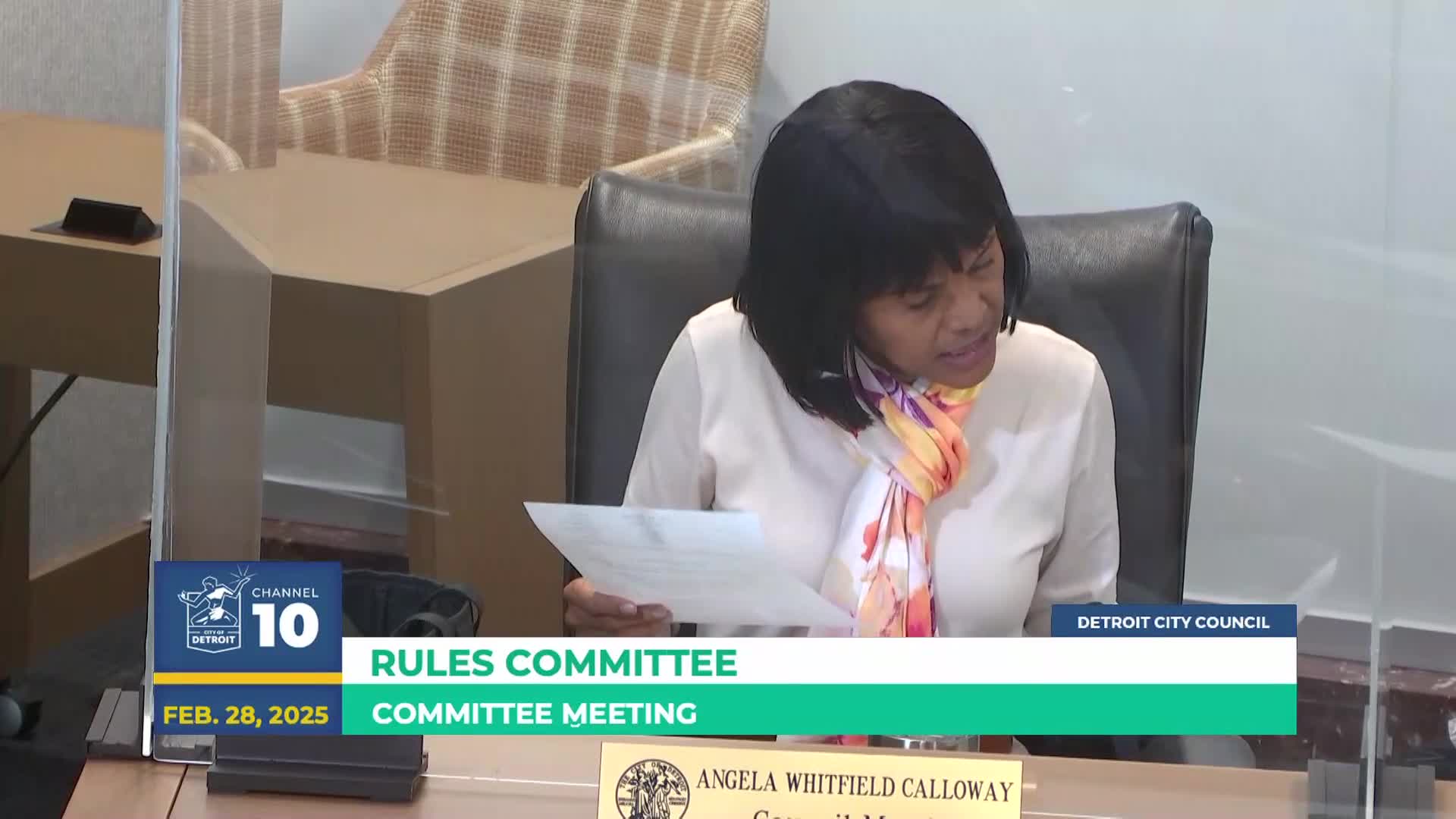
Rules Committee directs staff to draft language delaying waiver effect until end of meeting; agrees to revise testimonial and speaker rules
Summary
Members of the Detroit City Council Rules Committee voted to have Legislative Policy Division draft language to make approved waivers take effect at the end of a formal session instead of immediately, and authorized LPD to draft changes related to testimonial resolution signatures and requests to speak beyond standard public comment.
The Detroit City Council Rules Committee voted to direct Legislative Policy Division staff to draft rule language that would make approved waivers take effect only at the close of a formal session, rather than immediately after the body approves them.
The change was proposed to prevent the committee from being locked into votes when new information emerges during a meeting. Pro Tem James E. Tate Jr. moved the direction to staff; the committee approved the motion. Mr. Whitaker, who advised the committee on procedure, explained that currently "when the Council members requested a waiver be attached to an item, that waiver is attached to the item at the point the council, votes to have it attached. So once you have a waiver attached, there's no way to go back and change the results of that vote." He recommended letting the effect of waivers occur at the end of the meeting so members can correct votes if new information appears.
The committee also walked on two previously filed rule-change items from Pro Tem Tate and asked LPD to draft language on both: (1) requiring or clarifying signatures on testimonial resolutions and establishing a tracking/archive process for prior awards, and (2) tightening the process for petitioning to speak beyond the allotted public-comment time — including added guidance about requests from individuals or entities engaged in active litigation against the city. Dr. Powers told the committee that language addressing archives and other suggested amendments already exists in LPD's notes and that LPD is preparing a report with outstanding items to be presented before the next Rules Committee meeting.
Members debated details and implementation. Member Coleman Young II said he preferred the current system, adding, "I'm partial to the system we already have. I mean, I like the way it works. I like the way that you can request a waiver and then it'll be done. I just like the immediately." Pro Tem Tate and others argued the proposed change would allow the body to correct votes within the same meeting when new facts arise. On testimonial resolutions, Tate said some awards escalate in stature and he favored requiring members' explicit sign-off for the highest honors; others cautioned that requiring written signatures could slow timely recognitions, especially in urgent situations such as memorials.
LPD staff said their forthcoming report will show suggested edits in context and that any adopted rule changes will be subject to a public hearing before being finalized. Committee members discussed scheduling and indicated a preference to hold the next Rules Committee meeting in May, before the budget season, so amendments can proceed through the required public-hearing timeline.
Votes at a glance
- Motion to direct LPD to draft language making approved waivers take effect at the end of the formal session. Mover: Pro Tem James E. Tate Jr. Outcome: approved (no roll-call tally specified).
- Motion to walk on two previously filed rule-change items from Pro Tem Tate (testimonial-signature language; petition-to-speak procedure) and to assign LPD to draft or merge language for those items. Mover: Pro Tem James E. Tate Jr. Outcome: approved (Member Coleman Young II registered an objection regarding signatures; committee nonetheless directed LPD to prepare language).
Context and next steps
The actions are limited to drafting rule language; no final rule amendments were adopted at the meeting. LPD will prepare the drafted language and a report of outstanding suggested amendments; the committee expects to schedule a public hearing on the proposed rule changes ahead of final action, with timing discussed for a May meeting to avoid conflict with budget season.
Ending
Committee members emphasized that any formal changes to council rules will proceed through the standard public-notice and public-hearing process before becoming effective.