Get Full Government Meeting Transcripts, Videos, & Alerts Forever!
Get email alerts on the Truck Routes topic
No spam. Unsubscribe anytime.
Detroit residents, public health experts push council for semi‑truck routing and enforcement
Summary
Residents, health researchers and community groups told the Public Safety Committee that heavy truck traffic through residential streets is harming air quality, damaging homes and increasing traffic danger; presenters urged a city truck‑route ordinance, buffers and coordinated enforcement.
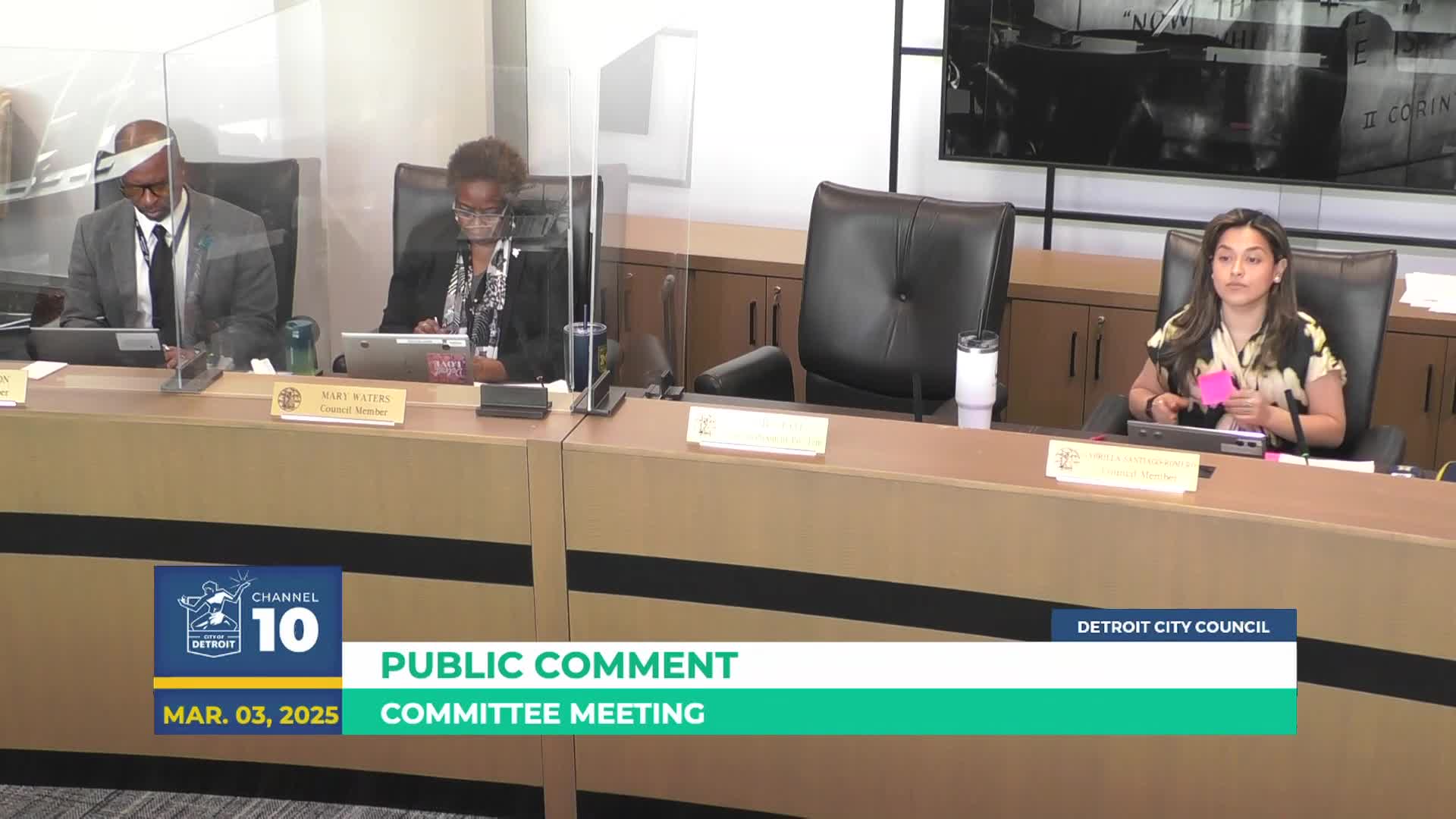
Residents, community advocates and public health researchers pressed the Detroit City Council’s Public Health and Safety Committee on March 19 to adopt a semi‑truck route ordinance and step up enforcement to remove large commercial trucks from residential streets.
The testimony focused on neighborhoods in Southwest and East Detroit where advocates said diesel truck traffic has caused noise, road damage, frequent crashes and elevated rates of asthma. ‘‘Residents across the city cannot afford any more time where we do not have protections from diesel truck traffic,’’ said Erin Stanley, senior director of environmental justice at Eastside Community Network.
Why it matters: Advocates said diesel emissions and road dust are linked to short‑ and long‑term health risks for children and older adults, and to property damage and roadway safety problems. University of Michigan and community monitoring cited during the meeting found elevated particulate matter and black carbon levels near industrial truck routes; presenters also cited a city truck study that counted about 1,000 semi trucks per day on Livernois Street, a narrow residential corridor.
What speakers said and asked: Simone Cygovac, a District 6 resident working with the Southwest Detroit Community Benefits Coalition, described decades of community monitoring and engagement and asked the council to pass a truck‑route ordinance this year. Roshan Harris, director of community power building and advocacy at Eastside Community Network, presented air‑monitoring data and asked for short‑term fixes as well as long‑term policy changes. Xavier Thomas, a senior at Southeastern High School, said pollution is ‘‘in our streets, our classroom, and our lungs’’ and called for accountability for facilities and trucking companies.
Community testimony tied health data to local experience. ‘‘My home is being torn up by the constant trucks,’’ said Thomasinia Weston, a Livernois resident of 24 years, who described foundation damage and multi‑generation asthma in her family. Laura Chavez, president and CEO of the Southwest Detroit Business Association, said trucks have damaged storefronts, disrupted business activity and eroded neighborhood walkability.
Public health context: Dr. Natalie Sampson, public health faculty at the University of Michigan‑Dearborn, summarized decades of epidemiological literature linking diesel exhaust to asthma, cardiovascular disease, adverse birth outcomes and cancer. Presenters cited local analyses showing that residents living within about 500 feet of truck corridors have higher asthma rates; community monitoring programs reported frequent PM2.5 exceedances and elevated black carbon ratios.
Calls for action: Residents and organizations asked the council to (1) enact a truck‑route ordinance that reroutes heavy trucks away from residential streets; (2) fund enforcement and training so city police can cite prohibited driving times and anti‑idling rules; (3) pursue buffers, trees and other landscape measures where appropriate; and (4) coordinate with state and county agencies and with private carriers to change industrial behavior.
Council response and next steps: Chair Gabriela Santiago Romero said the council is developing a truck‑route ordinance and intends to advance it this year. She asked city departments to compile regular health impact data so elected officials and residents can set funding and mitigation priorities. The committee agreed to continue engagement with community groups and to return to the topic in subsequent meetings.
Ending: Presenters left the committee with data and requests for both near‑term enforcement and longer‑range planning, including zoning changes and buffer measures. Committee members urged more interagency coordination and pledged to pursue the ordinance and funding to support enforcement and community health monitoring.