Get Full Government Meeting Transcripts, Videos, & Alerts Forever!
Get email alerts on the Downtown Economic Development topic
No spam. Unsubscribe anytime.
Ellensburg Downtown Association outlines 2024 achievements, funding needs for trash cans, planters and murals
Summary
The Ellensburg Downtown Association told the City Council it logged 2,100 volunteer hours in 2024, secured new Main Street Tax Credit participants and is seeking partners and grants to replace deteriorating trash cans and planters and restore a major mural.
Teresa Chanis, director of the Ellensburg Downtown Association, updated the City Council on the association’s 2024 activities and 2025 priorities, saying the nonprofit’s volunteer-driven work supports downtown businesses and placemaking.
The update matters because the association receives a city contract (about $60,000 annually as Chanis described) and uses that funding together with state Main Street tax credits, sponsorships and private donations to operate events and small business supports that aim to boost downtown foot traffic and local revenue.
Chanis told council the EDA is a 501(c)(3) and a nationally accredited Main Street program. She said the group contributed more than 2,100 volunteer hours in 2024 and runs four committees—economic vitality, design, organization/outreach and promotions—to run events, maintain public spaces and recruit volunteers. “We are a small and mighty team of 3,” Chanis said.
She said the EDA awarded $12,000 in microgrants to downtown businesses in 2024 and that over four years the microgrant program has returned nearly $40,000 to downtown merchants. The association ran 11 public-facing events last year and organized a second annual holiday-ornament program and a “vacant storefront tour” that drew more than 70 attendees and helped fill two retail spaces.
On funding, Chanis said Washington State’s Main Street tax credit program allocated $5 million statewide and gave Ellensburg a theoretical allocation of up to $333,000 if businesses pledge their B&O tax line back to the EDA; 36 local businesses participated in 2024, up from 23 in 2023. She said event sponsorships generated more than $35,000 and that 58 businesses supported the EDA in 2024 through tax credit pledges or sponsorships.
Chanis raised infrastructure concerns in downtown: she said there are 48 trash cans and 66 planters downtown, several of which are deteriorating. She said replacing or refurbishing the planters and trash cans is costly—Chanis cited a $1,200 cost to replace one planter and an estimated “over $80,000” for larger repairs— and said the EDA is working with city staff to identify grants or partnership funding. “We’re looking at over $80,000 … those are big part of keeping our downtown clean, but also beautiful,” she said.
Chanis noted a planned restoration of the historic Ross the Hub mural (at Pearl and Third) and said restoration will begin in spring, at an estimated cost of about $40,000. She also said the EDA is working to “relight downtown,” starting with blocks where building owners will allow access to electrical panels and rooftops.
Chanis asked the public to complete the Main Street America transformation survey (open through March 18, she said) and encouraged residents to volunteer, join committees and support downtown businesses.
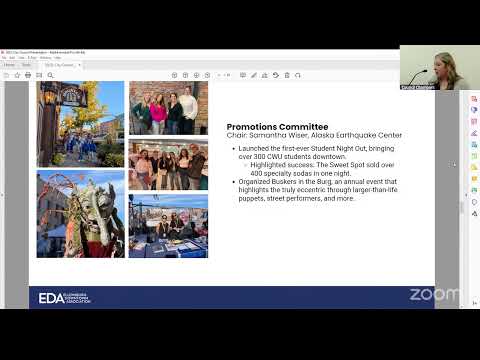
Council members asked about event locations and the EDA confirmed that much of the planned activity—tree lighting, Hoedown, Trick-or-Treat Harvest Fest, buskers and other family events—will use Unity Park; the Pine Street summer night market will remain on Pine Street as part of Pine Street revitalization. Chanis said the EDA is coordinating with Central Washington University to bring students downtown; she said a CWU Student Night Out last year brought more than 300 students to downtown businesses. “They were saying, ‘I didn’t know this shop was here,’” Chanis said.
The EDA will continue to pursue lodging-tax funding for tourism-related initiatives and plans to participate in Main Street America’s in-person strategy visit at the end of the month.
Chanis closed by listing ways to engage—survey completion, volunteering and business support—and asked council whether there were questions. Council members thanked the EDA for its work and suggested continued coordination with city staff on trash-can and planter funding.
Looking ahead: the EDA asked the council and community to help share the Main Street survey and to consider grant and partnership opportunities to address infrastructure needs in downtown.