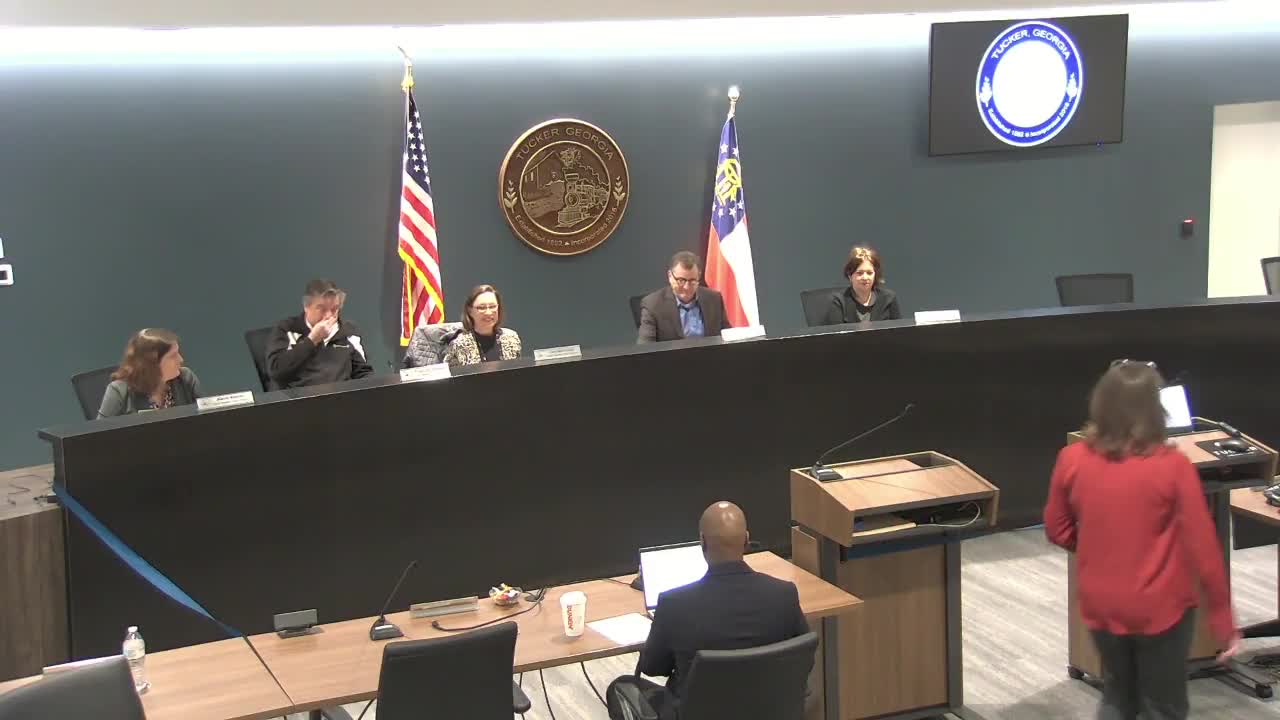
Tucker holds second hearing on state’s HB 581 floating homestead exemption; no public comment
Loading...
Summary
Tucker held the second of three required public hearings on Monday, Feb. 24, on House Bill 581, the state’s new floating homestead exemption; no members of the public spoke and the council scheduled a third hearing for 6 p.m. tonight.
Tucker held the second of three required public hearings on Monday, Feb. 24, on House Bill 581, the state’s new “floating” homestead exemption that limits annual taxable-value increases to the prior year’s CPI; no members of the public spoke for or against opting out during the hearing, and the council scheduled the required third hearing for its regular meeting at 6 p.m. tonight.
City staff presented numeric examples intended to show how Tucker’s local freeze homestead exemption — established in the city charter when Tucker became a city in 2016 — compares with the statewide formula enacted by HB 581. “The city of Tucker has a very robust current freeze exemption. That was part of our charter when we became a city in 2016,” said Ms. Hilton, city staff and the meeting presenter. She told council that, under current practice, the DeKalb County tax commissioner will calculate and apply whichever exemption yields the greater benefit to the taxpayer.
Why it matters: opting out would exempt Tucker from being covered automatically by the new statewide floating exemption; doing nothing would let the state law apply to Tucker taxpayers but, in practice, the tax commissioner would compare the state and local exemptions and apply the larger reduction. Opting out requires three public hearings, a council resolution and must be completed before March 1.
Ms. Hilton walked council through two hypothetical homeowner scenarios to illustrate the difference. In one example using Tucker’s freeze exemption, a home with a fair-market value of $350,000 produced an assessed (taxable) value of $140,000 (40% of FMV) and, after a $10,000 standard homestead exemption, a taxable value of $130,000. In the second example applying the HB 581 cap (a year in which CPI-limited growth would be lower than market growth), the applied FMV was lower than market growth would produce but yielded a slightly higher taxable value than Tucker’s freeze in the example Ms. Hilton provided; when the same millage was applied in the examples, the city’s freeze produced a larger reduction in the taxpayer’s bill.
Council members asked procedural and policy questions. One council member said, “This is our only chance to opt out,” and Ms. Hilton confirmed that the opt-out process is time-limited and, absent action, the statewide exemption would become effective for Tucker but would not replace the city’s current freeze unless changed by the legislature and by voter action. Ms. Hilton also clarified: “Tax commissioner is obligated for every taxpayer to compare the 2 and the taxpayer gets whichever is the greater benefit.”
The council opened the public-hearing segments for 10 minutes each for proponents and opponents of opting out; no speakers appeared either for or against, and both public-hearing segments were closed. Council did not vote on an opt-out resolution at the special meeting. The mayor noted the regular meeting tonight will open with the required third hearing so the council can consider a resolution before the March 1 statutory deadline.
The meeting concluded with a motion to adjourn that was seconded and carried by voice vote; no roll-call tally was announced.