Get Full Government Meeting Transcripts, Videos, & Alerts Forever!
Get email alerts on the Disaster Recovery topic
No spam. Unsubscribe anytime.
Burke County weighs Army Corps mission, private contractors for post-Hurricane debris removal
Summary
Burke County officials on Monday reviewed recovery work from Hurricane Helena and moved to request federal assistance for waterway and private-property debris removal after weighing costs, reimbursement rules and administrative burdens.
Burke County officials on Monday reviewed recovery work from Hurricane Helena and moved to request federal assistance for waterway and private-property debris removal after weighing costs, reimbursement rules and administrative burdens.
County Manager Brian Mann told the Board of Commissioners that Burke County has registered about 13,000 people in FEMA’s Individual Assistance program, with roughly 59% meeting eligibility; FEMA awards in the county total about $14.6 million for individual assistance and $4.2 million for housing assistance so far. Mann said 24 owner-occupied homes and 18 rental units were listed as completely destroyed in county housing-assistance statistics.
Mann said the county has collected more than 255,000 cubic yards of debris from public right-of-way removal, using three alternative debris sites at the Burke County Fairgrounds, the county solid-waste facility at Marsh Trail and East Fleming. He described efforts to reduce material to mulch and current storage at the FEMA-approved landfill, noting that a short-term burn trial was stopped due to wildfire risk in nearby McDowell County.
The core remaining decisions, Mann said, are how to handle waterway debris and private-property debris removal (PPDR). He described two options: (1) hire state-approved private contractors, which can mobilize faster and allow the county to prioritize areas but requires heavy local administrative oversight and exposes the county to de-obligation risk if contractors handle material incorrectly; or (2) submit a mission request through the state Emergency Operations Center to request the U.S. Army Corps of Engineers to perform waterway and PPDR work, which shifts administration and much of the financial and operational responsibility to the Corps.
Mann described a drone-based estimate for the Catawba River that used a planning assumption of about $25 per cubic yard and produced a remediation estimate just under $900,000 for the Catawba segment surveyed; he cautioned that many county waterways remain to be inventoried and scaled. He also encouraged pairing PPDR and waterway work for operational efficiency: private property access is often required to reach waterways and debris placed onto private property frequently becomes a source for right-of-way collection.
On cost-sharing and reimbursement, Mann reviewed the public assistance formula: the typical federal share is 75% with a 25% local cost share, but for very large disasters that reach a Level 1 designation the split becomes 90% federal / 10% local. He said federal authorities granted a 180-day grace period for public-assistance eligibility that covers most county work. Mann also reported hearing from Joe Stanton, deputy director of recovery for State Emergency Management, that the state expects to assume the local 10% share when the event reverts to the 90/10 split, but Mann stressed that the county has no written assurance of that commitment.
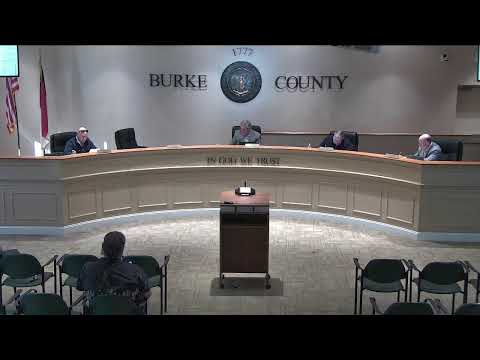
Commissioners discussed experience with private contractors, the Corps’ prior performance in neighboring counties, and the tradeoffs between local control and federal administration. Commissioner Barry said the Army Corps has been working “pretty good” in neighboring counties, while another commissioner noted that private contractors in mountain counties have sometimes been dismissed for poor performance and that the Corps can impose more discipline. After discussion the board gave direction to staff to request a mission from the Army Corps of Engineers for waterway and private-property debris removal and to proceed with coordination through the state emergency operations structure; no formal roll-call vote was recorded in the transcript for that request.
Mann also updated the board on other recovery items: the county-operated disaster-recovery center logged about 3,500 visits; the regional debris total across 24 counties is roughly 3.7 million cubic yards; and Burke County has received about $14.6 million in individual assistance awards and $4.2 million in housing assistance awards to date. He noted the state-run Home Mitigation Block Grant (for acquisition, repair or elevation) has been processing applications and that the county must approve participation when the state forwards a list of eligible properties, which Mann expected to appear for commissioner action at a subsequent meeting.
Mann said the county received 695 informal property-value appeal applications after the storm — roughly 3½ times the normal annual number — and that early staff reviews suggest a residential value impairment of about $5–6 million and $20–25 million on the commercial side, pending final determinations.
Mann closed by asking for direction and offering to bring additional materials to the board’s regular meeting. Chairman Bridal and other commissioners signaled support for pursuing an Army Corps mission request and asked staff to proceed with the formal mission request through the state, while continuing to track reimbursement rules and maintain debris-site controls in line with FEMA requirements.
The county manager repeated key cautions: reusing debris material for commercial purposes can negate federal reimbursement (timber or mulch that is resold, for example), and any contractor mishandling of material can put county reimbursement at risk. Mann said staff would continue to develop detailed inventory, mapping and right-of-entry agreements for gated communities and private-property access and return to the board with any required authorizations or funding details.
The board did not adopt a binding resolution on the floor at the pre-agenda meeting; staff will proceed with the mission request process and return with any formal requests or documents for action as needed.