Get email alerts on the Building Energy Code topic
No spam. Unsubscribe anytime.
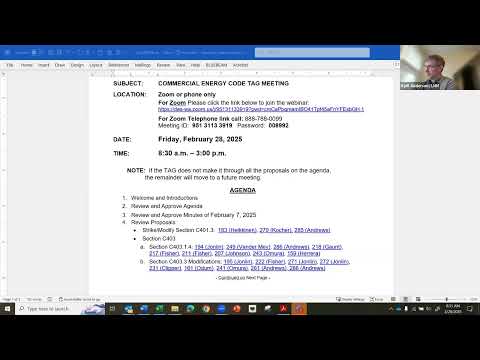
Commercial Energy Code tag backs Coker credit‑based compliance path, tables and disapproves several related proposals
Summary
The Building Code Council’s Commercial Energy Code tag voted at its February meeting to advance Johnny Coker’s credit‑based restructuring of C406 (proposal 279) as the primary draft for continuing work, while tabling or disapproving alternative proposals and leaving the final credit values contingent on third‑party recalculation.
The Building Code Council’s Commercial Energy Code tag voted on multiple draft changes at its February meeting and chose Johnny Coker’s credit‑based restructuring of C406—identified in the meeting as proposal 279—as the primary vehicle for the tag’s work while tabling or disapproving several alternative proposals.
Why it matters: The tag’s direction will shape how future commercial energy‑code compliance treats buildings that use fossil‑fuel equipment versus those that rely on heat pumps. The chosen approach reorganizes compliance around a credit table tied to site EUI (with an option to handle source energy if the council requires it), and the tag asked a third party (PNNL was discussed) to recalculate credit values before finalizing required credits.
Members described the decision as setting a path for further technical work rather than locking in final credit numbers. “I met with a few folks, about a half dozen people and and discussed several things. I’ve made some changes based on those discussions,” Johnny Coker said while presenting his updated proposal. Proponents and critics both said the remaining open questions hinge on how credits are calculated and whether the state adopts site or source energy as the metric—the state council planned a March hearing on that choice.
Key votes and next steps - The tag voted to advance proposal 279 (Johnny Coker) as the primary draft the group will develop further. The roll call recorded the outcome as 10 yes, 4 no, 2 abstentions. That motion does not finalize credit values; the tag expects a third‑party recalculation of credit values before the final package is sent forward. - Proposal 285 (Andrews) was formally disapproved; on roll call that motion passed (13 yes, 1 no, 1 abstention). - A set of related proposals and redrafts were tabled for future meetings so working groups can refine language, including several items that would affect how fossil‑fuel systems and specific exceptions are treated in the C403/C406 sections.
What proponents said - Johnny Coker, the proposer of 279, described a revised approach that separates heat‑pump and fossil‑fuel credit tables in the short term and asks for an objective recalculation of credit values. He explained a new annual energy factor used to translate equipment test metrics into a practical credit value and said the revised wording is intended to treat heat pumps and high‑efficiency combustion equipment consistently in the credit framework. - Gary (surname not given), who presented an alternate approach, argued the credits should be compared on a source‑energy basis if multiple fuels are being compared: “If you’re comparing different fuel sources, it needs to be done on source energy basis,” he said, and he put forward a spreadsheet illustration showing how site‑based credit tables can yield large apparent benefits for heat‑pump measures in some building types.
What critics said - Several tag members and public commenters pressed for clarity about the credit recalculation process and timetable. Mike Kennedy and others said the tag should determine a methodology or engage PNNL promptly rather than waiting until late in the process. Tag members also raised implementation concerns about equipment performance metrics (COP, HSPF2, defrost performance) and how those feed into credit equations. - Members repeatedly cautioned that the tag cannot require an external research lab to complete recalculations on a fixed schedule; the tag discussed assigning a work group and accepting the schedule risk.
Other actions at the meeting - The tag approved a number of discrete code clarifications and exception items that were not part of the big credit debate, including: an exception package for mechanical systems and wastewater heat recovery aligned with Seattle practice (proposal 249, approved), updates to reporting language for air‑to‑water heat‑pump product data (proposal 195, approved), and a lower combined fan‑power factor for DOAS/ventilation design (proposal 271, approved). Several rule‑level wording changes to demand‑response language were approved as well. (Tallies for these items varied; when a roll‑call count was recorded the meeting minutes show it. Where the transcript did not provide a numerical tally the item is recorded as approved without a vote count in this summary.)
Tabled and postponed items - The tag postponed discussion of multiple humidification proposals (including proposals 161 and 288) for further work and for proponents to offer additional evidence and cross‑referenced proposals. The tag also tabled alternate credit proposals and asked proponents and staff to coordinate working groups.
Nuts and bolts and what comes next - The tag explicitly framed today’s votes as directional and as the start of additional drafting: the adopted direction will guide working groups and subsequent tag meetings. Tag leaders asked proponents to return with adjusted language and more precise technical inputs (credit recalculation methods, equipment test‑to‑metric translations). The state Building Code Council is scheduled to hear and (possibly) decide the site vs. source energy metric in March; the tag will revise its drafts to match whatever the council decides.
Ending: The tag’s action moves the code discussion from competing draft formats toward a single, credit‑based structure, but significant technical work remains—particularly the objective recalculation of credit values and the mapping from equipment test data to credits. The tag set work groups and follow‑up meetings to resolve those items before final votes.
AI generated
The text on this page is AI generated. Summaries, highlights, analysis, and video transcripts are all produced from the original source material.
AI can make mistakes, so if you spot one, and we will fix it for everyone.
Note: the source content is unaltered by us. Any content source we link to, be it a video, an audio recording, or a document, is presented exactly as its publisher released it. That publisher is usually a government body, sometimes an individual official or another organisation.