Get Full Government Meeting Transcripts, Videos, & Alerts Forever!
Get email alerts on the Transportation Infrastructure topic
No spam. Unsubscribe anytime.
McKay Harbour Road options narrowed; county told to commit up to ~$2.5–2.9M for federal grant to move road inland
Summary
Public works briefed council on a longstanding shoreline erosion project at McKay Harbour (Lopez Island). Federal partners require the county to secure right‑of‑way, fund wetland mitigation and commit roughly $2.5–$2.9 million of local match if the county wants Western Federal Lands to proceed on a previously awarded grant for a new inland road.
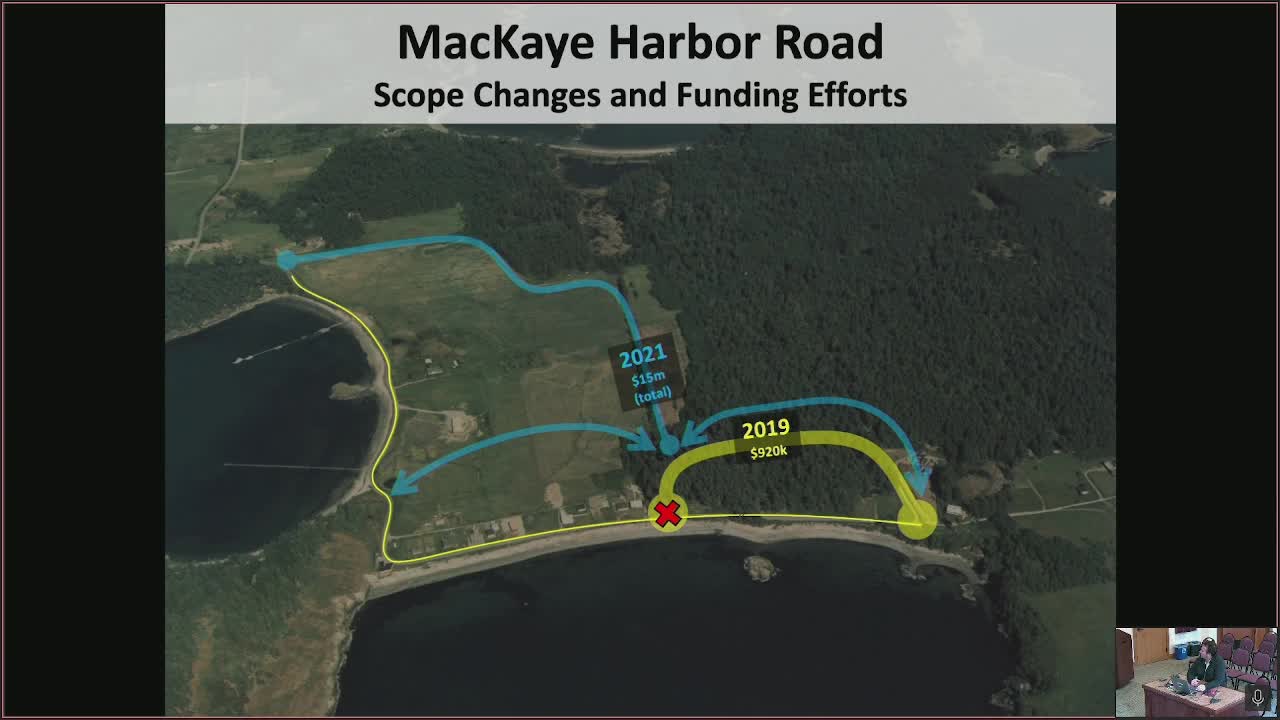
San Juan County Public Works presented an update on Feb. 25 on the McKay Harbour Road project on Lopez Island and outlined requirements the county would have to meet for Western Federal Lands to proceed under a previously awarded grant.
Colin Huntamer, director of public works, recapped decades of shoreline armoring, erosion repairs and earlier grant efforts. He said a 2019 concept to construct a new inland alignment (funded in part by Western Federal Lands) remained feasible only if the county satisfied three conditions: secure necessary right‑of‑way from at least two private owners, provide off‑site wetland mitigation (consultant estimate roughly six acres of mitigation), and allocate the local funding share the federal team now estimates at about $2.5–$2.9 million. Huntamer said project cost estimates rose to about $5.9 million in recent reappraisals.
Huntamer described efforts to locate acceptable mitigation sites owned by public entities; staff identified a Land Bank parcel at Richardson Marsh as the only clear in‑kind option, but that would consume a sizable portion (roughly a quarter) of that parcel. Out‑of‑kind mitigation remains technically possible but would require further negotiation with regulatory agencies; Huntamer said regulators expect the county to demonstrate in‑kind mitigation is not viable before permitting out‑of‑kind options.
Huntamer said the inland alignment would remove the existing coastal roadway and could convert the present paved area into trail or natural space, but that would reduce parking at the county park and require careful design. He warned the county faces strong regulatory constraints (wetland buffers, mitigation acreage ratios) and private‑property complexities including a privately maintained access road whose change of status could create additional legal and access issues.
Council members said the project is emblematic of broader shoreline challenges across the county, with delayed action having driven up costs. Members asked staff to return with detailed financing scenarios, including whether REET or other capital funds could reimburse the County Road Fund for an advance payment, and to outline how this project would fit with the county’s broader managed‑retreat policy discussions. No formal vote was taken; staff will return with financial options and a recommended path forward.