Get Full Government Meeting Transcripts, Videos, & Alerts Forever!
Get email alerts on the Early Learning Budget topic
No spam. Unsubscribe anytime.
Education subcommittee reviews SB 5514, governor’s budget for Department of Early Learning and Care
Summary
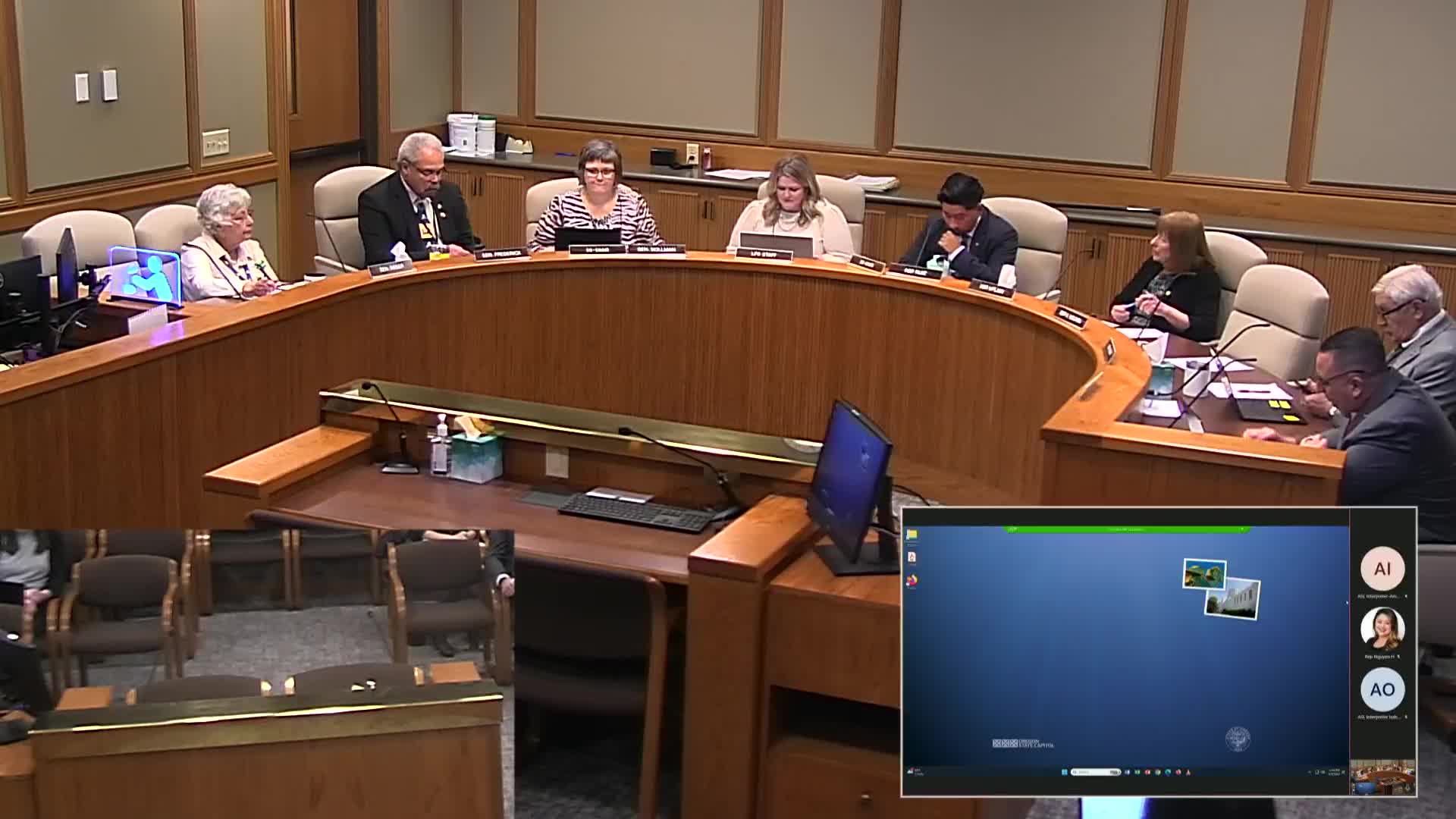
The Education Subcommittee met Monday, March 3, a little after 1 p.m., to hear an informational presentation on Senate Bill 5514, the governor’s recommended 2025–27 budget for the Department of Early Learning and Care (DELC).
The Education Subcommittee met Monday, March 3, a little after 1 p.m., to hear an informational presentation on Senate Bill 5514, the governor’s recommended 2025–27 budget for the Department of Early Learning and Care (DELC). DAS and DELC staff described the agency’s funding mix, program priorities, recent audit findings and planned investments in licensing and IT while answering lawmakers’ questions.
The presentation matters because DELC administers programs that affect families, early childhood providers and employers statewide — including the Employment Related Day Care (ERDC) subsidy, preschool programs, and licensing that enforces health and safety standards. Committee members and agency leaders focused on a growing ERDC wait list, federal funding rules tied to the Child Care Development Fund (CCDF), investments to expand literacy and tribal funding, and operational risks tied to IT and staffing.
Mike Streepi, representing the DAS Chief Financial Office, told the committee ERDC implemented a wait list in November 2023 that has grown to “over 10,000 families,” and the governor’s recommended budget does not assume changes to ERDC eligibility or wait-list protocols. Streepi said the governor’s budget shifts certain one-time federal ARPA (American Rescue Plan Act) funds onto ongoing general fund to maintain subsidy commitments and adds ongoing general fund support for previously temporary payments. He also detailed specific budget items: a $20 million one-time shift onto federal CCDF carry-forward to save general fund in ERDC, a reported roughly $60 million shortfall in Corporate Activity Tax (CAT) revenue recognized elsewhere in the education budget but not reducing DELC’s recommended budget, and an assumed Student Success Act beginning balance of about $32,600,000 to help cover 2025–27 expenses.
Alyssa Chatterjee, DELC director, summarized the agency’s statutory charge and strategy. “We build and administer core parts of Oregon’s early learning system,” Director Chatterjee said, describing DELC’s role after House Bill 3073 (2021) consolidated early learning programs from other agencies. She outlined DELC’s strategic plan goals — keeping children safe through licensing, expanding access and early literacy, supporting the workforce, centering tribal sovereignty, and building operational foundations.
Deputy Director Cooper Brown described DELC’s operations and accountability efforts, including a newly established audit function and a research, analysis and data team. Brown said DELC’s operations are lean — under 10% of the agency budget — and highlighted ongoing IT projects such as a provider management platform that will include ERDC payments and a new licensing system.
Budget staff Linnea Whittakin provided the funding breakdown: general fund roughly 50% of DELC’s budget, the Corporate Activity Tax (CAT) just under a third, and federal CCDF funds the remainder (about 18% overall for the agency). Whittakin noted some CCDF revenues were one-time ARPA funds in the current biennium and that the governor’s recommendation replaces some of those with ongoing general fund support for subsidy commitments. She said CCDF carries both mandatory and discretionary components and that DELC keeps a carry-forward reserve to smooth year-to-year variability in the federal award.
Child Care Licensing Division Director Alicia Gardiner described licensing’s role in safety and quality, summarizing federal CCDF health-and-safety requirements DELC must enforce to receive federal funding. Gardiner said licensing inspects and renews programs, conducts background checks on adults in contact with children, operates a public complaint hotline, and provides technical assistance. She recited the required CCDF topics such as sanitation, safe sleep practices, staff-to-child ratios, emergency preparedness and pediatric first-aid training. Gardiner also described consumer-information requirements (a publicly available compliance history portal) and said the division prioritizes initial licensing applications to get new providers operational quickly; she added background checks typically take about two weeks when applicants complete fingerprinting promptly.
Lawmakers pressed on several operational points: Senator Weber asked about “vacancy savings” assumptions and was told DELC applied an additional vacancy-savings assumption above the 5% used at current service level. Committee members questioned DELC about reliance on federal CCDF funding and contingency planning; Whittakin said the agency is monitoring draws and maintains a federal carry-forward reserve. Members also asked about suspension and expulsion policy; Gardiner noted Oregon’s 2021 law (Senate Bill 236) prohibits suspension and expulsion and that federal guidance and state data show disproportionate impacts for children of color and children with disabilities; DELC staff said they are still developing prevention and coaching approaches and will bring more detail in later sessions.
DELC staff described several governor-recommended investments: funds to expand birth-through-5 early literacy grants including full funding of the Dolly Parton Imagination Library for 24 months; $4.7 million general fund proposed as a tribal learning block grant; about $4.4 million for infant and early childhood mental health supports (to expand consultant coverage statewide); ongoing operations funding including 15 general-fund-supported staff and operations/maintenance for critical IT systems; a $3.2 million federal funds increase to support 13 licensing division positions intended to align licensing caseloads with national best-practice ratios; and additional general-fund and federal-fund package items to support accounting, budget, IT, HR, data analytics, communications and project management.
Agency leaders reiterated the limits of DELC’s authority within the broader early childhood system: eligibility determination for ERDC remains with partner agencies; early intervention and early childhood special education remain with the Department of Education; and other programs (housing colocations, infrastructure funds, higher education scholarships) sit with other agencies. Chatterjee and Brown emphasized DELC’s role as a coordinating agency inside the statewide early learning council, which includes leaders from Oregon Health Authority, Department of Human Services and Department of Education.
The committee was briefed on tribal work: DELC has an Office of Tribal Affairs, is finalizing a tribal consultation policy, and supports a tribal advisory committee formed under earlier legislation. DELC said eight of nine federally recognized tribes accepted a noncompetitive sole-source birth-to-5 literacy grant opportunity in the prior biennium and that House Bill 2815 (currently in committee) would establish a Tribal Early Learning Plan and a Tribal Early Learning Fund in the governor’s recommended budget.
Committee members requested follow-ups and additional detail in later briefings; DELC staff said they will continue presentations across the week, with public testimony scheduled for Thursday. The informational hearing concluded without committee action; staff noted presentation materials would be posted on OLIS under the committee date.
Looking ahead, agency staff said they will return with additional detail on licensing models and exempt-care types, suspension/expulsion prevention programs and coaching, and the technical design of new IT systems and related implementation timelines.